
Here’s an interesting twist on the process which, in some states, recognizes the ability of one private owner to condemn the property of a neighbor. Most often this arises when a landlocked parcel exercises eminent domain to take the property of a neighbor for access.
It always struck us a little odd that the sovereign power to take property for the public use or a public purpose can be used by private party A to involuntarily acquire the private property of B. These statutes operate somewhat like common law easements by necessity, so we never gave them that much thought. But over the years, we’ve seen some interesting cases from Pennsylvania (private takings still must serve a public purpose) and Colorado (condemning owner must have concrete development plans), for example.
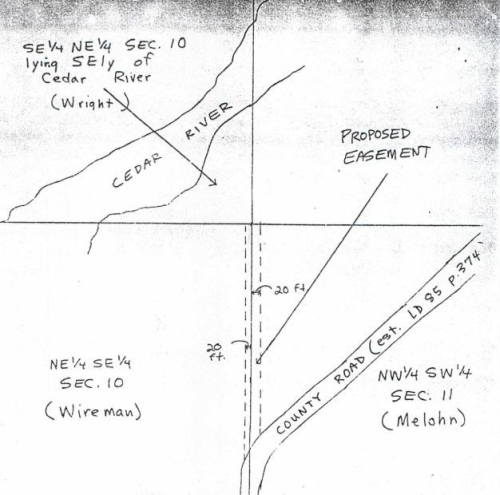
The unusual twist in the Iowa Court of Appeals’ opinion in Ragsdale v. Wireman, No. 18-1437 (Aug. 21, 2019) is that the condemnee-owner didn’t really fight the taking. Instead, he took it very seriously. Here’s the story. Wright owned the parcel next to Wireman, and via the above-described process, took a strip of Wireman’s property to gain access to the County Road. Wright eventually sold to Ragsdale.
Apparently, Wireman used the property too. So Ragsdale sued him for trespass. “That’s my land, because Wright took it from you, and I succeeded to Wrights’ rights.” (We’re paraphrasing of course, but you get the drift.) Not to be outdone, Wireman replied “yes, Wright did take it, but since a taking can only be for public use, that strip is public and I can use it also.”
The trial court (and eventually the court of appeals) agreed with Wireman. The statute does not authorize a taking for a “private driveway.” Slip op. at 4. A private owner can exercise the delegated power of eminent domain, but only to take a public road. The courts rejected Ragsdale’s argument that “only he and his guests may traverse the condemned tract.”
To the contrary, private property may be condemned solely for public use, not for private use. Our Constitution says as much, as do our condemnation statutes. See Iowa Const. art. I, § 18 (“Private property shall not be taken for public use without just compensation . . . .”); Iowa Code § 6A.4(2) (2017) (“The right to take private property for public use is hereby conferred . . . [u]pon the owner or lessee of lands, which have no public or private way to the lands, for the purpose of providing a public way which will connect with an existing public road.”); id. § 471.4(2) (1987) (same). Although the condemnation application made reference to a “driveway,” “private driveway,” and “easement,” that terminology cannot convert the access road into anything other than a public way.
Slip op. at 5.
That this situation arose now, decades after the original taking makes us wonder: was Wireman still sore about the condemnation of his land all those years ago, so decided to do something about it now? Or was Wright cool with Wireman’s use, and only after Ragsdale bought the land did he object to Wireman’s long-standing use? The opinion doesn’t say, but it sure would be interesting to find out.
The lesson we take is this. Be careful, private condemnors: that property you are taking isn’t for your use only, it’s for public use. That means everyone.
Ragsdale v. Wireman, No. 18-1437 (Iowa App. Aug. 21, 2019)