
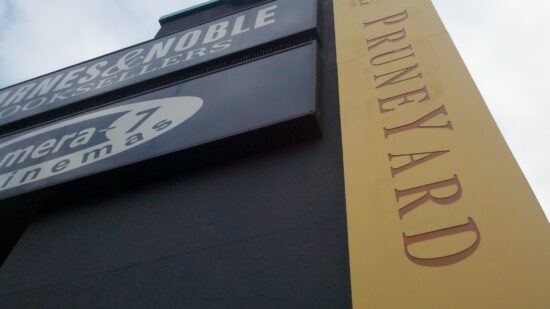
Here’s a just-filed cert petition, which poses a question that has been around since at least 1980: when third parties enter private property under color of state law against the wishes of the owner, is this a taking?
That’s right, the issue decided by the U.S. Supreme Court in PruneYard Shopping Center v. Robins, 447 U.S. 74 (1980). (And yes, the above photo is from a visit to The Pruneyard shopping center in Campbell, California a while back.)
This one is from our shop, so we won’t be saying much. But let’s start with the Question Presented:
Petitioners own and operate adjoining shopping centers in Southern California (“the Centers”). The Centers prohibit petitioning and leafletting on their property. Alex Salazar, a self-described “activist,” sought permission to distribute leaflets expressing his belief that “[m]en are not legally and financially responsible for supporting a child that a woman chooses to have,” and “[m]en are not owned by women through their bodies!” Consistent with its policy, the Centers denied his request. Salazar sued, claiming he had a right to engage in expressive activity on the Centers’ property under the California Constitution’s free speech guarantee. In a published decision, the California Court of Appeal agreed. Relying on Robins v. PruneYard Shopping Center, 23 Cal. 3d 899 (1979), aff’d, 447 U.S. 74 (1980), the court held that Salazar’s activity was protected by the state constitution’s free speech provision and did not violate the Centers’ right to exclude under the Fifth Amendment’s Takings Clause or its right to remain silent under the First Amendment compelled speech doctrine.
The question presented is:
Whether, contrary to PruneYard, a State violates the Takings Clause and the First Amendment when it requires the owners of private commercial property to allow unwanted expressive activity on their land?
If the Court decided this in 1980, why is it imperative to revisit it now? Here’s what the petition says:
PruneYard has always been difficult to square with this Court’s jurisprudence, but, over the last four decades, this tension has exploded into full-blown conflict. PruneYard is plainly incompatible with this Court’s subsequent takings precedent establishing that a government-authorized invasion of private property by third parties is a per se taking because it eviscerates the owner’s fundamental right to exclude others. Cedar Point Nursery v. Hassid, 594 U.S. 139, 149-52 (2021).
Pet. at 3.
And there’s a First Amendment issue as well:
Since PruneYard, this Court’s First Amendment jurisprudence has also developed to more clearly and firmly protect the individual right to refrain from speaking. In particular, Janus v. American Federation of State, County, and Municipal Employees, Council 31, 585 U.S. 878, 894 (2018), holds that the “compelled subsidization of private speech seriously impinges on First Amendment rights.” PruneYard’s conclusion that California can require shopping center owners to subsidize speech by providing their property as a platform for unwanted speech by third parties is incompatible with the modern compelled speech doctrine.
Pet. at 4.
Check it out, and stay tuned here for further developments.
Petition for a Writ of Certiorari, Majestic Realty Co. v. Salazar, No. ____ (U.S. May 26, 2026)