
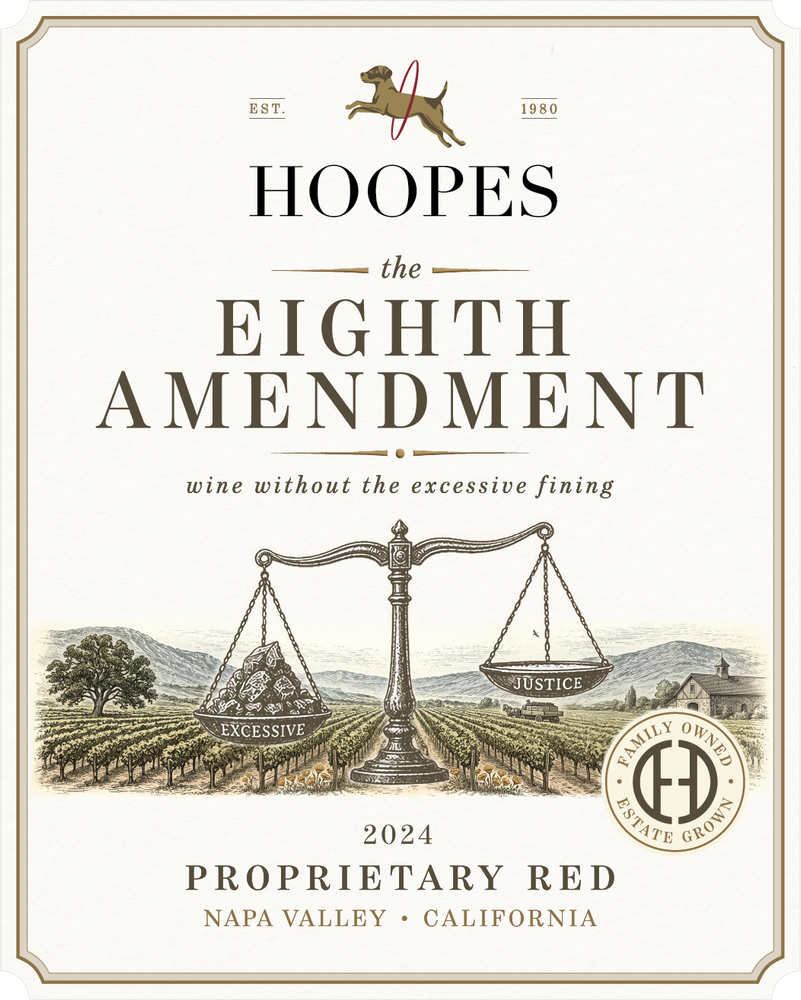
Worth checking out: in the vein of our old favorite Eminent Domaine, a Napa Valley winery is offering for preorder its “Eighth Amendment” wines:
The Eighth Amendment Red Cuvée is a Cabernet Sauvignon-dominant blend from our Yountville and Napa Valley AVA vineyards — structured, expressive, rooted in place. The Proprietary White Blend is crisp and luminous, carrying forward the fruits of struggle transformed into clarity and balance. Together they reflect something larger: what happens when authenticity is not refined away, but allowed to remain intact.
So what’s the deal with the name and the constitutional law theme?
We all know the U.S. Constitution’s Eighth Amendment, which prohibits the imposition of excessive fines:
Excessive bail shall not be required, nor excessive fines imposed, nor cruel and unusual punishments inflicted.
(And before we go further, Hoopes Vineyards is a client on — you guessed it — an Excessive Fines matter.)
The winery and its owner find themselves on the target end of Napa County’s claim that what seem like pretty routine things wineries in Napa Valley do — serving wine, selling merch, and hosting visitors, for example — are public nuisances, even though the winery possessed a county-issued Small Winery Exemption, and State of California alcoholic beverage and outdoor tastings permits. The winery and its owner were hit with fines and other penalties (including paying the County’s attorneys fees) that totaled a whopping $3,500,000.
The winery asked the trial court to vacate or amend the judgment to conform the fines to the requirements of California law and the Excessive Fines Clause (still pending), and also (successfully) asked the court of appeal to stay collection of the fines by the county.
Which takes us to the wine offering. It’s not quite a “commemoration” or a “celebration” of something, obviously, maybe more like a recognition. As the owner and winemaker puts it:
Named for the constitutional protection against excessive fines, and inspired by a philosophy that what is authentic to place should not be stripped away before it reaches the glass, this limited release commemorates a chapter I never expected to live through, and one I believe matters far beyond our vineyard. …
This release is dedicated to the small agricultural businesses that define Napa Valley’s heart. To the families who have carried them across generations. And to the meaningful support of the Pacific Legal Foundation, whose advocacy for fairness and due process made a real difference.
And for you non wine-buffs out there, there’s a double-meaning to “fining.” Yes, there’s the Excessive Fines meaning. But in winemaking, “fining” is mixing in some non-wine stuff in your wine. As wine.com describes it:
Fining is a winemaking process that is commonly – but not always – implemented. Wine fining involves stirring an adsorbent substance, called a coagulant, into the wine when it lies in barrel or tank, for the purpose of adhering to and removing certain undesirable molecules. This is done to clarify and stabilize the wine before bottling since most consumers prefer wines that are neither cloudy nor excessively tannic.
Wine fining agents fall into one of two basic types, inorganic and organic. The latter include liquids derived from animal by-products like egg whites, casein (a milk protein), gelatin (typically derived from skin, tendon, and muscle), and isinglass (made from air bladders in fish). The most common inorganic example is bentonite, a type of clay. What these substances have in common is a strong ability to adhere to any particles that may contribute to haziness or instability, pulling them out of the wine and depositing them on the bottom of the vessel. When the wine is racked off for aging or bottling, those deposits stay behind. So no worries – there will be no fish bladder in your wine!
As mentioned, not all wines go through the fining process. While quite common in inexpensive wines, the technique is not always used in prestige bottles, since some winemakers believe that it may detract from a wine’s complexity.
Thus, the label of both the Proprietary Red and the White Blend note: “wine without the excessive fining.” Ah, got it!
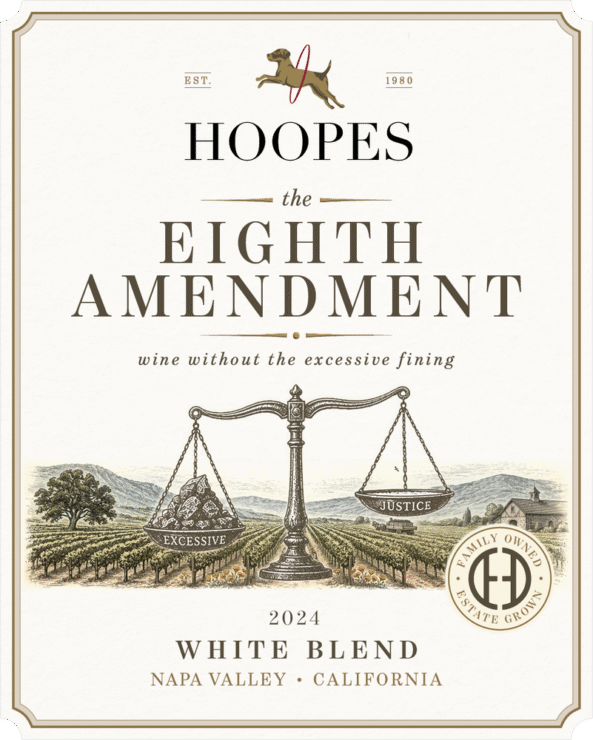
In addition to the Proprietary Red, there’s also one for you lovers of white wines.
Reserve yours today. Limited run. No future production planned. So this is your one chance.