
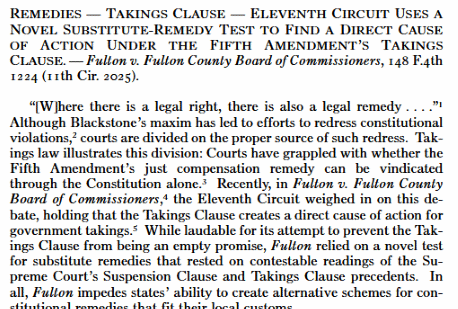
Check this out. A student-authored case summary from the latest edition of the Harvard Law Review, commenting on Fulton v. Fulton County Board of Commissioners, an Eleventh Circuit case we designated as an honorable mention in 2025’s highlights.
The Fulton panel split 2-1 (and we understand that the case is pending a decision on the County’s en banc petition), with the majority addressing the issue the U.S. Supreme Court sidestepped in DeVillier v. Texas, 601 U.S. 285 (2024): do you need Congress’s ok to sue for just compensation for a taking? The Fulton court split 2-1, with the majority holding that the Just Compensation Clause is “self-executing,” meaning that even in the absence of a legislative recognition of a cause of action, an owner whose private property has (allegedly) been taken by government action may sue for compensation.
The case summary criticizes the majority reasoning:
In its eagerness to find a cause of action in the Takings Clause, the majority committed two fundamental errors. First, it overread the Court’s Suspension Clause precedent by brushing colorable ambiguities under the rug or ignoring them altogether. Second, it imposed a novel adequate-alternatives test for state procedural restraints unmoored from the Court’s Takings Clause jurisprudence. In finding Georgia law inadequate under a test resting on shaky ground, the majority improperly displaced states’ abilities to create remedial schemes for constitutional rights.
….
Though it may be unsettled whether Congress or states should design takings remedies, courts should not intervene by imposing a stringent substitute-remedies test. Federal courts should be hesitant to intervene in state remedial schemes for takings claims because it upsets state legislatures’ delicate balance of interests between procedural constraints and substantive benefits. Such an intervention also disregards the Supreme Court’s admonition that federal courts “should not ‘assume the States will refuse to honor the Constitution.’”
139 Harv. L. R. at 1253, 1256.
We view it differently. We shouldn’t be seeking a balance between the Fourteenth Amendment, which was expressly designed to subject states and their instrumentalities to the requirements of the Constitution (and not relegate to states the protection of fundamental rights), and federalism and respect for state procedures. Our thumb is firmly on the side of the former.
A federal constitutional guarantee of just compensation should never take second place to a need to respect state procedures and remedies. We tried that for the decades between Barron v. Baltimore and the Civil War amendments, and it didn’t work out too well. And even after that fundamental change, a reluctant Supreme Court slow-walked the change in the Slaughter-House Cases. Only after it finally recognized that things were different, and that states alone could not be assigned the task of protecting fundamental rights where Congress has not acted, by applying the Just Compensation Clause to the states did we get to where we are.
PS – save this one for your files for a few years hence, when the author is up for a seat on the federal bench.