
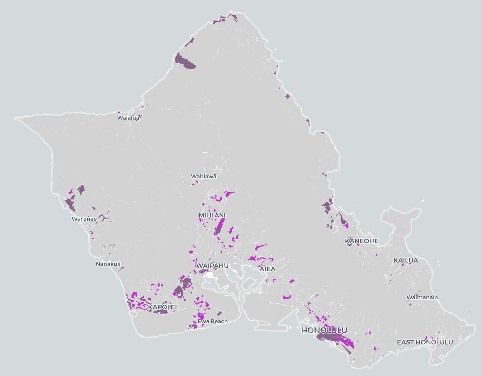
Where you can build 1-4 family residences by right
The Hawaii Zoning Atlas project has announced publication of the Hawaii Zoning Atlas, an “interactive map [that] explores how restrictive zoning laws can make it difficult to build diverse, affordable housing.”
The official announcement notes:
The map is based on an original dataset compiled by over 30 students [including some of our U.H. Law students!] and volunteers who combed nearly a thousand pages of regulations to extract key policy details, including whether housing units are legally allowed in an area and how many; restrictions on height, yards, and lot coverage; and parking requirements. All in all, more than 100 data points were collected for each zone in three counties–Honolulu, Maui, and Hawaiʻi. Kauaʻi will be available in a future release.
This is designed for people who are not land use insiders, to help understand how land use regulations restrict the availability of places to live. Click a link, check the boxes on the left for how you want to filter the data, and voila!, you see what is permitted, and where. It is a graphic visualization of one of major problems with Hawaii’s byzantine system of land use regulations and restrictions. The image above is where 1-4 family residences may be built without seeking discretionary approvals — a very limited area.
And that is what the Zoning Atlas is designed to illustrate. The media advisory includes this quote from an obscure law blogger:
Robert H. Thomas (Joseph T. Waldo Visiting Chair in Property Rights, William and Mary Law School, and Director of Property Rights Litigation, Pacific Legal Foundation)
“The Hawai‘i Zoning Atlas has made us aware that exclusionary zoning is one of the primary culprits in the affordable housing crisis—causing hardship for individuals, families, and employers across the state.”
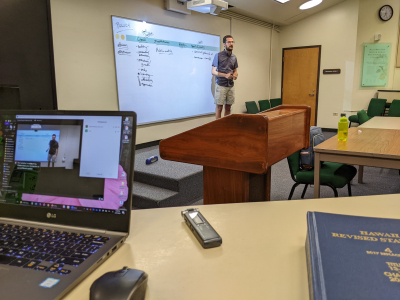
The project director, Trey Gordner, joined our U. Hawaii Law School Land Use class earlier this year, where he previewed for our students the project as well as the dynamics of zoning and land use regulations (from a non-lawyer’s perspective).
This is part of a national project (the National Zoning Atlas), which describes itself as “a collaborative of researchers digitizing, demystifying, & democratizing ~30,000 U.S. zoning codes. It is housed at the Cornell University Legal Constructs Lab, led by Professor Sara Bronin, and has team members working on regional and statewide atlases around the country.” In short, the atlases catalog and help us understand local land use on a big scale.
Trey said this:
“Zoning is the most important law you’ve never heard of,” said Trey Gordner, director of the Hawaiʻi Zoning Atlas, “By regulating what buildings can be built where, what they look like, and what they can be used for, zoning determines the shape of our communities, the size of our houses, the length of our commutes, and more. The Hawaiʻi Zoning Atlas brings these rules to light to help our community determine whether they are delivering the future we want.”
Check it out and play around with the various layers. It will open your eyes.