
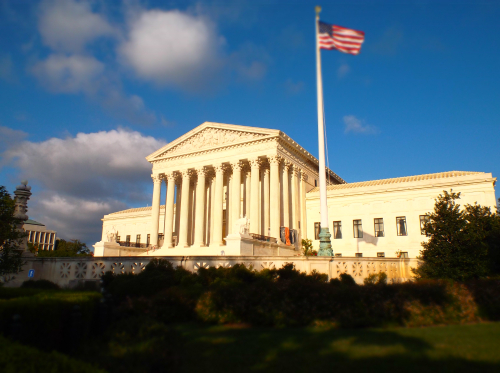
Two cases which we’ve been following are up for consideration on the Supreme Court’s conference schedule today. Indeed, by the time we post this, the conference will likely be over, although we won’t know the results until next week. Check these out, and hold your breath:
- Petro-Hunt, LLC v. United States, No. 17-1090. As we wrote here, the question in this case is “whether the Takings Clause applies to the decisions of federal courts.” Well, if you have been following our threads on judicial takings, that’s a pretty tall order. Download the cert petition, the USG’s BIO, and the Reply brief here.
- Stanford v. United States, No. 17-809. The question here is when a federal court takes possession of an innocent spouse’s property for her husband’s securities fraud, is this a judicial taking? Check out the briefs here.
Sidebar: one of things that that has always bugged us about how the “judicial takings” question is framed (we also see this in Rooker/Feldman type cases), is how the government presents the issue as the power of a court to “review” the decision of another court. In federal judicial takings cases (like these two) the government most often argues that the Court of Federal Claims has (in the words of the BIO in Petro-Hunt) “had no jurisdiction to review the Fifth Circuit’s decisions on that issue.” BIO at 8.
Well, not quite. In a judicial takings case, the court being asked to award compensation isn’t really “reviewing” the other court’s earlier decision, because it cannot overrule it or otherwise determine it was wrong. The remedy in these type of judicial takings cases is compensation, not invalidation. Indeed, the court being asked to award compensation must accept the earlier decision as valid. All it is being asked to do is consider the effect or impact of that decision (it took property).
Perhaps a minor point, but one that still chaps us when we see it presented that way.
Stay tuned to see whether either of these cases have traction.