
Hawaii Business magazine has a new report about Honolulu rail whose headline asks, “How Much Will it Cost?”
Et Tu? In The “To Kill A Mockingbird” Sequel, The New York Times Reports That Atticus Finch Has Feet Of Clay
Nobody’s perfect, as much as we may want them to be. Least of all fictional characters. But Atticus Finch, the Alabama lawyer portrayed in the novel “To Kill a Mockingbird” and the celebrated film, seemed above reproach.
The first year we sponsored the Law in Film festival, we had to feature “
SCOTUS To Decide Another Reapportionment Case: Both Hawaii Issues Now In Play
Prepared For Honolulu’s Plastic Bag Ban? Get Your Damon Key Eco-Friendly Bag Here, Free
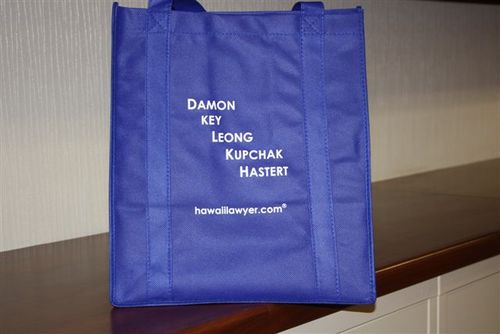
You probably already knew this, but in case not. As of tomorrow, Wednesday, July 1, 2015, you no longer will be able to get the old-style plastic bags at checkout at most grocery stores on Oahu.
If you don’t already have your own bags to bring with you (so you can avoid paying the $.10
Girding For Honolulu’s Plastic Bag Ban – Get Your Damon Key Ecobag Now
Easy Cases Made Hard: Horne v. USDA And California Raisins (And Affordable Housing)
Any time the Supreme Court rules for a property owner in a takings case, you’ve got reason to celebrate.
They didn’t pay the fine, g8vt didn’t take grab their raisins. Case over
So whats next? Does the dept have to write a check to the Hornes for $xxxx? Well, no, they csnt get that relief
Wisconsin App: Any Loss Of Value Was Because Of Proximity To Airport, Not Overflights
A few years back, we posted the Wisconsin Supreme Court decision holding that airspace is property under Wisconsin law, Brenner v. New Richmond Regional Airport Comm’n, 816 N.W.2d 291 (Wis. 2012). The property owners argued that a runway extension project — which condemned a portion of their property which was zoned commercial-industrial, but used
Big Law vs. Honolulu’s Not-So-Big Law
For those of you who might ever have contemplated pulling up stakes and relocating your law practice to the last major inhabited time zone on Planet Earth, check out “A Tale of Two Cities: Honolulu and San Francisco,” by Nick Kacprowski, a lawyer at a “large” Honolulu law firm who recently transplanted
Book Review: “The Grasping Hand: Kelo v. City of New London & The Limits Of Eminent Domain” by Ilya Somin
 After Berman v. Parker and Hawaii Housing Authority v. Midkiff, observers of the law could not be faulted for opining that “the public use limitation is a dead letter.” See Thomas W. Merrill, The Economics of Public Use, 72 Cornell L. Rev. 61 (1986). Those two decisions, after all, seemed to leave nothing