
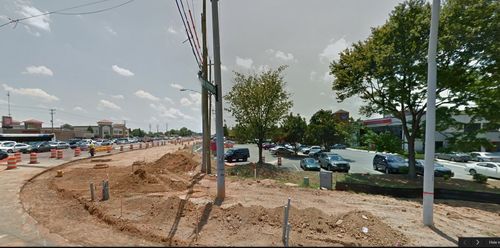
Urban property at the intersection of two main thoroughfares can be pretty valuable. It’s about location, for sure, but it’s also about visibility and the ability to be seen from four directions.
Charlotte, NC needed a part of such property for a rail line extension. The rail will be in the middle of the road, so the road needed widening, necessitating the partial taking. The rail “Bridge” will be part of that middle-of-the-road construction in an existing public right of way, but will partially block views of the owner’s remaining property (a bank branch).
But the Bridge won’t be on the condemned property, and the city asserted that means it isn’t liable for damages resulting from the loss of visibility. The trial court concluded that the jury could consider evidence of loss of visibility, and the city’s interlocutory appeal followed.
In City of Charlotte v. University Financial Properties, LLC, No. COA15-473 (Apr. 5, 2016), the North Carolina Court of Appeals held that the loss of visibility isn’t part of the compensation and damages which the city owes. Likening the loss of visibility to to reduction of traffic flow past condemned property (which isn’t compensable under NC law), the court concluded that the visibility loss does not “flow directly” from the taking of the bank’s land. The landowner won’t lose all visibility — and there’s no “constitutional right to have anyone pass by his premises at all — this is like a change in traffic pattern:
We are unable to discern a meaningful distinction between (1) the assertion that a landowner is entitled to compensation because its property has diminished in value due to the reduction in traffic caused by a municipality’s actions; and (2) University Financial’s contention here that it is entitled to compensation for the decreased value of its property based on the reduced visibility to passing traffic caused by the City’s construction of the elevated light rail bridge. Consequently, we hold that the loss in visibility of University Financial’s property to passing traffic is not “part of the taking” and that the trial court’s order holding otherwise must be reversed.
Slip op. at 9-10 (footnote omitted). “Thus,” the court concluded “the fact that a physical taking has occurred is not enough to render compensable injuries that are otherwise recognized as noncompensable that do not arise from the condemnor’s use of the particular land taken.” Slip op. at 12.
City of Charlotte v. University Financial Properties, LLC, No. COA15-473 (N.C. App. Apr. 5, 2016)