
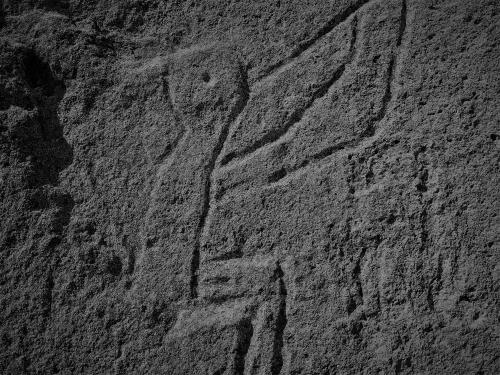
 This is either a petroglyph of an alien astronaut who visited Earth and gave
ancient peoples wonderful space technology like how to build
the Pyramids, or it’s a guy playing a flute.
When an opinion starts off by characterizing your complaint as asserting “a bevy of claims,” you know you are probably not going to be happy with the outcome.
So it is with the U.S. Court of Appeals’ opinion in Santa Fe Alliance for Public Health and Safety v. City of Santa Fe, No. 20-2066 (Mar. 30, 2021), a case in which the Alliance challenged the federal Telecommunications Act, the the New Mexico statute, and the city’s ordinance that foster the installation of cell towers on public rights-of-way. Collectively, these statutes impede or bypass the usual land-use process, which results in these (alleged) effects:
The Alliance’s membership consists of Santa Fe residents concerned about the health and environmental effects of radio-frequency emissions from telecommunications facilities installed on public rights-of-way. The Alliance alleges the radio-frequency emissions contain dangerous levels of radiation. The Alliance further alleges that exposure to radio-frequency emissions resulted in its members experiencing the following health problems: headaches, nausea, insomnia, tinnitus, seizures, cancer, fatigue, neurological issues, respiratory issues, cardiac issues, laryngospasms, numbness in extremities, high blood pressure, and internal bleeding. As a result of installation of telecommunications facilities and the accompanying exposure to radiation, many Alliance members have fled their homes, abandoned their businesses, and either moved to remote sections of Santa Fe or taken up residence in their vehicles. The increasing presence of telecommunications facilities also constrains the ability of Alliance members to travel within Santa Fe city limits and to access government buildings and governmental services. The Alliance contends the impact from radio-frequency emissions will worsen as telecommunications companies upgrade the network in Santa Fe from 4G to 5G and as citizens retrofit their residences into smart homes.
Slip op. at 3-4.
Included in that “bevy” (22 counts!) of constitutional claims (22 counts, including pro and sub due process, anti-delegation, free speech, petition, for example), was a takings claim (there’s always a takings claim, isn’t there?). The district court dismissed for lack of jurisdiction (no standing to assert the claims against one group of defendants), and failure to state a claim against other defendants.
We’re not going to plow through the Tenth Circuit’s complete analysis of each claim, but instead will beam down to page 16, where the court tackled the plaintiffs’ standing to assert the takings claim. “In Count Three, the Alliance contends the WCAIIA and the Amendments to Chapter 27, by facilitating the placement of telecommunications facilities on the public rights-of-way, effect a taking of its members’ homes and businesses.” Slip op. at 16-17. The plaintiffs alleged that its members (who were already “refugees from cell towers and antennas”) will have their homes and businesses rendered uninhabitable and unuseable, resulting in a taking.
First, the court noted that some of the plaintiffs sought relief for future acts (they will lose their properties down the road, presumably when the towers are installed). “Thus, any injury is speculative.” Sllp op. at 17. The takings, if any, would occur when the plaintiffs lost their properties. No injury, no standing, no jurisdiction.
This is kind of a ripeness rule, with its source in the usual constitutional ripeness requirement of a case and controversy, not a Williamson County style ripeness.
Second, what about the plaintiffs who alleged they had already lost their properties? Sorry, the Tenth Circuit concluded, you may be specifically injured, but there’s no plausible showing that your injuries are “fairly traceable” to the statutes listed above:
While these two legislative acts made it slightly easier for telecommunications companies to obtain approval to construct new telecommunications facilities, the Alliance fails to allege facts capable of showing that “but for” these two legislative acts Santa Fe would not have approved the construction of the telecommunications facilities at issue. Notably, the Alliance does not allege members of the Santa Fe boards in charge of land use and zoning/planning were prepared to deny approval for new telecommunications facilities in the absence of the adoption of the WCAIIA and the Amendments to Chapter 27. Put another way, the allegations in the amended complaint do not create a substantial likelihood that construction of the telecommunications facilities causing Alliance members to leave their homes and businesses would not have occurred but for passage of the WCAIIA and the Amendments to Chapter 27.
Slip op. at 18. These plaintiffs: no standing either.
There’s more, but we shall let you read the rest yourself.
—————-
*This photo is from Bandelier National Monument, a short drive from Santa Fe. Why did we include it here? Because its the only photo we have of anything related to Santa Fe, that’s why. And it is cool. If you are ever in the vicinity of Santa Fe or Los Alamos, we recommend you pay a visit.