
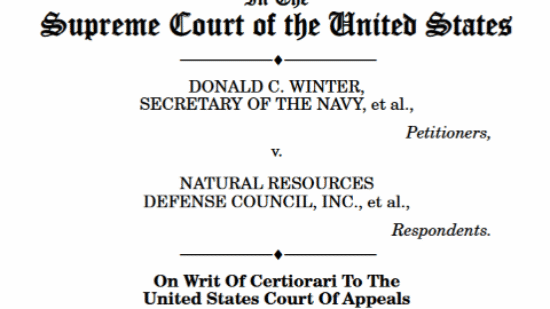
In Winter v. Natural Resources Defense Council, 555 U.S. 7 (2008), the Court clarified the standards for preliminary injunctions, and concluded that the Ninth Circuit wrongly prohibited the U.S. Navy from training its sailors in the Pacific Range using MFA (active) sonar which is used to detect, inter alia, Kilo-class diesel-electric submarines. Environmental groups challenged the use of MFA sonar, asserting that the Navy had not completed an environmental impact statement to study the possible harms to marine mammals. MFA sonar is used to detect silent diesel-electric submarines, which the Navy considers to be one of the top threats to surface ships.
The Ninth Circuit agreed with the plaintiffs and enjoined the exercises, imposing restrictions on how the Navy trains with the sonar, even though the record in the case contained “no evidence that marine mammals have been harmed by the use of MFA sonar in the…training area.”
Our brief was on behalf of nine retired Admirals, including a former Chief of Naval Operations, former Commanders of the Pacific (Pearl Harbor) and Seventh (Asia-Pacific and Indian Ocean) Fleets, and Commanders of the Pacific Command. They have also commanded Navy battle groups, aircraft carriers, and surface ships. The brief detailed the threats from diesel-electric subs, and why training operators on active sonar detection techniques was (and apparently is) essential, even where there could be some “environmental” impacts:
Submariners use a single term for all surface vessels of any type whether they be naval surface combatants, aircraft carriers, supply ships, merchant marine, or passenger liners: “target.” A few submarines can wreak extraordinary damage upon men, material, and international commerce. The threat to Allied supply lines by U-Boats in the Atlantic during World War II – and the damage caused to the enemy by our own submarines in the Pacific – graphically brought home the terrifying reality of submarine warfare.
After World War II, the development of deep diving, indefinitely submerging, and very fast nuclear submarines which could run below the various deep ocean layers hampered active sonar ranging detection of such vessels. Accordingly, the Navy developed a variety of “passive” systems, both shipboard and at the bottom of the sea (the Sound Surveillance System, SOSUS), to detect such vessels by the noise they made in their operation, both from internal machinery and from the cavitation sounds made by their propellers. For every measure, however, there is a countermeasure, and presently, most of the submarines deployed by the world’s navies use diesel engines for propulsion while surfaced, and battery-powered electric motors while submerged. … Diesel electric submarines are uniquely effective in avoiding detection by passive sonar: “Modern diesel-electric submarines are designed to suppress emitted noise levels specifically to counter and defeat the best available passive SONAR technology.” Id. at 5, ¶ 9. “Until at very close ranges, a diesel-electric submarine operating on battery power is nearly undetectable to U.S. and allied naval forces using passive SONAR alone.” …
The threat that these submarines present to the young men and women who man our surface combatants and other ships is not in any sense idle. A single conventional explosive device (torpedo or otherwise) can sink an aircraft carrier with over 4,000 sailors aboard. As for the tactical or strategic nuclear devices these vessels can carry, the definition of “target” expands dramatically from just vessels to entire cities and their surroundings. The only effective countermeasure to such silent threats is the considerably more sophisticated active sonar which the Navy is now developing and putting into effect. The People’s Republic of China, North Korea, and Iran have developed or obtained extraordinarily quiet diesel electric submarines which make their detection by passive sonar difficult and, in many cases impossible. … China may currently have as many as twelve diesel electric, 636 KILO-class submarines purchased from Russia. … Iran purchased several 877 KILO-class submarines, an older version of the 636, from Russia in the past and, despite a June 1995 pledge not to enter any new arms contracts with Iran, it is reported that the two countries were engaged in discussions regarding the modernization of the diesel electric submarines operated by the Iranian Army as recently as 2005. …
The business of war is never a pleasant one. For those charged with the defense of their country, the need to do that job very well – with maximum efficiency and effectiveness – is critical not only to ensure victory, but also to do so with the minimum loss of our own Sailors and Marines in a way that, whenever practicable, minimizes damage to the environment. To meet that goal, there is one absolutely critical element every servicemember understands and values above all, and that is training. Discipline is always present in one form or another in a military environment, but without training, that discipline is useless. Sailors and Marines may be ordered into combat and discipline may make them go, but if they have not first been trained to use their equipment effectively, their leaders have breached their duty.
Today’s headlines seem to bear out these points: the Navy’s training and technology appear to have borne fruit. The Winter case and the Admirals’ brief are good reminders that these kind of legal challenges are not one-sided affairs where “the environment” is of paramount concern and serves as a trump card overruling everything else. And that courts should avoid blind adherence to such dogma, because of the real-world consequences.