
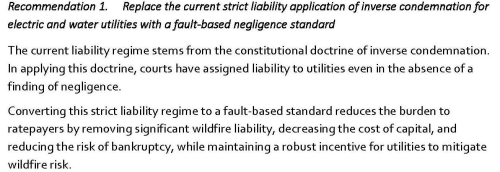
There’s a lot to digest in the draft workgroup reports of the California Commission on Catastrophic Wildfire Cost and Recovery, which were released yesterday.
But the bottom line stands out: California’s version of inverse condemnation liability — which holds a private utility liable for just compensation and damages if its activity was a cause of the damage or loss caused by a wildfire — has got to go. Or at least be so substantially modified as to lose its salient feature, liability even in the absence of the utility’s negligence, as the excerpt of the draft executive summary above details.
The draft Utility Liability Workgroup Report goes into it a bit more:
Finding 3. The current application of inverse condemnation imperils the viability of the state’s utilities, customers’ access to affordable energy and clean water, and the state’s climate and clean energy goals and does not equitably socialize the costs of utility-caused wildfires.
Draft Report at 3. Inverse condemnation, a “flawed system of allocating liability,” could lead to bankruptcy for the utilities, “increases electricity rates, [and] imperils 75 percent of the states’ residents’ ability to have their energy need served.” Id.
Finding 4. The increasing costs of capital and the risk of bankruptcy associated with the application of strict liability inverse condemnation doctrine to water companies, publicly-owned utilities, and investor-owned utilities is harmful to wildfire victims, ratepayers, and the utilities themselves.
Report at 5.
The draft concludes with this recommendation:
Recommendation 1. Replace the current strict liability application of inverse condemnation for electric and water utilities with a fault-based negligence standard.
Report at 7.
How to go about doing this is left unreported. Can the California legislature change the rules? Or is an amendment to California’s constitution required because compensation for inverse condemnation is a constitutional doctrine?
And for how the California Supreme Court views negligence actions, check out Southern California Gas Co. v. Superior Court, No. S246669 (May 30, 3019), which the court issued earlier this morning. The court concluded that “purely economic loses” (without an accompanying personal injury or property damage) “are best not treated as compensable in negligence.”
So there are no answers yet to the inverse condemnation situation, so fasten your seatbelts. This is going to get interesting.
So. Cal. Gas Co. v. Superior Court, No. S246669 (Cal. May 30, 2019)