
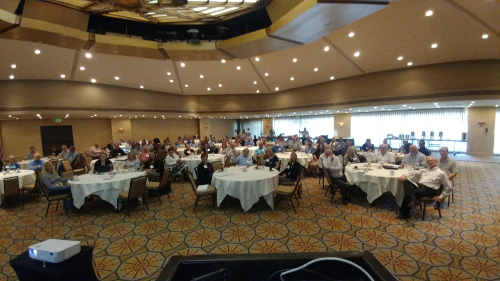
The conference is being held at the Arizona Biltmore.
Proof that we are actually in the room (and not on the golf course).
Here are the cases which I mentioned at today’s conference. What a great turn out (130+ lawyers, appraisers, right-of-way professionals, and others).
Many thanks to colleagues Chris Kramer and Jennifer Cranston for planning the conference and for the the invitation to present, and to my co-panelist Laura Curry.
Public use, public purpose, and necessity
- Colorado: Taking for public infrastructure use is not for a taking for a public purpose. Oh, and necessity!
- St Bernard Port Authority v. Violet Dock Port – taking for private benefit, replacement cost as measure of just compensation.
- Cert denied: is land only partially owned by an Indian tribe immune from a state’s power of eminent domain? Public Service Co. of New Mexico v. Barboan.
- City of Marietta v. Summerour – Georgia Supreme Court on the Pirate’s Code and the “strict construction” maxim (“before” means before).
- North Carolina: DOT can’t take land by condemnation it was already deemed to have been taking in an inverse case.
- There’s more than one way to attack a taking: New York appellate court invalidates a taking for environmental reasons.
- Getting creative in right-to-take challenges in Texas: The Lazy W.
Just compensation and damages
- Louisiana – “dirt farming” and loss of business in eminent domain.
- North Carolina’s Map Act cases: project announcement and condemnation blight.
- Hawaii Supreme Court on the “larger parcel” and “conditional deposit” issues (the parcels need not touch).
- Here’s the amicus brief we filed in the above case, which cites Baetjer v. United States, 143 F.2d 391, 395 (1st Cir.) (condemnation on island of Vieques caused severance damages to parcels on Puerto Rico), cert. denied, 323 U.S. 772 (1944).
- North Carolina: real estate broker can testify about fair market value.
- Fla App: Highest And Best Use Doesn’t Require Owner Have More Than “Conceptual Plans.”
- Texas: Rail construction cutting off access could be an inverse condemnation, even where there’s been no actual take.
Regulatory takings and inverse condemnation
- Action vs. inaction: MR-GO, and Katrina flooding as a taking. More on “takings by inaction.”
- Knick v. Township of Scott (SCOTUS): Williamson County ripeness on the chopping block?
- Murr v. Wisconsin (SCOTUS): should unified use be the most critical determining factor?
- The first post-Murr case? Here’s the cert petition in that case.
Other cases and issues of interest
- Martin’s Beach v. Surfrider Foundation: judicial takings cert petition.
- Leone v. County of Maui – loss of all “use” or of all “value” as the measure of a Lucas taking?
- Song v. Sessions: eminent domain protests as the basis for political asylum
- NC: Evidence Of Rental Income From A Billboard Is Admissible In Just Comp Trial.
- Oregon Supreme Court on “Fees on Fees.”
- We’ve Always Done it This Way: Brott v. United States and Article III judges and juries in federal inverse condemnation cases.
- The Staten Island case: owner proved it was reasonably likely that it would have proven a taking for preexisting wetlands regulations (and won a Penn Central case!).
- Colorado App Clarifies State Constitution’s “Damaging” Clause: Forcing A Neighbor To Provide Lateral Support Is Compensable.
- Virginia’s “Buyback” Statute Requires Owner Pay Premium After Condemnor Devalues Property.
- The (federal) Uniform Relocation Act and attorneys’ fees in inverse condemnation cases: Long v. South Dakota, No. 17-1168 (cert. petition filed Feb. 19, 2018) (update: cert denied).
- Issues to watch: Inverse condemnation for wildfires and flooding. More here.
Other conferences of interest
- Brigham-Kanner Property Rights Conference (Williamsburg, Virginia, October 4-5, 2018).
- ALI-CLE Eminent Domain and Land Valuation Litigation Conference (Palm Springs, CA Jan 24-26, 2019).
The balance of the presentations are very good, so we’ll be spending the rest day with our colleagues, learning.