
Here’s the first in a series of three recent cases decided by the South Dakota Supreme Court involving a highway renovation project by the SD Department of Transportation.
We think to more easily understand the three separate opinions in South Dakota v. Miller, No. 27198 (Dec. 7, 2016), you should read them out of order. Start of page 18, read the bit about whether the DOT’s taking of a “small triangular piece of property” on Cliff Avenue resulted in a substantial impairment of access to lots on both sides of 63rd Street, and then go back and start at page 1 and read the court’s analysis of whether several lots could be combined to calculate just compensation and damages.
First, access. The owners claimed compensation for impairment of access to Lots 5 through 8, because in the after condition, drivers could no longer use Cliff Avenue and 63rd Street, and in order to reach their property, drivers would need to use a more circuitous route. The Supreme Court held:
Today we clarify that before a landowner may present evidence of and recover for loss resulting from a change in access, the court must first determine that such change amounts to a substantial impairment of access—even when the State coincidentally appropriates some land. If the change in access amounts to substantial impairment and is caused by the physical taking of a landowner’s property, the landowner is entitled to compensation for the substantial impairment of access as an element of severance damages. If the change in access amounts to substantial impairment and is not caused by the State’s actual taking of the landowner’s property, then the landowner must demonstrate that he or she meets the requirements of an inverse-condemnation claimant: the landowner must also prove that the injury is peculiar to the landowner’s property and not of a kind suffered by the public as a whole. In either case, the court’s determination that the change in access amounts to a substantial impairment of access is a prerequisite to obtaining compensation for the change in access. To the extent that Schuler holds otherwise, it is overruled.
Prior to this ruling, South Dakota law did not clearly allow that certain impairments of access were noncompensable, so even though the court reversed and sent the case back down to the trial court, it clarified that these questions are not the enforcement of per se rules, but to be determined on the specific facts of each case. Disappointing for the landowner here perhaps, but not for South Dakota landowners generally.
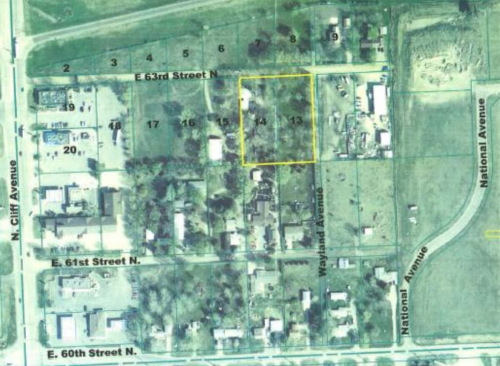
Second, the larger parcel issue. The court held the trial judge should not have entered judgment as a matter of law in favor of the property owner on the issue of whether separate parcels were considered as a whole in a condemnation case. The court held that the property owner’s evidence that a separate lot (Lot 15 on the map above) should be included with Lots 5, 6, 7, and 8 as a single economic unit for purposes of calculating compensation and damages. Lot 15 is next to yet another lot (owned by another) on which a hotel was planned had the highway project not interfered. The owners of Lots 5-8 and 15 planned to develop these lots “in conjunction” with the planned hotel.
The trial court allowed the property owners to present evidence that Lot 15 should be considered, sua sponte prohibited the DOT’s expert from testifying otherwise, at the close of evidence determined as a matter of law that Lot 15 was part of the larger parcel, and instructed the jury that its job was to determine compensation for Lots 5, 6, 7, 8, and 15.
The DOT appealed. It didn’t challenge the three-part larger parcel test (unity of use, title, and contiguity), just how it was applied. The DOT argued that mere “‘hopes to enjoy the benefits of a nearby hotel project do not establish the single, integrated and inseparable use required by our law.’ In the State’s view, [the owners] must present specific evidence that the highest and best use of Lot 15 is in a commercial development with Lots 5, 6, 7, and 8. Slip op. at 14.
The Supreme Court agreed with the DOT, concluding that the owners “did not establish that Lot 15 would, in the reasonably near future, be put to its highest and best use in combination with Lots 5-8 for a single unified use. The owners also did not establish that Lot 15 was necessary to the use and enjoyment of Lots 5-8. It was possibility, but not such a certainty that the trial court should have taken the question away from the jury.
The Supreme Court also disapproved of the work “project” in a phrase in the jury instructions, “before and after the project.” The court concluded that the more accurate term was “taking.”
South Dakota v. Miller, No. 27198 (S.D. Dec. 7, 2016)