
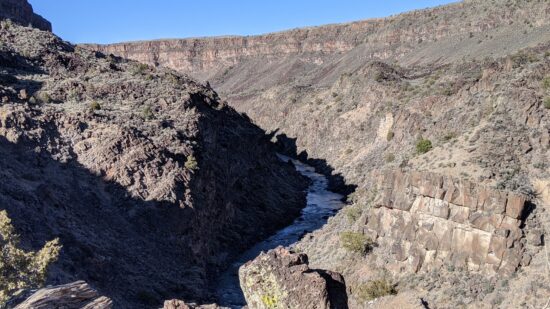
There’s a lot to like the panel opinion from the U.S. Court of Appeals for the Tenth Circuit in Sanchez v. Torres, No. 25-2009 (Apr. 21, 2026), even though the court ultimately rejected the claim the State of New Mexico had taken the plaintiffs’ property right to exclude the public.
[Note: this is one where we rep the property owners, so we won’t be adding a lot of commentary.]
The good stuff was from the unanimous panel, which reversed the district court’s jurisdictional dismissal (on justiciability grounds, primarily on the conclusion the plaintiffs lacked standing), holding that the owners’ takings claims are justiciable.
However, the panel split 2-1 on what to do next, with the majority concluding that the complaint failed to plausibly plead that the plaintiffs had the right to exclude and thus did not state a claim for a taking (dismissed!), while the dissenting judge, having concluded that the case was justiciable, would have sent it back to the district court for more and would not have dismissed. The concurring (in part) and dissenting (in part) judge summed up the outcome of the appeal in his separate opinion:
I fully agree with the majority’s incisive analysis of the standing, sovereign immunity, and other jurisdictional issues in this appeal. I therefore join Parts I–II.D of the majority opinion in concluding that we have jurisdiction to hear this case. From there, however, I part company with the majority. While the majority affirms because the plaintiffs (Landowners) fail to state a claim for a judicial taking, I would have stopped our decision at jurisdiction.
Slip op. (Federico, J., concurring in part and dissenting in part) at 1.
For decades, New Mexico has acknowledged that the public did not have the right to access nonnavigable waters, and did not have the right to trespass on privately-owned land. State agencies, and even the state legislature, adopted rules and statutes in accord. But in 2022, the New Mexico Supreme Court “held that the public waters provision of the New Mexico Constitution granted the public, in addition to the right to fish and recreate in public waters, a right to touch the privately owned beds of public waters because ‘[w]alking and wading on privately owned beds beneath public water is reasonably necessary for the enjoyment of many forms of fishing an recreation.'” Slip op. at 6 (quoting Adobe Whitewater Club of New Mexico v. New Mexico State Game Comm’n, 519 P.3d 46, 49, 53 (N.M. 2022)).
This decision resulted in State officials walking back their pre-1922 approach:
Following this decision, New Mexico officials took steps to enforce Adobe Whitewater’s holding. The Commission repealed the regulations allowing streambeds to be certified as private, 33 N.M. Reg. 485 (Mar. 22, 2022), and sent letters to owners of previously certified streambeds informing them that their certificates were void. The letters directed landowners to take down any signage referencing certification or restricting public access to the water as well as directing them to remove barriers limiting access to public water on their property. New Mexico Attorney General Raúl Torrez has also sought to enforce Adobe Whitewater—having brought a now-settled enforcement action against Plaintiff Mr. Briones asserting his use of signs and fencing impermissibly restricted access to the Pecos River. Plaintiff Mr. Jenkins has likewise received informal threats of enforcement.
Slip op. at 7-8.
Federal takings lawsuit followed, seeking a ruling that “New Mexico Officials’ enforcement of that holding amounted to a taking of the Landowners’ property–that is, their right to exclude, for public use without just compensation in violation of their Fifth and Fourteenth Amendment rights as enforceable under 42 U.S.C. § 1983.” Slip op. at 8. The remedy sought: declaratory and injunctive relief (federal court, state officials, and all that). The district court dismissed without reaching the merits, concluding the plaintiffs lacked standing.
As noted above, the Tenth Circuit reversed the not-justiciable dismissal, but a two-judge panel majority continued, concluding that the complaint failed to state a claim (12(b)(6)). We’ll let you read the justiciability analysis, but here’s what we think is the money quote regarding standing:
While the court correctly identified a credible threat of enforcement as an injury in fact, it mistakenly analyzed traceability and redressability with reference to a different injury—the loss of the Landowners’ right to exclude. Although the alleged loss of property rights was not caused by the New Mexico Officials, the threat of enforcement is. And although the Landowners’ requested injunction would not return their lost property right or prevent enforcement by the public, it would redress the threat of prosecution by officials with special enforcement authority. Thus, partial redressability was available and, as we explain, is sufficient for standing.
Slip op. at 11.
The panel also rejected the State’s Rooker–Feldman and abstention claims.
The split came on what to do next. As we noted above, Judge Federico would have stopped there and sent the case back to the district court for further factual development and determination. But the two-judge majority concluded that the complaint failed to state a claim because it didn’t plausibly allege that prior to 2022, the plaintiffs possessed the right to exclude:
The Landowners fail to show their claimed right to exclude was established such that their property rights were taken as opposed to merely clarified. We therefore assume without deciding that the Fifth Amendment protects against judicial takings and affirm on the alternative ground that the Landowners fail to state a claim for relief.
Slip op. at 36-37 (footnote omitted).
The majority relied on the plurality opinion in Stop the Beach Renourishment (our thoughts on that case here), holding that the owners must show that their property rights alleged to have been taken were “sufficiently established” before the change in the law:
We take a similar approach here because, even if judicial-taking claims exist, the Landowners have failed to state a claim for a judicial taking as outlined in Stop the Beach Renourishment’s plurality opinion. The Landowners bear the burden of demonstrating that their rights were sufficiently established before Adobe Whitewater such that this decision amounted to a judicial taking. See Stop the Beach Renourishment, 560 U.S. at 730 (“There is no taking unless petitioner can show that, before the Florida Supreme Court’s decision, littoral-property owners had rights to future accretions and contact with the water superior to the State’s right to fill in its submerged land.”); Robbins v. Oklahoma, 519 F.3d 1242, 1247 (10th Cir. 2008) (“The burden is on the plaintiff to frame a ‘complaint with enough factual matter (taken as true) to suggest’ that he or she is entitled to relief.” (quoting Twombly, 550 U.S. at 556)). The Landowners’ allegations in this case are plainly insufficient.
Slip op. at 44.
Check out pages 44-50 for the majority’s reasoning, supporting its conclusion that the owners’ right to exclude were not all that clear. Especially page 50 where the court (correctly) notes that New Mexico law isn’t the be-all-end-all of whether the owners had a right to exclude, and that other sources may need to be consulted:
To be sure, state law is not the only source of property rights, which likewise depend on “‘traditional property law principles,’ plus historical practices and [Supreme Court] precedents.” Tyler, 598 U.S. at 638 (quoting Phillips, 524 U.S. at 167). However, the Landowners have failed to meet their burden to demonstrate that these traditional principles, historical practices, and precedents established their claimed property right. The facts before us instead support the New Mexico Supreme Court’s conclusion that it merely clarified the scope of the public’s easement to use public water and that the Landowners never enjoyed the right to exclude they claim.
Slip op. at 50.
Judge Federico saw it differently:
The parties to this appeal have not sufficiently illuminated their arguments on the merits of the Landowners’ judicial takings claim. Between their opening and reply briefs, the Landowners allocate just over five pages to the matter. In their response brief, the New Mexico Officials offer even less, providing little more than a page. The parties’ district court briefing is also of little help. It is similarly sparse, totaling five and half pages between both sides, and it contributes no additional substance to the parties’ appellate arguments.
More importantly, the parties’ cursory briefing fails to grapple with the complexity and novelty of the matter at hand. The law on judicial takings is unsettled, and even the most basic question – Is there such a thing as a claim for a judicial taking? – remains largely unanswered. Assuming such a claim exists, as the majority does, invites more questions. We know that a judicial takings claim would require the Landowners to prove the existence of an “established” property right and the taking of that right, but we don’t know much more than that. Stop the Beach Renourishment, Inc. v. Fla. Dep’t of Env’t Prot., 560 U.S. 702, 732 (2010). By what standard do we measure whether a property right is sufficiently established? And how does that legal standard intersect with the pleading rules under Federal Rule of Civil Procedure 12(b)(6)? The parties don’t say.
Slip op. (Federico, J., concurring in part and dissenting in part) at 2-3.
We recommend you check it out.
Sanchez v. Torrez, No. 25-2009 (10th Cir. Apr. 21, 2026)