
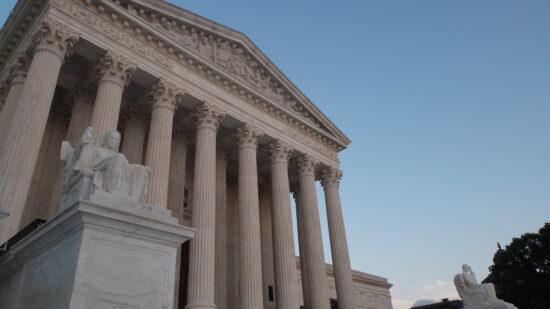
Yesterday, in First Choice Women’s Resource Centers, Inc. v. Davenport, No. 24-781 (Apr. 29, 2026), the U.S. Supreme Court held that an organization which provides counseling and resources to pregnant women had standing to bring a First Amendment challenge to the New Jersey Attorney General’s subpoena which sought information about the organization’s donors.
Interesting issue, for sure. But what’s the case doing here? Well, among other things, the Court held the case was ripe. Ah, now you get it.
Check out page 16 of the unanimous Justice Gorsuch-authored opinion, where the Court rejected the NJ AG’s attempt to analogize this case to takings “final decision” ripeness. The AG argued that the organization’s case was not justiciable in federal court because the state court proceedings to confirm issuance have not been completed. The Court didn’t buy it:
Failing in one analogy, Mr. Platkin attempts another. This time he points to Pakdel v. City and County of San Francisco, 594 U. S. 474 (2021) (per curiam). In that case, we explained that a plaintiff normally cannot sue in federal court over an alleged regulatory taking until local land use authorities “commi[t] to a position” regarding how “the regulations at issue apply to the particular land in question.” Id., at 478–479 (internal quotation marks omitted). Applying the same logic here, Mr. Platkin insists, means that First Choice should not be allowed to challenge his subpoena in federal court until state court proceedings have run their course. Until then, after all, his non-self-executing subpoena is “subject to negotiation” and it remains uncertain which of its demands will be enforced. Brief for Respondent 25, 27.
But even setting aside the question whether a Takings Clause rule might be properly transposed into the First Amendment context, the rule Mr. Platkin invokes has little purchase here. He “committed to a position” when he issued his subpoena demanding donor records. To be sure, he remained free to narrow the scope of his demands later, and he might fail to secure a judicial order compelling production. But none of this means he failed to commit to a position. Nor does any of this undo the “inevitable” injury First Choice experienced to its associational rights when Mr. Platkin issued his subpoena—an injury that it continues to experience so long as the subpoena remains outstanding. Buckley, 424 U. S., at 65.
Slip op. at 16-18.
A couple of thoughts.
First, be careful about “transposing” prudential ripeness in the takings context to other types of cases. We see courts doing just that in RLUIPA challenges (because, like takings, they are “land use” cases!), and procedural due process cases, for example. So be careful!
Second, takings ripeness focuses on the government, and whether it had “committed to a position.” As Pakdel held, this is a “modest” requirement, and is a fact-specific inquiry. It does not require exhaustion of any administrative or remedies, or heroic measures to convince the government to say yes, when it is clear enough that it has said no. Here, the AG issued a subpoena. Yes, he could have narrowed its scope, or the state court could tell him no you can’t do this, but that didn’t change the fact that he had told the organization “give me the records of your donor.” And that, to the unanimous Court, was enough.
Check it out.
First Choice Women’s Resource Centers, Inc. v. Davenport, No. 24-781 (U.S. Apr. 29, 2026)