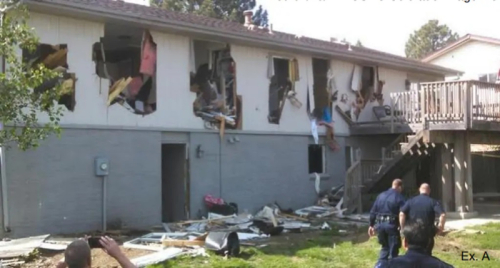
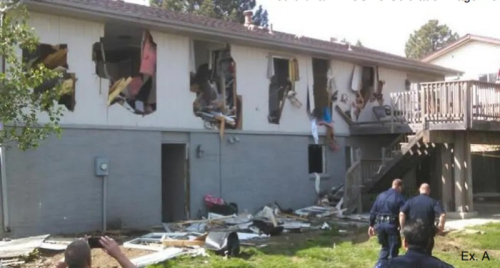
The situation in Hamen v. Hamlin County, No. 28671 (Feb. 10, 2021), a recent opinion by the South Dakota Supreme Court seems pretty bad, but a road we’ve gone down before. Believing that a suspect was inside, the local SWAT team (along with the county Special Response Team — drone and two armored vehicles included) damaged the mobile home belonging to the suspect’s parents:

To create the communication portholes for the Hamens’ trailer, an armored vehicle pulled away the front stairs and deck, which were not attached to the mobile home or secured in the ground, and pushed in the front door with a ram. The second armored vehicle opened three portholes on the opposite side of the mobile home by breaking through windows and a sliding patio door, causing significant damage to the walls and the septic system.

Well, it turns out the suspect wasn’t there. “Shortly after this procedure and before officers entered the mobile home, Gary was seen walking in the river near the Hamens’ residence. Law enforcement apprehended him at approximately 6:00 p.m.”

The owners of the trailer sued for $18k, asserting both inverse condemnation under the South Dakota Constitution (which has an “or damaged” clause), and for civil rights violations under 42 U.S.C. § 1983. The trial court granted the county and the sheriff summary judgment – no damaging.

In Hamen v. Hamlin County, No. 28671 (Feb. 10, 2021), the South Dakota Supreme Court agreed. The court understood it had a choice. Many states have concluded that the “or damaged” clause of their constitutions does not include situation where someone’s private property is, you know, damaged, as long as the damage was the result of “a manifestation of the police power.” Slip op. at 8. Other states go the other way, and hold that in some circumstances a property owner may seek just compensation when property is taken or damaged by law enforcement. 

After reviewing the language of article VI, § 13 of the South Dakota Constitution and decisions from other jurisdictions, we join the courts that have denied a right of compensation by eminent domain when law enforcement damages private property while executing a warrant or pursuing a fleeing felon. Courts which have denied compensation under similar eminent domain provisions of their state constitutions have properly applied “the framework established by [their] constitution” that a taking or damage claim arises from a public use function, rather than a police power function.

Slip op. at 15. In short, the damaging must — as in takings — be for a public use, and damage by the police in the course of their duties isn’t for public use. If that’s so, we ask: what did the inclusion of “or damaged” add to the South Dakota Constitution. We’re not sure (and on this, we defer to our SD colleagues, and to Molly Brady who has studied “damaging” clauses). Are they merely to recognize loss of access in eminent domain cases as compensable? 

This issue has bothered us for a while. Why wasn’t the damaging of the trailer “for public use?” It’s a good thing for police to go after potentially dangerous suspects, right? In our view, this really just boils down to a policy choice by the courts – do we want people suing for “self-executing” damages without a searching inquiry into issues usually associated with tort-y claims? As the South Dakota court noted, many states come down on the side of no.

We don’t think that has to be the case, and that courts don’t need to draw such a bright line of no liability, as we wrote in our amicus brief in support of the homeowner in the Colorado case, an invocation of “police power” isn’t the sole question the court should be asking, because the government’s assertion that it destroyed property for a police power purpose should be but one of the factors a court considers when an owner asserts the destruction resulted in a taking or damaging. Police power may be a compelling factor militating against compensation. But as we see it, the nature of the power being exercised should never be the sole factor, as South Dakota court concluded.

No better illustration of that than how the court addressed the second issue: whether the government actors were entitled to qualified immunity as a defense to the § 1983 claim. Check that out, starting on page 16 of the slip opinion. There, the analysis hinged on the reasonableness of the actors’ conduct. We’re not suggesting that the existing state of QI doctrine and analysis is satisfying to us, merely that hard lines of liability or no liability may not be the best way to examine these situations. You can see how, in some circumstances, a law enforcement action that damages property should be compensable. And how in others it might not be.

But the South Dakota Supreme Court instead chose a bright line rule of no takings or damaging liability at all once a court decides the action was undertaken under the police power. To that, we ask the question we’ve asked before: aren’t most “regulatory takings” cases based on the idea that the exercise of some power other than eminent domain (you know, like the police power) have the same effect as an affirmative seizure by eminent domain? 
Hamen v. Hamlin County, No. 28671 (S.D. Feb 10, 2021)

Continue Reading The “Or Damaged” Part Of South Dakota’s Constitution Doesn’t Really Add Much: Damages From Police Actions Are Neither Takings, Nor Damagings

Lech

The Supreme Court today declined to review a Tenth Circuit decision that held a municipality could not be liable for a taking when its police officers pretty much destroyed a house in the course of dislodging a suspect who had holed up there. 

Along with our colleague Bill DeVinney, we filed an amicus brief in support of the homeowner, arguing that an invocation of “police power” isn’t the only question in these kind of cases, and the government’s assertion that it destroyed property for a police power purpose is but one of the factors a court considers when an owner asserts the destruction resulted in a taking. Police power may be a compelling factor militating against compensation. But it should never be the sole factor, as the Tenth Circuit concluded.

We had hoped that the Court would take notice of this case because after after the petition was filed, the coronavirus pandemic exploded and the legal questions about the power of the government to act for police power and other emergency reasons while avoiding takings liability has moved to the forefront of a lot of people’s thinking. We set out our thinking about this issue (including Lech) in Evaluating Emergency Takings: Flattening The Economic Curve. 

The “police power categorically isn’t a taking” issue isn’t going away. We’ll stand by for the next case.

Continue Reading Cert Denied In Police Power Takings Case (Lech v. Greenwood Village)

EX A

Here’s the city’s Brief in Opposition in a case we’ve been following (so closely, in fact, that we filed an amicus brief in support of the property owner – see “Amicus Brief: Invocation Of “Police Power” Is Not Dispositive In Takings“). A case in which the issues have taken on new and heightened importance.

This is the case where the municipal police pretty much destroyed a family home in the course of their efforts to dislodge a shoplifter who had taken refuge there while fleeing. The homeowner sought compensation for a taking. The Tenth Circuit, however, concluded “no taking” because the police were exercising the police power. And you can’t have a taking where the government is exercising the police power, right?

The homeowner filed a cert petition, arguing that “[t]he question presented is whether there is a categorical exception to the Just Compensation Clause when the government takes property while acting pursuant to its police power.”

The city doesn’t see it that way, naturally, and it formulates the Question Presented this way:

This Court, along with lower federal and state courts, has historically and consistently distinguished between the power of eminent domain and the police power. The question presented is whether damage sustained to a third-party’s rental property caused by law enforcement’s admittedly reasonable efforts to apprehend an armed, aggressive and barricaded suspect gives rise to a compensable taking of property under the Fifth Amendment of the United States Constitution.

The reason why we think that this case has taken on even more importance, is twofold. First, the case presents the same issue as in the coronavirus takings cases (here are some of the complaints that have been filed in courts around the nation: see here, here, here, here and here). Our thoughts on the takings aspects of that issue here (“Evaluating Emergency Takings: Flattening The Economic Curve.”). This case could not be a more timely opportunity for the Court to provide guidance on whether an invocation of “police” or emergency power short-circuits the takings analysis.

Second, the ongoing protests and focus on police misconduct. While this case is not one where the police are alleged to have misbehaved, the question of whether a municipality can be held liable for just compensation when the police — in the course of an otherwise proper pursuit — destroy property for public use or benefit, is certainly highly related. If police remain immune from civil liability by the qualified immunity doctrine, perhaps the Takings Clause can serve as a check on unconstitutional municipal action?

As for the BIO’s contention that there’s no lower court divergence of opinion on this question? We think otherwise: customs agents inspect and seize your laptop at the border to check it out but destroy the data on the hard drive? no taking; DEA holds your legal prescription drugs as evidence against a third party but eventually don’t use the evidence and return it to you (but by then the drugs have expired)? no taking. But not every jurisdiction goes that way, however.

We will keep following along (Court’s e-docket here), of course. Stay tuned.  

Brief for the Respondents in Opposition, Lech v. Jackson, No. 19-1123 (June 3, 2020)

Continue Reading BIO In “Police Power” Takings Case: Can A Municipality Be Liable For A Taking If The Police Destroy Private Property In The Course Of Apprehending A Suspect?

Lech

Today, along with our colleague Bill DeVinney, we filed this amicus brief in support of the property owners’ cert petition in a case we’ve been following for a while. 

Yes, this is the case where the Village police pretty much destroyed a family home in the course of their efforts to dislodge a shoplifter who had taken refuge there while fleeing. Homeowner sought compensation for a taking. The Tenth Circuit, however, concluded “no taking” because the police were exercising the police power. And you can’t have a taking where the government is exercising the police power.

Instead of summarizing our brief, how about we just post the Summary of Argument:

This Court should review the Tenth Circuit’s holding that action taken by the government under its police power—as opposed to an exercise of eminent domain—can never trigger a taking under the Fifth Amendment’s Just Compensation Clause. This brief makes two main points.

  1. Government’s assertion that it destroyed property for a police power purpose is but one of the factors a court considers when an owner asserts the destruction resulted in a taking. Police power may be a compelling factor militating against compensation. But it should never be the sole factor, as the Tenth Circuit concluded.

  2. The brief also addresses a question that often arises after the police or other government officials damage a home—or, as in this case, nearly destroy it: why should the homeowner be able to seek just compensation for a taking when insurance is available? The short answer is that nearly all homeowners’ insurance policies exclude from coverage any loss caused by an order of a government or civil authority. A majority courts have interpreted this provision to preclude recovery for damage inflicted by the police in executing a search warrant or apprehending a fleeing suspect.

Consequently, if the Tenth Circuit’s holding stands, many homeowners who suffer losses when their homes become are occupied or damaged by the police—no doubt a public purpose—through no fault of their own will be left without any remedy for damage inflicted by police searching for evidence, apprehending suspects, or otherwise exercising the police power.

The petition presents the Court an opportunity to clarify that an invocation of “police power” is not the dispositive fact in a takings analysis. Rather, the “character of the government action” is but one of the issues to be determined, not the conclusive one as the Tenth Circuit concluded. The Court should grant review.

Now we wait. Stay tuned.

Brief of Amicus Curiae Owners’ Counsel of America in Support of Petitioners, Lech v. City of Greenwood, No…. 

Continue Reading Amicus Brief: Invocation Of “Police Power” Is Not Dispositive In Takings

IMG_20191209_091814

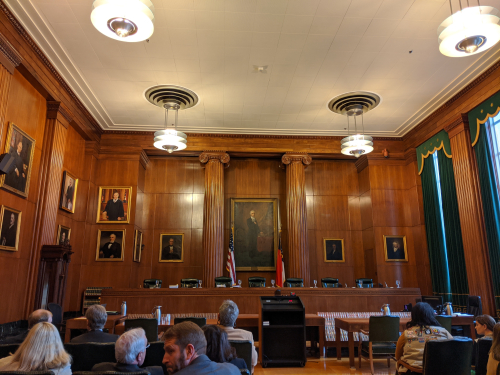
This time last week, we were sitting in the North Carolina Supreme Court’s (very beautiful) courtroom, above, having just observed oral arguments in a case we’ve been following for quite a while, Chappell v. NCDOT, No. 51PA19 (docket here). 

This case is the follow up (after remand) of the N.C. Supreme Court’s landmark decision in Kirby v. North Carolina Dep’t of Transportation, No 56PA14-2 (June 10, 2016), in which the court held that the “Map Act,” a statute by which DOT designated vast swaths of property for future highway acquisition, was a taking because the Act prohibited development and use of designated properties in the interim. The court concluded “[t]hese restraints, coupled with their indefinite nature, constitute a taking of plaintiffs’ elemental property rights by eminent domain.” The court remanded the case for a parcel-by-parcel determination of just compensation. On remand, the trial court concluded the Chappell case was a permanent taking, and awarded compensation accordingly. DOT appealed, and here we are. 

The biggest theoretical gap we witnessed in the arguments was that each of the parties seemed to have a different conception of exactly what “property” has been taken, and thus is being valued. On one hand, DOT argued that the Map Act’s restrictions were like a negative easement, severely restricting the use of the property, but not totally wiping out all uses. Thus, DOT argued, the taking could not be valued as a “permanent” taking (and by “permanent,” we think they meant taking of the fee, even though they never expressly argued that). The property owners, by contrast, argued that the court in Kirby held these takings were “indefinite” and therefore “permanent,” because a decades-long restriction on economically beneficial uses is the equivalent of a permanent take. 

A couple of thoughts. First, one thing we didn’t hear argued in detail was the effect of the subsequent repeal of the Map Act. Immediately following the Kirby decision, the N.C. legislature repealed the statute, which in our view transformed the formerly “indefinite” takings into temporary takings, albeit very long-term takings. The advocates didn’t focus on this question, and we heard only a couple of questions from the otherwise hot bench. To us, this is a critical issue, since in our view, the government always retains the authority to repeal a statute or regulation, and thus put an end date on a formerly indefinite taking. And as we all know, the U.S. Supreme Court held in First English Evangelical Lutheran Church v. Los Angeles County, 482 U.S. 304 (1987) that temporary takings are takings, and the owner is entitled to just compensation for the time which a statute or regulation “clouded” use. Here, that seems like a very long time for DOT to have, in effect, rented the property from the Chappells. But if that’s how comp plays out, that’s how it plays out.

Second, we’re not sure if the record shows that DOT preserved its main argument by an offer of proof of the uses supposedly remaining under the Map Act “negative easement.” If not, that seems like one way for the court to rule in favor of the property owners and affirm, without dealing with the temporary vs indefinite nature of the taking. If the owners are satisfied with being compensated for the fee taking in this proceeding and not seeking the rent-plus-interest, who are we to say otherwise, provided the court does not establish a (wrong) rule that these type of cases generally are valued as permanent fee takes. 

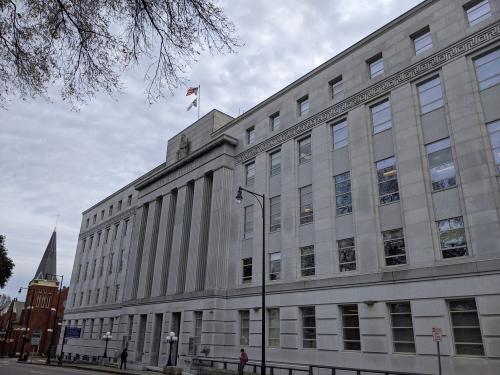
One last thing before we go (and await the court’s opinion). If you are in the neighborhood of the N.C. Supreme Court, you should drop in and pay a visit, even if there isn’t a case on the docket that is in your alley. It’s a historical building (surrounded by other similarly historical buildings), and the courtroom itself is impressive. Very impressive. 

MVIMG_20191209_142521

Continue Reading NC Supreme Court Considers Just Compensation For Formerly Indefinite–But Now Temporary–“Map Act” Takings

EXHIBIT A

We’re back again at that supposed distinction between the police power and the eminent domain power, which reminds us of that old tale about President Lyndon Johnson:

After reviewing a contingent of Viet Nam-bound Marines in California, Lyndon Johnson strode purposefully toward what he thought was his helicopter. “That’s your helicopter over there, sir,” said an officer, steering the President toward a different craft.

“Son,” replied Johnson evenly, “they are all my helicopters.”

Well, it’s all government power. 

But not to the Tenth Circuit, which in this unpublished order concluded that when local SWAT teams destroyed an innocent family’s house to dislodge a fleeing suspect who had for hours holed up there and taken shots at the police, it wasn’t a taking because, guess what, the police were not exercising eminent domain power, it was the police doing what police do.

The Tenth Circuit relied on the fact that this was a physical taking (and not a regulatory taking). You might think that it would be better for the owners to have characterized it as a physical taking because those are per se takings. No, because this was a physical occupation pursuant to the police power and not pursuant to some regulation, the usual Loretto rule doesn’t apply, the court concluded.

But we thought the regulatory takings doctrine wasn’t necessarily built on the idea that it was only regulations that can take property, but the recognition that any action by government where it does not recognize its obligation to pay compensation could be a taking, aka inverse condemnation.

The court also relied on the “nuisance” or “necessity” rule in takings, which finds no taking if property is destroyed in order to prevent a greater public harm. You know, cedar rust and stuff. The idea there’s no taking if your property needs to be destroyed for the greater good.

So suck it up, property owners. Police destroyed your house chasing a bad guy. Not your fault, but you get to bear the entire burden. 

Not that we’re terribly surprised by this ruling as grossly unfair as it is, mind you. Pretty typical. Customs agents inspect and seize your laptop at the border to check it out but destroy the data on the hard drive? No taking. DEA holds your legal prescription drugs as evidence against a third party but eventually don’t use the evidence and return it to you (but by then the drugs have expired)? No taking. 

Not every jurisdiction goes that way, however.

More on the decision from the Washington Post here. 

Order and Judgment, Lech v. Jackson, No. 18-1051 (10th Cir. Oct. 29, 2019) 

Continue Reading CA10: SWAT Attack On Home Where Shoplifting Suspect Holed Up Isn’t A Taking

Our final 2018 post focused on what we thought was the biggest case of that year, and which, we’re predicting, will be the biggest case of 2019: Knick v. Township of Scott, No. 17-647, that’s the one in which the Supreme Court is considering whether federal takings claims can be brought in federal court, and whether to revisit the 30-year old Williamson County “state procedures” requirement. 

So we’re kicking off 2019 with our thoughts on that case, coming up for reargument next week. 

Before we get to our prognostication (yes, we’re going to go there, however futile doing so might be), we wanted to lay out our thinking on the issues so you can see how we got there. The wildly divergent positions taken by the three main players — Ms. Knick, the Township, and the United States — illustrate well how mucked up and opaque regulatory takings doctrine is: after nearly 100 years, the Supreme Court hasn’t quite got around to defining the constitutional cause of action is in these cases.

Or has it?  

First Principles (or Would You Rather Win?)

Which leads us to a related topic: how do you argue an issue to the Supreme Court when the existing analysis is based on decades of built-up precedent (much of it confused, or simply bad), misinformation, judicial sleight-of-hand, and semantics? Do you go try to get the Court back to “first principles” and make an attempt to straighten out the intellectual mess, once and for all? Or do you play it as it lies, and look for a way to reconcile the existing precedent with a favorable result, with the hope of sorting out doctrinal damage in the future?

The first is a recipe for your ego writing checks your body can’t cash (and a spectacular — but principled — defeat). And while the latter may be the more likely path to victory, it also countenances further screwing up the doctrine, and a deepening of the intellectual difficulties which made winning difficult in the first place. 

That’s our sense of what is fueling the narrative disconnects that lie at the heart of Knick. Neither party nor the amicus federal government has much interest in asking the Court to go back and start all over again. Instead, each tries to harmonize the existing precedent with their theory. A wise move, no doubt.

But in trying to figure out what the Court might do, we’re going to be looking at the issue of whether a property owner who alleges that a local government action violates the incorporated Fifth Amendment can raise that claim in a federal court in two ways: first, from the ground up – what should the law be? And then second, what’s the way the Court’s majority may treat this, given the existing law, and the questions from the Court the first time the case was argued back in October 2018.  

So for the moment, please put aside the tortured history of the regulatory takings doctrine, and let’s go back to basics. 

Is the Problem A “Taking,” or Only A “Taking Without Just Compensation?”

All the way back to 1922. That’s when the Supreme Court recognized in Mahon that regulation could result in a taking (and yes, we know that this idea was certainly around before Mahon, but most people think that Mahon created the doctrine, and that’s good enough for our purposes), and require the payment of compensation. The “storied but cryptic” formulation that while property “may be regulated to a certain extent, if regulation goes too far it will be recognized as a taking.” Property owners, regulating entities (both federal and state), lawyers, judges, and legal scholars spent the next half-century-plus trying to figure out just what “a taking” is. 

After some false starts (Agins‘ “substantially advance” test, for example), the Court in 2005 in Lingle finally settled on what looked like a minimally-workable doctrine. A regulation will effect a taking if it has a similar impact on an owner’s property rights as an affirmative exercise of eminent domain; the more a regulation looked like a condemnation, the more likely it would be deemed to be a taking requiring the payment of compensation. The more the regulation did what regulations do — govern the use of property without actually depriving the owner of a fundamental attribute of ownership — the more likely it would be deemed to be merely regulation.

Thus, a physical invasion of property (the most classic form of eminent domain) was always a taking (Kaiser, Loretto), as was a regulation that wiped out property’s economic use (Lucas). But pretty much everything else would be judged on a sliding scale by measuring a series of “factors” to try and intuit whether the regulation or other government action really looks like an exercise of eminent domain (Penn Central). It certainly is not the best of theories. Lord knows, the Penn Central test has resulted in more judicial, practicing bar, and academic head-scratching and frustration over the decades, with only the Supreme Court itself seemingly confident of the meaning of each factor, and how to apply them. But at least it was something.

During this time, however, there wasn’t a big effort put into effort trying to figure out whether a “taking” alone was actionable in federal court, or whether a taking was only of interest to the federal courts it a local government didn’t provide compensation. This wasn’t for lack of thinking about it, and in our view it was more the result of the remedy sought by the property owners in the key cases (Kaiser, Loretto, for example), or the procedural posture of the cases (First English, Agins), which resulted in the issue not being presented. 

Thus, during most of the time the above theory was being developed, there wasn’t much of a question that when a local government (not the feds or a state government) was accused of perpetrating a regulatory taking, the plaintiff property owner could ask a federal court to determine whether there had been a “taking” requiring compensation. After all, the claim sure would seem to “arise under” the Fifth Amendment, which, since Chicago, Burlington, & Quincy Railroad v. City of Chicago, 166 U.S. 226 (1897), had been incorporated under the Fourteenth Amendment’s Due Process Clause against local and state governments. Indeed, the private property clause in the Fifth Amendment was the very first part of the Bill of Rights which was selectively incorporated against the states by the Fourteenth Amendment.

On top of that, add the Anti-Ku Klux Klan Act (otherwise known as the Civil Rights Act of 1871, 42 U.S.C. § 1983), in which Congress created a private right of action for damages or equitable relief for persons whose “rights, privileges, or immunities, secured by the Constitution and laws” are “deprived” under “color of state law.” Federal courts have jurisdiction over those claims, too. Thus, the Fifth Amendment as incorporated under the Fourteenth, along with section 1983, and the federal courts’ jurisdiction-conferring statutes sure seemed to add up to a federal claim, enforceable in federal court. 

A “Reasonable, Certain, and Adequate” Means to Recover Post-Hoc Compensation

But 1985’s Williamson County changed all that. Based mostly on the Solicitor General’s argument that any allegation a municipality violated the incorporated Fifth Amendment by regulating property “too far” cannot arise before the municipality has denied compensation, the Court held that a property owner must, in effect, exhaust state compensation remedies before coming to federal court with their “takings” claim. 

The Court and the SG analogized the situation to those in which the federal government affirmatively takes property, but does not contemporaneously provide compensation. Thus, a violation of the Fifth Amendment does not arise when the federal government employs a “take now, pay later” scheme, provided there is a “reasonable, certain, and adequate” means for the property owner to recover compensation in the future (either by final judgment in the eminent domain action, or by raising a claim against the feds seeking compensation under the Tucker Act in the Court of Federal Claims or a district court), and you have a perfect recipe for keeping what sure look like federal constitutional claims out of federal court. See, e.g., Kirby Forest Industries, Inc. v. United States, 467 U.S. 1 (1984). 

In Williamson County, the Court concluded that a municipality’s “denial” of compensation not only includes the municipality telling the property owner that it wasn’t going to be paid squat for regulating the property (this is only a regulation, after all, and municipalities aren’t in the habit of paying to regulate), but also includes the courts of the state telling the property owner that it wasn’t going to be paid squat under a state-law inverse condemnation lawsuit to force the municipality to pay compensation. Thus, what we refer to as a “federal takings claim” against a municipality doesn’t belong in federal court at all because even if there’s been a taking, there’s no constitutional problem yet if there’s a chance the owner might recover compensation down the road from the municipality. 

Which brings us to where we are now. What follows is our attempt to reconcile taking principles (what should be) with the plain fact that current doctrine isn’t consistent or comprehensive (what is). As we noted in an earlier post, the October 2018 arguments before an eight-Justice Court didn’t give us a lot of confidence that a majority had a firm grasp on what the whole “takings” thing is about. Several Justices don’t quite seem to understand the fundamental principles at play, nor the critical differences between an exercise of the eminent domain power, what it means to “take” property, and the nature of a state-law claim for “inverse condemnation.” And the briefing from the parties often seems to be a case of talking about apples and oranges (especially the briefs of the Township and the SG). 

The Hill to Die On: “Take Now, Pay Later” 

The one issue that we think isn’t going to be revisited substantially by the Court is the one motivating the SG’s attempt to “retcon” its arguments (as we noted in this post). This is the notion that there’s not been a “violation” of the incorporated Fifth Amendment if there’s only been a taking, if there is a “reasonable, certain, and adequate” means for the property owner to obtain compensation after the fact. As the Court noted in Williamson County:

The Fifth Amendment does not proscribe the taking of property; it proscribes taking without just compensation. Hodel v. Virginia Surface Mining & Reclamation Assn., Inc., 452 U.S. at 452 U. S. 297, n. 40. Nor does the Fifth Amendment require that just compensation be paid in advance of, or contemporaneously with, the taking; all that is required is that a “reasonable, certain and adequate provision for obtaining compensation'” exist at the time of the taking. Regional Rail Reorganization Act Cases, 419 U. S. 102, 419 U. S. 124-125 (1974) (quoting Cherokee Nation v. Southern Kansas R. Co., 135 U. S. 641, 135 U. S. 659 (1890)). See also Ruckelshaus v. Monsanto Co., 467 U.S. at 467 U. S. 1016Yearsley v. W. A. Ross Construction Co., 309 U. S. 18, 309 U. S. 21 (1940); Hurley v. Kincaid, 285 U. S. 95, 285 U. S. 104 (1932). If the government has provided an adequate process for obtaining compensation, and if resort to that process “yield[s] just compensation,” then the property owner “has no claim against the Government” for a taking. Monsanto, 467 U.S. at 467 U. S. 1013, 467 U. S. 1018, n. 21. Thus, we have held that taking claims against the Federal Government are premature until the property owner has availed itself of the process provided by the Tucker Act, 28 U.S.C. § 1491. Monsanto, 467 U.S. at 467 U. S. 1016-1020.

Williamson County, 473 U.S. at 194-95.

This general principle isn’t going to be revised in Knick because it insulates the federal government’s quick-take power from challenge, and also validates the Tucker Act procedures for alleged regulatory takings and inverse condemnations by the federal government, and the SG (and the Court, no doubt) likes that situation just fine, thank you.

Which leads to our first question: is Kirby, or the decisions relied upon by the Williamson County court, perfect analogies when it is a local government — and not the feds — accused of the unconstitutional act? Not to us. 

First, Kirby involved the affirmative exercise of the eminent domain power. Thus, when the Court noted that “the Fifth Amendment does not forbid the Government to take land and pay for it later,” the blanket rule should be limited to those situations where the government has acknowledged that it is taking property, and is as a consequence, willing to pay for it and the beef is just over how much. In federal quick-takings where the government takes now and pays later, title transfers immediately, which vests the owner’s right to recover compensation. In situations where title does not transfer at the same time that a taking occurs and the owner’s right to compensation vests, the “take now, pay later” rule should not be so casually applied. 

Second, in each of the cases noted in the above quote, it was the federal government that was alleged to have been doing the taking. Williamson County concluded, without citation, that the general principle from the noted cases holds true even where it is a local government doing the alleged taking: 

Similarly, if a State provides an adequate procedure for seeking just compensation, the property owner cannot claim a violation of the Just Compensation Clause until it has used the procedure and been denied just compensation.

Williamson County, 473 U.S. at 195 (emphasis added).

Are State Law Inverse Lawsuits The Same As Tucker Act Claims in the CFC?

Which leads us to our second question: are state-law inverse condemnation lawsuits in state court totally analogous to or Tucker Act claims in the Court of Federal Claims? We don’t think so for two reasons. 

First, remember that what we call an “inverse condemnation lawsuit” against the federal government in the CFC is, in reality, an Article I proceeding to consider whether compensation is owed, and if so, how much. You don’t get a lifetime appointed judge, or a jury. Thus, as a matter of first principles, the CFC isn’t really a “court” at all. It’s simply an Article I tribunal established by Congress to consider whether certain claims are meritorious enough to be compensated. In short, a CFC lawsuit is really a glorified administrative claims procedure. The Court’s unanimous approach in Horne v. USDA, 569 U.S. 513 (2013), illustrates this, because it approved approved of the property owner raising (raisin!) a “takings-based defense” without first having sought compensation through a Tucker Act inverse claim in the CFC, by concluding that by adopting the raisin price control statute (which included an administrative claims process), Congress intended to withdraw the Tucker Act claim. There’s no such municipal analogue in Ms. Knick’s case. 

Second (and relatedly), the CFC Article I Congressional claims procedure is the federal government’s own mechanism for processing these claims. It is Congress’ way of saying “we think we’re merely regulating your property, but if you think we owe you money, here’s a way to make that claim.” By contrast, a state-court inverse condemnation lawsuit against a municipality isn’t really the same thing because it isn’t an executive or legislative claims procedure set up by the municipality. It’s just a plain old lawsuit. The state court isn’t part of the local government’s own compensation mechanism, and a state court isn’t the local government refusing to pay, as noted by the Court in First English:

Williamson County Regional Planning Comm’n, is not to the contrary. There, we noted that “no constitutional violation occurs until just compensation has been denied.” 473 U.S., at 194, n. 13. This statement, however, was addressed to the issue whether the constitutional claim was ripe for review and did not establish that compensation is unavailable for government activity occurring before compensation is actually denied. Though, as a matter of law, an illegitimate taking might not occur until the government refuses to pay, the interference that effects a taking might begin much earlier, and compensation is measured from that time. See Kirby Forest Industries, Inc. v. United States, 467 U.S. 1, 5 (1984) (Where Government physically occupies land without condemnation proceedings, “the owner has a right to bring an ‘inverse condemnation’ suit to recover the value of the land on the date of the intrusion by the Government“). (Emphasis added.)

First English Evangelical Lutheran Church of Glendale v. County of Los Angeles, 482 U.S. 304, 320-21 n.20 (1987) (emphasis added).

Stop Making Sense: Why Haven’t State Courts Adopted Williamson County‘s Logic? 

Best illustrating this to us is the fact that we cannot locate a single state court decision determining that a state law inverse claim against a local government is unripe under Williamson County‘s rationale. Before you shake your head at what might appear to be illogical (how can a local government have taken property unconstitutionally without compensation under the state constitution, if the owner hasn’t sued for compensation via the state’s “reasonable, certain, and adequate” procedures for obtaining compensation?), please hear us out: you might think that a state court, considering whether a taking is “without just compensation” would be within Williamson County‘s logic to conclude that a state court inverse case isn’t ripe because there are procedures for obtaining compensation, the state law inverse condemnation lawsuit itself. But that is an Escher-esque infinitely regressive loop, no?

Thus, state courts consider it okay to consider the question of whether property has been taken at the same time as the question of whether compensation has been owed, because they really are part and parcel the same question: the very process which determines there has been a taking is also the process which determines whether compensation is required. In other words, by bringing the claim for a taking, the property owner is ripening her claim for compensation. No state court has gone down a contrary logical path, yet the Court in Williamson County did so. 

Does that make any sense to you?

The Dusky Gopher Frog

That takes us to our final point in this post. Will a Supreme Court majority be willing to de-couple the “takings” question from the “compensation” issue? In other words, allow federal courts to consider both Fifth Amendment “takings” issues where the remedy sought isn’t compensation (which they do now, see Kaiser Aetna, Nollan, and Horne, for example), and those cases where it is claimed that the local government hasn’t provided compensation, and thus compensation is the remedy? 

After all, in the dusky gopher frog decision, the Court recently de-coupled the term “habitat” from “critical habitat,” even though the latter phrase was a term of art, defined by statute. The unanimous Court concluded that “critical habitat” must include “habitat,” even where Congress didn’t include it.

Might the Court, under similar logic, be willing to revisit the concept that the action triggering federal jurisdiction for a section 1983 incorporated Fifth Amendment takings claim isn’t limited to “takings without just compensation,” but the “takings” issue generally? 

Prediction? Pain

And we can’t leave without this: our prediction for what the Court is going to do.

We think there are going to be at least five votes for Ms. Knick. Now maybe that is wishful thinking on our part. But overall, we think she has the better arguments (and the support of the federal government, if not exactly for the same reasons). As long as the majority can preserve the general rule of “take now, pay later” and can otherwise thread the needle without having to overturn swaths of established takings doctrine (no matter how much of it doesn’t make a lot of sense), we think the Justices will do so. 

We’ll see. 

Programming note: we’ll be in DC next week for a conference, and assuming that the Court is still open on Wednesday and hasn’t been shut down, will attend the Knick rearguments. We’ll bring you a report. 

Continue Reading Stop Making Sense: Knick, Williamson County, And Lessons For Takings From The Dusky Gopher Frog Decision – Are “Takings” Federally Justiciable?

Update: the audio recording is posted here.

* * * *

Here are the links to the cases we mentioned in today’s ABA State and Local Government Law Section presentation, “Takings: Emerging Issues.”

The “Larger Parcel” In Regulatory Takings (and Eminent Domain)

Emerging Issues

Flooding and Takings 

Williamson County Ripeness

Continue Reading Links From Today’s ABA Presentation – “Takings: Emerging Issues”

In the course of negotiating a successful hostage situation with tear gas, flash-bang grenades, and a bulldozer, the Spartanville, SC police department damaged a convenience store. So badly that the owners “were later asked by the City to tear it down as it did not comply with ordinances regarding vacant commercial buildings.” After the owners said no, the City demolished it. 

In Carolina Conveniece Stores, Inc. v. City of Spartanburg, No. 27663 (Aug. 31, 2016), the South Carolina Supreme Court held that this wasn’t an inverse condemnation. The court didn’t provide any substantial analysis, holding merely that the South Carolina Constitution does not contemplate that damage occasioned to private property by law enforcement in the course of performing their duties constitute a taking.” Slip op, at 4-5. Why? Because “the framers of the Constitution did not intend that law enforcement operate under the fear that their actions could lead to takings-based liability.” Id. at 5. Does the court provide a citation to this constitutional history? Nope. 

Interestingly, the court rejected the Court of Appeals’ analysis that this was not a physical appropriation and that this was an exercise of the police power, even though that court reached the same result — no liability. Thus, we have to conclude that this is a pure legislative policy call by the majority — police shouldn’t worry about who’s gonna pay if they bust down doors (or, in this case, totally trash a building). 

Two justices dissented from the holding:

Here, we consider the question of whether an inverse condemnation claim arises where private property is destroyed by the government during the course of an emergency. I believe this question has a simple answer. The police damaged the convenience store so significantly as to “take” the property from its owners, and this taking clearly served the public use of apprehending a dangerous suspect. Regardless of who is assigned fault for this act, faithful interpretation of our constitution demands compensation for the innocent individual.

Dissent at 8 (footnote omitted). 

Carolina Convenience Stores, Inc. v. City of Spartanburg, No. 27663 (S.C. Aug. 31, 2016)

Continue Reading SC: Damage Caused By SWAT Isn’t A Taking

William W. Wade, Ph.D., a resource economist with the firm Energy and Water Economics (Columbia, Tennessee) is a frequent author and speaker on the topic of regulatory takings and is familiar to readers of this blog. (His next gig is a talk on Penn Central and inverse condemnation at the 12th Annual Texas Eminent Domain SuperConference February 11-12, 2013, in Austin.)

Bill fills us in on the Texas Supreme Court’s decision in EdwardsAquifer Authority v. Day, 274 SW.3d 742, (Tex. 2012). The court issued the opinion in February 2012, but recently denied a motion to rehear the case, thus making it final. 

++++++++++++++++++++++++++++++++++

Regulatory Takings, Texas Groundwater, and Hydrofracking

by William W. Wade, Ph.D.

Texasmay have created the takings and condemnation lawyer full-employment act. 

TheTexas Supreme Court in February 2012 reversed a hundred years of water law,changing groundwater ownership rights from a “rule of capture” to ownership of”groundwater in place.”  (Edwards AquiferAuthority v. Day, 274 SW.3d 742, (Tex. Feb. 23,2012, “Day”)) The decision equated groundwater ownershipto oil and gas and concluded that differentiating “between groundwater and oiland gas in their importance to modern life would be difficult.” Ownership of the surface provides ownershipof the water regardless of capture.  

Day sets-upa conflict between value of the owner’s groundwater in place and management of thelarger aquifer for public benefit. TexasWater Lawyer, Drew Miller, who represented Edwards in the litigation, reportedthat “[t]he . ..  immediate result of the Day decision is that landowners mayassert regulatory takings claims against . . . governmental entities in response to regulation that limits or prohibitsaccess to, or production of, groundwater.” (November 8, 2012.) The Daydecision invoked SCOTUS legal theories that might govern compensation–Loretto, Lucas and Penn Central–and remanded Day“to the district court for further proceedings” to sort them out.

Here’sthe rub: water is scarce in Texas and about 2/3 of human consumption isgroundwater. Drought is upon the land in2013 and expected to become increasingly recurrent. Groundwater Conservation Districts (GCDs)regulate usage of groundwater within most Texas counties. Now that title to the water in place resideswith the landowner, GCD management of the larger aquifer for the public good runs the risk of a takings claim seekingcompensation. 

Suppose you are the GCD for part of an aquifer within a TexasCounty. Assume that the aquifer providesthe municipal water supply for a town of 200,000. For decades, surrounding ranchers have reliedon the aquifer to provide a few hundred acre-feet of water for their livestockand a few homes. Now, assume that thecounty overlies a large shale oil and gas resource and several of the ranchershave leased their land and water rights to an oil company that plans to produce(an unknown but maybe) thousands of acre-feet of groundwater for hydrofrackingwells for years to come.

The ranchers, the oil company, the GCD and the municipal waterusers are about to find out exactly how much the water is worth and whether theproduced oil and gas or the life-sustaining water is more valuable. Besides working out what might be the termsof exchange between the ranchers and the oil company for the water, I can thinkof a number of engineering, hydrologic, environmental and other economic issuesthat must be sorted out to even consider litigating a regulatory taking case.

If Penn Central werethe governing legal theory, I can imagine a number of empirical hurdles tosurmount to establish severity of economic impact and frustration of distinctinvestment backed expectations. Penn Central’s average reciprocity of advantagemight invoke careful scrutiny of the benefits and burdens at issue. In short, “further proceedings” for the PennCentral test invoke myriad challenges those who follow the arcanenuances of regulatory takings – well-beyond multiplying some water price timesa quantity to claim damages!

Continue Reading Guest Post: Regulatory Takings, Texas Groundwater, And Hydrofracking