Here’s the latest in an issue we’ve been on for a long time: whether government actions taken under the police power are categorically exempt from providing just compensation when those activities take or damage private property.

In Blue 42 Organics, LLC v. Georgia Dep’t of Public Safety, No. S25G1493 (Sep. 9, 2026), the Georgia Supreme Court held no, and that the State was not categorically immune from an inverse condemnation claim just because the government damaged the property in the course of an apparently valid exercise of the police power.

Whether it is what we call “SWAT takings,” or a government claiming it is immune because it was exercising the police power, or deploying the police power as the dispositive factor in the Penn Central “character” factor, the argument is the same: no liability for just compensation when the government is acting within the broad power to regulate and restrict to promote the public health, safety, welfare, and morals. Here’s a sampling of some of our posts strenuously objecting to that argument:

Wait, I Thought The Police Power and the Public Use Clause Were “Coterminous”

CA3: Claim That Govt Is Keeping Property Seized (But Not Used) As Evidence “checks all the Fifth Amendment boxes.”

Cert Denied In Police Power Takings Case (Lech v. Greenwood Village)

Fed Cir Tries To Avoid “Police Power” Takings Exception In Bump Stock Case By (Unsuccessfully) Finessing The Property Interest

The Blue 42 case came about after Georgia state police aircraft flew low enough to damage crops on Blue 42’s hemp farm, and Blue 42 sued in state court for inverse condemnation under Georgia’s constitution. The trial court dismissed the case and the court of appeals affirmed, concluding that the damage occurred in the course of a valid exercise of the State’s police power, which meant no inverse claim.

The Georgia Supreme Court disagreed. That court held that police power justifications may be exceptions to the usual rule to pay compensation, but situations involving extreme or “urgent public necessity” are “very narrow” and

that from our earliest days, this Court recognized that just compensation was generally required when the government destroyed property for public use and that there was a narrow exception to this general rule when government destroyed private property in extreme or urgent situations.

Slip op. at 8 (footnote omitted).

We recommend you read all of the “history and tradition” stuff the court lays out in this part of the opinion. Not only is it instructive, it is very interesting. There’s also some good stuff about the Georgia Constitution’s Just Compensation Clause that is worth repeating here:

From our earliest days, this Court recognized that the doctrine of just compensation was a part of Georgia foundational law because it was a part of the English common law that we adopted nearly 250 years ago. See, e.g., Parham, 9 Ga. at 349 (“It is not, therefore, necessary to go to the Federal Constitution for [the principle]. It came to us with the Common Law — it is part and parcel of our social polity — it is inherent in ours, as well as every other free government.

Slip op. at 5-6 (footnote omitted).

There’s also a section of the opinion devoted to describing the “police power.” Yes, it is a broad power, and “[h]istorically, legislative bodies have exercised police power in a wide range of contexts, including zoning restrictions, building standards, health regulations, nuisance abatement, and alcohol regulations.” Slip op. at 12. This “power is among the broadest of government powers.” Id.

But this broad power “is not limitless.” Slip op. at 13. It must be exercised within the bounds of the Georgia Constitution, and the police power does not permit the government to “invade the personal rights and liberty of the individual citizen by legislation which has no reasonable relation to a legitimate State purpose.” Slip op. at 14.

The Georgia Supreme Court has now joined others which hold the same. See, e.g., this case, this one, and this one.

While we like this decision, we also find it weird that we have to constantly relitigate a foundational 104 year old SCOTUS decision (remember that in Mahon, Justice Brandeis dissented on the basis there could be no takings liability because Pennsylvania’s Kohler Act was unquestionably an exercise of its police power).

Blue 42 Organics, LLC v. Georgia Dep’t of Public Safety, No. S25G1493 (Ga. Sep. 9, 2026)

Here’s the latest in a case we’ve been following for a long time.

In Baker v. City of McKinney, No. 25-40396 (May 22, 2026), the U.S. Court of Appeal for the Fifth Circuit, in an unsigned per curiam opinion approved of the property owner’s “reelection of remedy” to ask for relief under the Texas Constitution, after the original section 1983 just compensation claim was rejected.

You remember this case, one of those “SWAT takings” claims that actually succeeded in the district court. The Fifth Circuit, however, said that the Fifth Amendment doesn’t require compensation if the government is validly exercising its police power, and the U.S. Supreme Court (over the mild objections of two Justices) denied cert.

But that wasn’t the end of the road:

After our court denied panel and en banc rehearing, see Baker v. City of McKinney, 93 F.4th 251, 251 (5th Cir. 2024) (per curiam), and the Supreme Court denied Baker’s petition for writ of certiorari, see Baker v. City of McKinney, 145 S. Ct. 11, 11 (2024) (mem.), this case returned to the district court. In December 2024, Baker filed a “Reelection of Remedy,” requesting the district court “reenter judgment pursuant to Article I, Section 17 of the Texas Constitution.” The City opposed Baker’s reelection and moved to dismiss her Texas takings claim, arguing that the district court should decline to exercise supplemental jurisdiction. In June 2025, the district court granted Baker’s reelection of remedy, denied the City’s motion to dismiss, and entered final judgment in favor of Baker. The City timely appealed the district court’s opinion and order, final judgment, and other filings in favor of Baker on her Texas takings claim.

Slip op. at 3.

With the federal claim gone, the City asserted that the district court should not have continued to exercise its (supplemental) jurisdiction over the remaining state law claim. Often, we see federal courts, when asked to consider state law claims after the federal claims go away, back off. But not here.

The Fifth Circuit first considered the question of whether there was a Texas taking. The court noted that the standards for liability “are not the same.” Slip op. at 6. The court also noted that the Texas Supreme Court has affirmed that the Texas Constitution may require compensation even if the government has destroyed property in the course of apprehending criminal suspect. See Steele v. City of Houston, 603 S.W.2d 786 (Tex. 1980). Slip op. at 6-7. So yes, a property owner who has suffered damage resulting form a police power action may recover for a taking under the Texas Constitution.

The Fifth Circuit also rejected the city’s claim that Baker didn’t properly reelect her state law remedy after remand:

The district court plainly instructed the jury on Baker’s federal and state takings claims, and our court has explained that, “[w]hen a plaintiff prevails on both federal and Texas state law causes of action for the same injury, federal courts apply Texas’s one satisfaction rule, which requires the prevailing party to elect between the alternative claims for purposes of recovery.” Malvino v. Delluniversita, 840 F.3d 223, 233 (5th Cir. 2016) (citation omitted). Baker was given the choice to make such an election and chose to pursue relief via § 1983, see Baker I, 84 F.4th at 382, and the City fails to identify “any authority holding that [Baker] cannot change h[er] election” in this case, where “the [§ 1983] claim [s]he elected to recover on [wa]s reversed” in Baker I, Malvino, 840 F.3d at 233. The “equitable nature” of Texas’s “one satisfaction rule counsels against such a stringent approach,” as there is no risk of “double recovery” for Baker post-Baker I. Id. at 233–34. As such, we do not disturb the district court’s application of Texas reelection of remedies law.

Slip op. at 7-8.

It’s good to see the courts approve what both looks like justice as well as dogged lawyering by Baker’s counsel.

Baker v. City of McKinney, No. 25-40396 (5th Cir. May 22, 2026) (per curiam)

Sometimes when you read a court opinion you imagine there’s a big gap between the objective, sterile words on the page and the reality of the situation.

The U.S. Court of Appeals for the Seventh Circuit’s opinion in O’Donnell v. City of Chicago, No. 24-2946 (Dec. 22, 2025) is one of those.

The words on the page reveal the court held that a Chicago ordinance which authorizes the city to seize vehicles for traffic violations — even other cars the violator owns — is not a taking because its “an exercise of the City’s police power to enforce its traffic code, and thus isn’t a taking.” Slip op. at 5. (We have problems with that conclusion, but more on that below.)

But reading the opinion gives a hint of the off-page reality on the ground.

Dig this. Get a traffic ticket in Chicago, and you can either challenge it or pay. If you don’t pay, or if you challenge and lose (and then have to pay), and you incur two more final violations the city can immobilize and every vehicle you own. Yes, even cars not involved the violation. And if you don’t pay up for the immobilization within 24 hours, the city may tow and impound all your cars (meaning the private towing and impound company with the city contract). Still don’t pay up? The city may sell or otherwise dispose of all vehicles.

We don’t know about you, but reading the opinion’s sterile description (see slip op. 2-3), gives us an ick feeling.

Anyone who has earned a traffic ticket or had your car towed knows what we mean. Especially those of you who have to deal with entrenched and seemingly-heartless apparatchicks, and really especially those who have dealt with private towing contractors and impound lots. A quick interwebs search reveal a lot of horror stories (such as this one , this one, and this one.

Once you are in the municipal traffic enforcement web, it is a difficult and soul-sucking effort to get out. So forgive us if we have some sympathy for the car owners/plaintiffs in this case, separate and apart from the merits of their legal challenge.

Back to the case. As noted above, the Seventh Circuit didn’t seem to apply any of the usual factors for considering a regulatory takings claim. Instead, the court focused on the nature of the power the city was exercising. If the city was exercising the police power, game over:

In Hadley v. City of South Bend, 154 F.4th 549, 554 (7th Cir. 2025), we considered a takings claim that—like this one—arose from a state’s exercise of its police power rather than eminent domain. Eminent domain traditionally refers to “a state’s power to physically take property by formally condemning it.” Id. The police power, conversely, refers to “a state’s general authority to determine, primarily, what measures are appropriate or needful for the protection of the public morals, the public health, or the public safety.” Id. (citation modified). As we acknowledged in Hadley, the takings analysis doesn’t draw “rigid distinctions between eminent domain and police power actions,” and every police power action may not bar a takings claim. Id. at 554–56 (citation modified). Nonetheless, we regarded the exercise of law enforcement authority as a “classic example” of police power that does foreclose takings claims. Id. at 556.

Slip op. at 4-5.

Hold on. As we have said here many times, the takings doctrine isn’t about the power being exercised, and courts are wrong to focus on the government power. See this post and this post, for examples. After all, we’re talking regulatory takings, not plain-old eminent domain takings. Regulatory takings by definition assert that the government’s exercise of some power other than its eminent domain power nonetheless has the same effect on the property owner as a plain-old eminent domain taking. Thus, the focus should be on the owner’s property rights, and whether and how the regulation or restriction the government imposes affects property rights.

Thus, we think the Seventh Circuit continues to get it wrong when it makes these kind of statements:

Applying that principle here, immobilizing, towing, impounding, and—if necessary—disposing of vehicles under § 9-100-120 is an exercise of the City’s police power to enforce its traffic code, and thus isn’t a taking.

Slip op. at 5.

This is very nearly a paraphrase of Justice Brandeis’s solo dissent in Pennsylvania Coal, where he argued that because Pennsylvania had a really good, super-duper, police power reason for adopting the Kohler Act, it just couldn’t be a taking. We don’t think that there’s much doubt that the Commonwealth was not acting arbitrarily and capriciously when it adopted the Kohler Act, because surface subsidence caused by overmining coal. But the majority concluded that despite the Commonwealth’s good reasons, the Kohler Act worked a taking.

We’re not suggesting that this should be the result here, merely that the court wrongly focused on the nature of the power the city is exercising and not the effects of that power on the property owners. Yeah, the city probably has the leeway to impose some pretty draconian measures and keep on ratcheting up the pain on non-paying traffic violators. At least our current due process mode of analysis would suggest.

But rather than analyze the property impacts, the Seventh Circuit imposed what looks like a categorical rule. If the government is enforcing the law (and when is it not?), no takings problem:

The threat of impoundment and disposal forces them to internalize the consequences of their behavior and, accordingly, deters those violations in the first place. See Tate v. District of Columbia, 627 F.3d 904, 909 (D.C. Cir. 2010). Because § 9-100-120’s function is to enforce the City’s traffic code, it’s the kind of law enforcement forfeiture scheme “firmly fixed in the punitive and remedial jurisprudence of the country” and does not constitute a taking. See id. (quoting Bennis v. Michigan, 516 U.S. 442, 453 (1996)) (finding that a scheme similar to the one here didn’t constitute a taking).

Slip op. at 5.

If there’s an Achilles’ Heel in the Seventh Circuit’s opinion it is this:

Finally, the plaintiffs err in relying on Tyler v. Hennepin County, 598 U.S. 631 (2023), to argue that the City commits a taking by retaining all vehicle sales proceeds without applying any of it to unpaid ticket debt. The principle at work in Tyler—that the government “may not take more from a taxpayer than she owes”—doesn’t apply here, where the government enforces laws pursuant to its police power. Id. at 639; see also Aldens, Inc. v. LaFollette, 552 F.2d 745, 749 (7th Cir. 1977) (noting that the police and tax powers are distinct and subject to different limitations). In sum, § 9-100-120 is an exercise of the City’s police power to enforce its traffic code, so the Takings Clause doesn’t apply and the plaintiffs cannot establish a federal or state takings violation.

Slip op. at 7.

In our thinking, the court is just plain wrong here. The Takings Clause doesn’t operate on a state or local government’s taxing power differently than it does on its police power. Or its eminent domain power. Or any local government power, for that matter.

O’Donnell v. City of Chicago, No. 24-2946 (7th Cir. Dec. 22, 2025)

This past week we were busy with the 22d Brigham-Kanner Property Rights Conference at the William and Mary Law School.

Here’s the text of the remarks which I prepared for the session on “Public Safety, Private Property, and Just Compensation.” Note: because of time, I truncated what I planned on saying and kept it shorter.

* * * *

Public Safety, Private Property, and Just Compensation

Before I begin, a prelude. As you learned earlier, yesterday the student Real Estate Law Society produced a reargument of Kelo.

Ms. Kelo won this time. Six-to-zero, adopting the rationale of Justice Thomas’s dissent in the original case, with one concurring opinion. (More about this event in a separate post.)

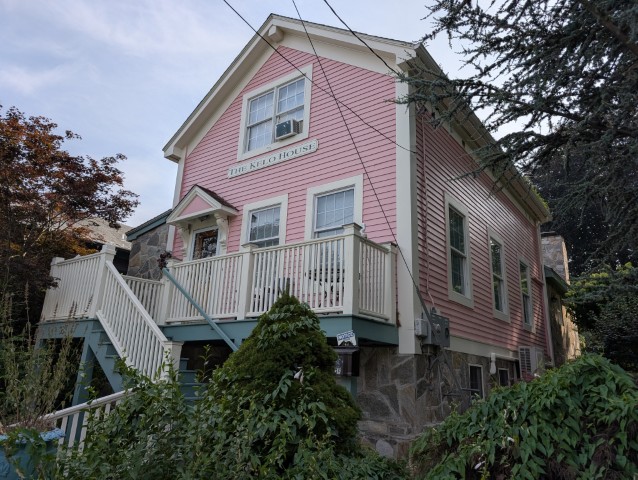
And for those of you in the audience who didn’t know, Ms. Kelo’s famous little pink house was saved, even though her property was not. The house was taken apart board-by-board and relocated to a different neighborhood in New London, where it was reassembled, where it is today. If you are ever nearby, it’s worth a visit.

And just a couple of miles away, right across Fort Trumbull, is the former Kelo land, which remains vacant. We paid a visit a couple of months ago, and here’s what it looks like.

OK, let’s get back to the topic of the day: public safety takings.

Dick Miller, a great teacher and mentor of mine once offered up this pearl of wisdom, and of all the things I took with me from my legal education, this one has perhaps stuck the most: “Robert,” he said, “if it ain’t Latin, it ain’t the Law!”

In that vein, the Latin at the heart of our discussion today is familiar to all of us: “salus populi est suprema lex.”

For those of you, like me, who can’t handle Law French much less Latin (for example, I have no idea how to pronounce “voir dire,” except to get the judge to say it first and then parrot her pronunciation), here’s the translation: “The welfare of the people is the supreme law.”

And on that, I would suspect that no matter whether one is a police power hawk or an advocate for property rights, that we would agree that this proposition, at least in its broadest form, should be government’s guiding principle. All government action should be to promote the public health, safety, welfare, or morals. Or put another way, government should not act arbitrarily or capriciously. Or contrary to the law of the land. No less a figure than John Locke—no enemy of property rights—started off his seminal Second Treatise on Government with the phrase (“SALUS POPULI SUPREMA LEX ESTO”). So it has an impeccable pedigree.

And we have seen our Supreme Court take that phrase to heart, particularly when it comes to the sovereign power to regulate and restrict the use of property (the police power), and even the power to expressly deprive an owner of his or her property, in whole or in part through eminent domain. With the takings power being “coterminous” with the police power, there’s little distinction between how government acts, as long as it does so for the public welfare. The difference being that when property is taken—and not merely regulated—the public must provide just compensation.

As the Court has persistently reminded us, the primary principle to be derived from the Fifth Amendment isn’t to stop government from acting in the public interest, but to ensure that the costs and burdens of that action are not concentrated on the owner whose property just happens to be in the way.

And the topic of this panel, SWAT takings—where the government damages or destroys the private property of an innocent homeowner in the course of apprehending a criminal suspect—brings the salus populi principle into sharp focus.

After all, all of the textual elements are there to show that this “goes too far” and a classic police power action should be treated as a de facto taking and trigger the obligation to compensate:

  • an owner has private property (and in the cases brought recently, the property is a home), there’s been a physical invasion resulting in pretty severe damage (some of the photos look like a war zone),
  • the government has unquestionably acted for the public welfare and safety (we all want Five-O to apprehend criminals, I assume),
  • and the owner is being required to bear the costs herself and the public has not offered up compensation (and as an amicus brief I did in one of these cases that is reproduced in your materials noted, homeowner’s insurance generally is not available to permit the owner to pay herself to avoid the risk of such government actions).

Armstrong, cost spreading…we all know the drill:

The Fifth Amendment’s guarantee that private property shall not be taken for a public use without just compensation was designed to bar Government from forcing some people alone to bear public burdens which, in all fairness and justice, should be borne by the public as a whole.

But if there’s a universality in the judicial approach, it is this: no taking … or at least no compensation is required. The variety occurs in how the courts get there.

Some say no absolute right to exclude, with the issue turning on whether the police are acting pursuant to a valid warrant, incorporating by reference Fourth Amendment property law. Some say the owner has no expectations of exclusion of the government as a background principle. Some say the owner can and should anticipatorily mitigate by insurance.

And in what I find to be the least defensible justification, conclude that because the police are exercising the police power—are acting for the public’s health, safety, and welfare—there can be no taking—categorically. Salus populi est suprema lex.

To me, to conclude that because that police action was necessary it is not a taking, is to reject the foundation of the regulatory or de facto takings doctrine: that an otherwise valid exercise of some power other than the eminent domain power will, if it “goes too far” into the property rights of an owner, be deemed to be a taking requiring compensation giving the government a choice: stand down or pay up. The more necessary for public health, safety, and welfare, the more it should be compensated. These are not Kelo-like actions where the government conduct has only predictable, or attenuated, public benefits, but a direct promotion of the public good.

For example, there’s no substantial question the Kohler Act was a valid, and seemingly very necessary, exercise of Pennsylvania’s police power. Even if you discount some of the more breathless portions of the brief of the City of Scranton—complete with photos of collapsed schools and unearthed caskets—the Pennsylvania legislature adopted the Act unanimously, at a time in history when one might expect that one of the stronger lobbies having a lot of influence in that legislature was the coal industry.

One sidebar: inspired by Professor Fischel’s peeks behind the curtain of important cases like the Cedar Rust case, on the day of the 100th anniversary of the Court’s issuance of the Mahon opinions in December 2023, John Ross and I were on site at the former Mahon home and property on that day, where we learned of the inherent oddity at the heart of the case: the Kohler Act was adopted unanimously with the mainstream coal industry aboard. It was designed to curb the mining of wildcat or cowboy mining companies, which would buy up the rights to continue mining coal in mines which more responsible coal companies like Pennsylvania Coal had ceased, precisely to avoid surface collapse. Thus, the Act made it illegal to mine out the support pillars, something the mainstream companies were not doing.

But Mahon (and it is pronounced “man”) sure looks like it was a test case by the Pennsylvania Coal Company. Not too many degrees of separation. Mahon was a lawyer and until Scranton intervened, represented himself. He was the son-in-law of the prior owner, the Chief Engineer of the Pennsylvania Coal Company, the owner who obtained the property subject to the deed covenant that the Pennsylvania Coal Company could mine out 100% of the coal under the home, even if it caused the home to fall into the resulting hole. It wasn’t likely that the Company was actually going to mine out beneath the home of the daughter of its former Chief Engineer.

But in the event that precipitated the litigation, it sent notice to the Mahons that indeed it was going to exercise its rights, and heads up: your house may fall into a hole soon.

The great mystery is why Pennsylvania Coal would challenge a statute it didn’t object to being passed. Perhaps having served its purpose of shutting down the cowboy miners, the mainstream industry wanted to be sure that it wasn’t hoist on its own petard, it was time to get it invalidated. And a historical note: despite winning in the Supreme Court, the Company never did mine out under Mahon’s home, and the present owner confirmed to John and I that of all the homes in his neighborhood, his home is the only one which has never suffered any subsidence.

And one final note on this sidebar: after that visit and with the consent of the owner, John and I thought it might be a good idea to commemorate the Mahon decision. After all, less that 3 miles away as the crow flies, Pittston, PA is the location of another famous Supreme Court decision, Erie RR v Tompkins.

If that deserved a roadside marker, then doesn’t Mahon?

I’m happy to report that, with the support of some of you in this room, that the Pennsylvania Historical Marker Commission recently approved our application for a Mahon property marker, to note the importance of the Supreme Court’s decision. Stay tuned for more – John and I will let you all know when the dedication ceremony for the marker is scheduled and ask you to join us in Northeastern Pennsylvania.

Now back to our story.

That all said, we tend to focus on the Holmes 8-Justice majority in Mahon and its “goes too far” language, contrasting it with the “government could hardly go on” phrasing later in the opinion. But we should pay more attention to the solo dissent of Justice Brandeis, who argued that because the Kohler Act was so necessary, it cannot be a taking, and cannot result in compensation. Salus populi est suprema lex.

This was a dissenting view, and why I think it is too bad that it is overlooked, is that the necessity principle seems to adopt and incorporate it, and it is troubling to me that Brandeis’ rationale is deployed to deny compensation, when a solid exercise of police power is not terribly relevant to the compensation question. But it is a minority view, and it should be seen as such.

But that’s just saying what won’t work. Thus far, the question of SWAT takings has not been taken up by the Supreme Court under any theory, despite at least a couple of very solid vehicles presenting the case. So what approach might interest the Court? Especially in a way that does not risk the Court’s majority, or even a minority in dissent, scaling back on what I view as the fundamental principles of Mahon?

As discussed earlier, I suspect what might catch the Court’s attention would be arguments centered on — you guessed it — text, history, and tradition. The Supreme Court has deployed the text, history, and tradition approach across a wide range of cases, not just property, and it looks like it is here to stay at least for a while.

The text on SWAT takings seems pretty straightforward. The public is “using” the property of innocent homeowners, or at least appropriating – temporarily – the owner’s right to exclude.

What about history and tradition? There, I have observed that courts focus on wartime or emergency cases which hold no compensation. But that history doesn’t seem to line up exactly with SWAT takings, because the cops chasing a suspect isn’t a “war” and it happens with such regularity that it hardly seems like an “emergency” where the usual non-emergency rules must be applied in a time of extreme distress.

What does tradition and our common law roots have to say about this?

After the Great Fire of London in 1666, the Fire Court was established was created to resolve “[d]ifferences touching Houses burned or demolished by reason of the late Fire which happened in London” between landlords and tenants. The court began its seating on January 1, 1668. The legislation charged the court with resolving disputes about the required rebuilding, property boundaries, the “Rents as if the same had not been burned,” and the like. The legislation noted the goal of spreading the public loss among the entire public, too:

And for that it is just that every one concerned should bear a proportional share of the loss, according to their several Interests, wherein in respect of the multitude of cases varying in their circumstances no certain general rule can be prescribed.

The Armstrong principle, applied.

As noted above, the jurisdiction of the court included not only structures actually burned by the fire, but those “pulled down or otherwise demolished, defaced, or otherwise ruined by reason of the said Fire.” The vibe of the statute seems to have been to get these disputes resolved in a single forum, and quickly (appeals had to be made in seven days for example).

This seems to presume that some kind of compensation was owed when someone’s property was purposely destroyed or damaged in order to protect the public’s welfare and safety.

This is in line with Lord Coke’s admonition in the Saltpetre Case that even though the King’s “saltpetre men” could exercise the King’s prerogative to enter private property with warrants against the will of the owner in order to mine saltpetre for use in gunpower to defend the realm against France and Spain (especially the Spaniards!), that the Crown has an obligation to leave the owner in as good a position he would have been in without the entry:

Yet it was resolved, that he may dig for Salt-peter, for this that the Ministers of the King who dig for Salt-peter, are bound to leave the Inheritance of the Subject in so good Plight as they found it[.]

12 Coke at C1. Sounds a lot like “the full and perfect equivalent” and “the owner shall be put in as good position pecuniarily as he would have been if his property had not been taken.” Seaboard Air Line Ry. v. United States, 261 U.S. 299 (1923).

And – thanks to a former student of mine who is now practicing eminent domain law with Clint Schumacher – David Wilde, I now understand that the compensation principle even when – or perhaps especially when – destruction or damaging of private property is necessary to promote the public good.

In the trial court arguments in the Ship Money Case, David discovered that the issue came up, and the advocate argued that in such cases there’s no proclaimed that there’s no “prejudice” because the Crown or the Parliament was obligated to indemnify for any loss. Fascinating stuff.

But OK, that’s English law. What about American law?

And again I have David to thank for this. His research is showing that in colonial and early American law, legislatures recognized that in the case of fires, local officials were authorized to “tear down or blow up” homes to stop the conflagration from spreading. But importantly, that the owners of those destroyed houses “shall receive reasonable satisfaction, and be paid by the same, and be paid by the rest of the inhabitants whose houses shall not be burnt.” History and tradition indeed.

But this is statutory or local ordinance, not constitutional law? As to that, we need look no further than Tyler v. Hennepin County for the Supreme Court looking at how state law addressed similar issues for an example. I suggest that were the Court presented with a case of a SWAT taking, it could take up the issue and resolve it without diving into the morass of Penn Central which, in my view, wrongly focuses the takings question on the “taken” part of the Fifth Amendment and not the “public use” requirement.

Thank you for granting me this time. A shout out to my students who are here today, thank you for being here. And a hearty congratulations to our Prizewinner, Professor Fischel.

Untitled Extract Pages

Here’s the latest in a case we’ve been following. This morning, in this Order, the Supreme Court denied cert in two cases which seemed to have a good chance at a grant, on two pressing issues which have divided lower courts, the physical occupation in tenancies (aka Yee), and the nature of the Penn Central takings test. Only Justice Gorsuch would have granted.

Here are the Questions Presented:

New York’s Housing Stability and Tenant Protection Act of 2019 transforms a temporary rent- regulation system into a permanent expropriation of vast swaths of private real estate, without just compensation, in the name of “affordable housing.” Among other things, the Act prohibits owners—even of small and midsized apartment buildings like Petitioners—from reclaiming rental units for their own personal use, and grants tenants a collective veto right over condo/co-op conversions. As Justice Thomas has observed, the constitutionality of regimes like New York’s is “an important and pressing question” that has divided the courts of appeals and should be addressed in “an appropriate future case.” 74 Pinehurst LLC v. New York, 2024 WL 674658, at *1 (U.S. Feb. 20, 2024) (statement respecting denials of certiorari). Although case-specific vehicle concerns may have dissuaded the Court from granting other recent petitions that sought to challenge the constitutionality of rent-control regimes in general, this case is based on a substantially different record, targeting only a specific set of amendments to New York’s regulatory regime, and thus provides an ideal vehicle for this Court’s review.The questions presented are:

1. Whether New York’s rent-regulation laws, and in particular its new restrictions on owner reclamation and condo/co-op conversions, effect physical takings.

2. Whether this Court should overrule Penn Central or at least clarify the standards for determining when a regulatory taking occurs.

Too bad, we thought this one had a chance.

Continue Reading SCOTUS Declines To Review NYC Rent Control Challenge

As we noted here (“SCOTUS Denies Review To Remaining Rent Control Takings Petitions: “Important and pressing question” (Just Not In This Case)“), a small silver lining in the Court declining review was the statement of Justice Thomas accompanying the denial, where he noted the issue is an “important question,” and set out a rough roadmap to future challenges.

Here’s a cert petition which asserts this is the case to take up the issue. Here’s the Question Presented:

New York’s Housing Stability and Tenant Protection Act of 2019 transforms a temporary rent- regulation system into a permanent expropriation of vast swaths of private real estate, without just compensation, in the name of “affordable housing.” Among other things, the Act prohibits owners—even of small and midsized apartment buildings like Petitioners—from reclaiming rental units for their own personal use, and grants tenants a collective veto right over condo/co-op conversions. As Justice Thomas has observed, the constitutionality of regimes like New York’s is “an important and pressing question” that has divided the courts of appeals and should be addressed in “an appropriate future case.” 74 Pinehurst LLC v. New York, 2024 WL 674658, at *1 (U.S. Feb. 20, 2024) (statement respecting denials of certiorari). Although case-specific vehicle concerns may have dissuaded the Court from granting other recent petitions that sought to challenge the constitutionality of rent-control regimes in general, this case is based on a substantially different record, targeting only a specific set of amendments to New York’s regulatory regime, and thus provides an ideal vehicle for this Court’s review.

The questions presented are:

1. Whether New York’s rent-regulation laws, and in particular its new restrictions on owner reclamation and condo/co-op conversions, effect physical takings.

2. Whether this Court should overrule Penn Central or at least clarify the standards for determining when a regulatory taking occurs.

Here’s the unpublished Second Circuit decision.

Follow along this case here or on the Court’s docket here.

Petition for Writ of Certiorari, G-Max Mgmt, Inc. v. State of New York, No. 23-1148 (U.S. Apr. 18, 2024)

Continue Reading We Heard You, Justice Thomas: NY Property Owners File New Takings Cert Petition Challenging Rent Control

40th ALI-CLE

We were eagerly anticipating 40th American Law Institute-CLE Eminent Domain and Land Valuation Litigation Conference. The 2022 Conference in Scottsdale was one of the first meetings where everyone was back in-person (and was a smashing success), but that conference was early in the game so not everyone could or would attend. But in the past year most of us got back to some semblance of “normal,” and the turnout promised to be good.

We had record registrations: with over 300 attendees, faculty, and staff signed up, things were shaping up.

Plus, we were headed to Austin, Texas. The last time we held the Conference there in 2016, we loved it so much it has been in-demand for a return visit. And this year is the debut Conference for some new planning co-chairs for both the main tracks as well as the “Condemnation 101” tracks, so the buzz for the 2023 Austin Conference was building.

But then the weather reminded us that Mother Nature is often the boss. 

PXL_20230201_161442550.MP
Very Icy Austin on Wednesday (Conference Eve).

On Tuesday, one day before the Conference was to get underway, the 2023 Central Texas Ice Storm blew in and things were gonna get (as they say) “challenging.”

Austin Airport effectively shut down with few flights in or out. Planes and cancellations stacked up nationwide. And even for those nearby, slick icy roads, and seemingly everything was closed, from gas stations to hotels to restaurants. Widespread power outages. 

Were we ready with Plan B if people couldn’t get on-site? Read on.

PXL_20230201_035037491

Unless you are already here or are driving,
you ain’t getting to Austin via AUS any time soon, pard.

Even flying from sunny California was a problem.

Ticket agent: Austin flight cancelled. How about flying to Houston and then driving?

Me: Sure, that’ll work. Just get me to Texas and I’ll figure it out from there.

Improvise, adapt, overcome: planes, trains, and automobiles (and car rentals, and long-distance rideshares, and four-layovers-from-Boise flights). Jacksonville to Austin via Chicago and Nashville.

Although those of us who made it to Austin were receiving widespread reports of people delayed and rerouted, we had only a handful who said they would not be pressing forward to get here. 

PXL_20230201_170706642
When this is what greets you when you arrive
at your conference site…uh oh.

And yes, Austin was cold and icy. Most things shuttered and widespread loss of power. But the Conference venue was up and running, and throughout the day on Wednesday, faculty, staff, and attendees were showing up. Trickling in, but showing up or on the way.

PXL_20230201_035147474.MP
When this is what you see at the United Airlines
luggage counter, you ask yourself:
Can I make my presentation in a t-shirt and sweats? (Yes!)

PXL_20230201_221724496.MP
We had confidence, and were prepared
for everyone to get to Austin.

So the aforementioned Plan B went into effect. Agenda items shuffled from tomorrow to today because the speaker is here, now. One speaker in the room, one speaker remote. Our audience is full of experts … say, Billy can you pinch-hit on this panel? Sure. One speaker remoting in from his (unexpected) hotel room in Phoenix and presenting, before he went to the airport in the afternoon to continue on to Austin.

And so forth. Our long-time ALI-CLE Program Attorney, Amy Weinberg (who was delayed out of Philadelphia) was working furiously behind the scenes doing a lot of juggling, updating, texting and calling, and making alternative arrangements. And the tech team from ALI-CLE was preparing for overload if needed.

PXL_20230201_221829160.MP
Plan A: continue to set the room up, assuming everyone is here or on the
way,
and we’ll have most or all of our people in the room.

PXL_20230201_221816832.MP
Our Planning Chairs were ready, even if not
all of us were actually there (yet).

PXL_20230201_224454357
Plan B: the ALI-CLE technical crew was prepared to livestream
and record the Conference if the weather made travel
to Austin impossible or infeasible.

PXL_20230201_224459288
The tech command center.

PXL_20230201_221733448.MP
Before we go on, a big thank you to our generous sponsors.
Without your support, this Conference would not be as
good as it is, year after year.

RHT contraband property
We’re underway, with a pretty good crowd.

Thursday morning, 9:00 a.m., and we’re looking not too bad. A fair number of folks have pressed forward despite the weather and travel disruptions and are in the room. More report they are not tapping out, and are pressing onwards.

We have more viewers remote than we originally anticipated, but the tech is holding up.

Over the next couple of days, our lawyers, judges, legal scholars, appraisers, law students, right-of-way agents, relocation experts, property owners, and other related professionals made their way to Austin.

The fact that folks who were experiencing some rather dramatic travel difficulties and delays (ask Jack about his late night Uber from Houston airport to Austin, or how our west coasters got re-routed all over creation), didn’t quit but were determined to get to Austin told us something about why this Conference has been so successful over the decades.

It’s more than great programming from the nation’s experts. The Conference is also an essential venue to get acquainted with new colleagues and welcome them to the Dirt Law Bar, reconnect with long-time friends, and have a bit of fun together.

Most of the Conference attendees eventually made it, and very few (reasonably) threw in the towel and turned around for home. This was the 40th edition of the Conference, and we really know why it is one of the most-established and successful conferences in the ALI-CLE stable of programs. This year’s experience really drove home why we come, and why our attendees and faculty are so dedicated and committed, despite the sacrifices we make to attend or to present. 

PXL_20230202_163552681.MP
Hybrid: Pacific Legal Foundation’s John Groen
remoting in while en-route via Phoenix, and
Baylor lawprof Jessica Asbridge on
“Everything Old is New Again: Why Today’s Practitioners
Need to Understand the Original Meaning of the
Takings and Just Compensation Clauses.”

PXL_20230202_163720672
The “Condemnation 101” track was wildly popular
both with new members of the Eminent Domain Bar,
as well as old hands. Standing room only throughout the day.

RHT
We also had reports from the field that the remote viewing
was going well.
Here’s how we looked in the
mountains of North Carolina.

PXL_20230203_211704026.MP
Let’s not forget the substance of the Conference.
Lots of practical learning. Here’s Hawaii’s Mark Murakami
and Virginia’s Steve Clarke on “Avoiding the Real Jeopardy:  
Structuring Eminent Domain Settlements.”
And no, two-time Jeopardy! champion Steve did not
give answers in the form of a question.

PXL_20230201_133332000
Weather throughout Wednesday and Thursday was icy and nasty,
but towards the end of Thursday seemed to be clearing up.

PXL_20230202_201432881.MP
Consequently, the view from the podium looked better and better
with more showing up and more reporting they were nearly there.

PXL_20230202_214930660
The programming at the Conference is traditionally
a mix of practical subjects and the more theoretical.
Here’s one of the highlight latter programs,
Alan Ackerman (Michigan), Matthew Ackerman (also Michigan),
and Steve Davis (Missouri) on “What Does the Supreme Court
Mean When it Says Just Compensation is “Self-Executing?”

PXL_20230203_141357764.MP
There’s an ethics program, naturally, for those of us in jurisdictions
with mandatory CLE requirements. But we try and not do “typical”
(i.e., boring) ethics programs. Here’s Sarah Kellner (Colorado) and
Shane Rayman (Ontario, CN) on “
Ethics: Building Your Practice
by Mentoring the Next Generation of Eminent Domain Professionals.”

PXL_20230203_195121731.MP
An example of our practice-oriented programming: Tony DellaPelle
(New Jersey), Bernadette Duran-Brown (California), 
and Andrew Lines (Illinois) on “Preparing Your Expert
Witness to Shine in Virtual Proceedings:
Tools and Tips For Trial Lawyers.” 

PXL_20230203_193632155.MP
Andrew actually pretended he was far, far away for his “deposition”
when he was in fact one floor up from the Conference room.
Way to go all-in.

PXL_20230203_180817574.MP
Thanks to our generous sponsors, we were able to avoid Austin’s
icy roads and have our Mickelthwait barbecue
brought in for lunch. Was it well-received? See for yourself. Line
was through the lobby and nearly out the front door.

PXL_20230203_174627512
Thank you to Texas Supreme Court Justice Jimmy Blacklock
for speaking on “Developing Property Right Issues in Texas,
Questions and Answers with Justice Jimmy Blacklock”
(interviewed by Justin Hodge (Texas)

PXL_20230203_153854295 (1)
It was not an echo-chamber either. Here, in a hotly-debated
session, Jeff Redfern (Virginia), Steve Silva (Nevada), and
Lawprof Emilio Longoria (St Mary’s Law, Texas)
debate “When the SWAT Team Comes (No) Knocking:
Police Power Takings.”

PXL_20230203_151759387 (1).MP
Jeff, Steve, and Prof Longoria’s session got everyone’s blood pumping.

Clubhouse
It wasn’t all serious, and we had a bit of fun.
Like this after-hours live edition of the Eminent Domain & Right of Way
Clubhouse
with Beth Smith (Wisconsin), Patrick McAllister (Indiana)
and some dude who was
having a post-CLE session beer.

PXL_20230203_200410007
Some of our faculty are more formal and like to speak
standing at the lectern.
Here, Pacific Legal Foundation’s Jon Houghton
(New Jersey) and Ben Stormes (Montana) on
“
Avoiding Pitfalls When Trying a Penn Central Case:
Lessons From the Takings Trenches.”

Kristen and Robert
Others are less formal, and speak while sitting
(and wildly gesticulating to make sure you are paying attention).
Kristen Renfro (California), and some guy on
“Your Regulatory Takings Case is in Federal Court – Now What?”

PXL_20230204_192518175.PORTRAIT
By Friday morning, the Austin weather was looking up. Really up.
And we nearly had everyone in the room.
By hook or by crook, most everyone was there.

PXL_20230204_160247666.MP
By Friday were were pretty much back to normal.
Nearly all faculty and all attendees in the room.
And thus we turned it over to our Saturday morning stalwarts,
starting with Jim Burling, here speaking about “The Many Theories of
Property – Do They Matter in Court?” (and Pufendorf)

PXL_20230204_153513190
No one wanted to miss Michael Berger’s “Regulatory Takings Update”
on Saturday morning either.

PXL_20230204_154413804.PANO

When you can fill this many seats at a CLE conference on a
Saturday morning after two full days of programming,
you know your speakers are the
right ones (thank you Jim and Michael).

PXL_20230204_173101018
After Jim and Michael did their thing, we held our “National Forum,”
a moderated “open-mic” session where Conference attendees
take to the podium and speak about their case or issue,
or crowdsource a question. Here, Pacific Legal
Foundation’s Kady Valois, speaking about
our firm’s latest takings cert grant.

PXL_20230203_165144271
We were happy to announce that the 41st ALI-CLE Eminent Domain &
Land Valuation Litigation Conference will be held February 1-3, 2024,
at the JW Marriott in New Orleans.

Save the date!

PXL_20230204_154114290.MP
Ivy Cadle (Georgia – Go Dawgs!) is already planning his trip to
#EminentDomain 2024 in New Orleans.

See you there, Ivy.

PXL_20230204_181117558
With the programming wrapped up, it was time for farewells
and thank yous. Here, four of our law students from William and Mary Law,
who took the time out of their schedules to make their way to
Austin for some real-world learning and networking.
Well done, new colleagues!

PXL_20230204_192654972.MP
Even after the proceedings closed, there was more work to be done.
Here, the ALI-CLE Tech Team breaks it down, after successfully
guiding us through the past four days. They are a large part of the
reason why this Conference works so well (plus, they make the
speakers look really good on camera).

To those who joined us – in-person or on-line, thank you. This conference reminded us of why this program is so successful, and why we all return year-after-year.

To those of you who didn’t (or couldn’t) join us, here’s what you missed. You need to remedy that, and come join us next year in New Orleans…

PXL_20230203_163204984.MP

We’ll see you in New Orleans for
#EminentDomain2024!

(Want to keep the conversation going in the
interim? Join the ALI-CLE Eminent Domain Conference
page on LinkedIn.)

Continue Reading Ice Ice Baby: A Report From The 40th ALI-CLE Eminent Domain & Land Valuation Litigation Conference, Feb 1-4, 2023, Austin

We really want you there…

One (nearly) last reminder that there’s still time to register for your space at the 40th ALI-CLE Eminent Domain & Land Valuation Litigation Conference, February 1-4, 2023, in Austin. In the past several years, we have sold out due to the conference room capacity and the conference hotel block. But there’s still space, although we are nearly full. So register now – don’t delay any further! 

Here’s the brochure with the complete agenda, schedule, and faculty listing. But to tempt you, here are some of the highlights of the program:

  • Everything Old is New Again: Why Today’s Practitioners Need to Understand the Original Meaning of the Takings and Just Compensation Clauses
  • When the SWAT Team Comes (No) Knocking: Police Power Takings
  • Private Utility Takeovers – Lessons From a 67 Day Trial

  • “Contraband”: How Property Rights Helped Pave the Way for Civil Rights

  • Valuation Issues When Billboards and Signs are Condemned

  • Setting Client Expectations and Identifying Red Flags

  • Preparing Your Expert Witness to Shine in Virtual Proceedings: Tools and Tips for Trial Lawyers
  • Developing Property Right Issues in Texas – Questions and Answers from the Bench (with Texas Supreme Court Justice Jimmy Blacklock)

  • Eminent Domain and Regulatory Takings Updates: Important Decisions You Need to Know

  • Ethics: Building Your Practice by Mentoring the Next Generation of Eminent Domain Lawyers

  • the Condemnation 101 program (a one-day course for those new to the practice, or for experienced practitioners wanting a refresher)
  • …and much more!

To register, go here.

Looking forward to seeing everyone in Austin for the 40th edition of the Conference.

Program Brochure, 40th ALI-CLE Eminent Domain & Land Valuation Litigation Conference, Austin, Texas, Feb 1-…

Continue Reading (Nearly) Last Call: There’s Still Time To Join Us For The 40th ALI-CLE Eminent Domain & Land Valuation Litigation Conference, Feb 1-4, Austin

To “slow the spread” in the early days of the Co-19 thing, the City ordered businesses to shut down. But not Wal-Mart, liquor stores, or churches. Golden Glow, a tanning salon objected, and told anyone who would listen that it could operate without person-to-person contact. Sorry, no exceptions.

Federal lawsuit followed, alleging the claims you might expect: equal protection and takings claims. Predictably, the district court granted summary judgment to the City.

And just as predictably, in Golden Glow Tanning Salon, Inc. v. City of Columbus, No. 21-60898 (Nov. 8, 2022), the U.S. Court of Appeals for the Fifth Circuit affirmed. The opinion, as you might expect is short.

Was Golden Glow treated differently from other businesses similarly situated without a rational reason? No. First, Golden Glow is similar to other shut down businesses: “[e]ach class of shut-down business provides recreational, social, or, as some would say, ‘nonessential’ services; the clientele typically spend more than a few minutes at the location; and the likelihood of close person-to-person contact may pose risks.” Slip op. at 4. Second, the distinction between which businesses got shut down and which didn’t isn’t subject to any meaningful judicial scrutiny because of rational basis review.

The right to work isn’t a “fundamental” right so you get whatever the City wants to give:

Golden Glow contends that the City Ordinance created an arbitrary distinction between tanning salons and liquor stores that bore no rational relationship to public health given the salon’s ability to operate safely and without customer contact. The City responds that tanning salons, when compared to liquor stores, were not “so important to society that the benefits of continued operations . . . outweigh[ed] the risks of spreading the virus.” The City rationalizes that the length of time spent in a tanning bed as compared to a liquor store raised the probability that the virus was more likely to spread in a tanning salon.

Slip op. at 7-8. The ordinance’s reach might have been too over or underinclusive, but so what? Invisible aliens might be walking among us.

The takings claim fared no better. The court rejected the physical invasion claim because there was not a physical invasion “because the City Ordinance did not authorize physical intrusions onto Golden Glow’s property.” Slip op. at 9 (footnote omitted). Of course, this was not like other physical-invasion-by-regulation cases in which the government invites third-parties to come on your property. But that conclusion dodges the real question of whether a business owner has a right to include patrons. Yeah, maybe Golden Glow would have lost that argument as well, but it would be nice to at least see the proper question being answered.

The court just as easily rejected the Lucas takings claim, concluding that the shutdown order did not render “the entire property ‘valueless.'” Slip op. at 10. Apparently, Golden Glow did not assert a Penn Central taking in the district court, so the Fifth Circuit declined to rule on that issue on appeal. See slip op. at 10 n.8.

Judge Ho issued an interesting concurring opinion, arguing that “[i]f we’re going to recognize unenumerated rights as fundamental, why not the right to earn a living?” Slip op. at 11, 12 (“Under the Court’s approach to unenumerated rights, we privilege a broad swath of non-economic human activities, while leaving economic activities out in the cold.”). Check it out.

Golden Glow Tanning Salon, Inc. v. City of Columbus, No. 21-60898 (5th Cir. Nov. 8, 2022)

Continue Reading Tanning Beds v. Liquor Stores – No Equal Protection, No Physical Take, No Lucas Take For Co-19 Biz Shutdown Order

Here’s a pretty rare one: a trial court entering summary judgment on liability in favor of the property owner in a takings case. Yes, you read that right.

And to top it off, this ruling comes in a case in which the taking alleged was a police invasion and destruction of a home for the valid public purpose of apprehending a holed-up criminal, a brand of claim that has not met with a whole lot of success. See, for example, this case from the Tenth Circuit, and this case from the Supreme Court of South Carolina.

In this order, the U.S. District Court for the Eastern District of Texas held the City of McKinney liable for a physical taking. The entire order is worth reading, but here are some of the highlights.

Definitely check it out.

Memorandum Opinion and Order, Baker v. City of McKinney, No. 4:21-cv-00176-ALM (E.D. Tex. Apr. 29, 2022)

Continue Reading District Court: City Liable For Physical Taking For Destroying Home While Apprehending A Criminal