EX A

Here’s the city’s Brief in Opposition in a case we’ve been following (so closely, in fact, that we filed an amicus brief in support of the property owner – see “Amicus Brief: Invocation Of “Police Power” Is Not Dispositive In Takings“). A case in which the issues have taken on new and heightened importance.

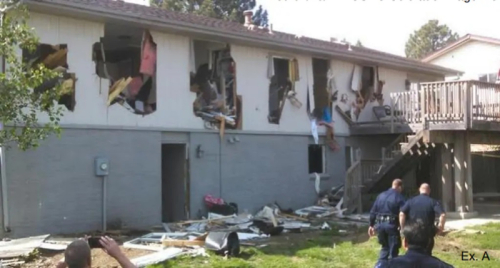
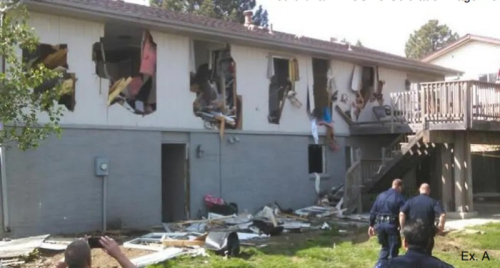
This is the case where the municipal police pretty much destroyed a family home in the course of their efforts to dislodge a shoplifter who had taken refuge there while fleeing. The homeowner sought compensation for a taking. The Tenth Circuit, however, concluded “no taking” because the police were exercising the police power. And you can’t have a taking where the government is exercising the police power, right?

The homeowner filed a cert petition, arguing that “[t]he question presented is whether there is a categorical exception to the Just Compensation Clause when the government takes property while acting pursuant to its police power.”

The city doesn’t see it that way, naturally, and it formulates the Question Presented this way:

This Court, along with lower federal and state courts, has historically and consistently distinguished between the power of eminent domain and the police power. The question presented is whether damage sustained to a third-party’s rental property caused by law enforcement’s admittedly reasonable efforts to apprehend an armed, aggressive and barricaded suspect gives rise to a compensable taking of property under the Fifth Amendment of the United States Constitution.

The reason why we think that this case has taken on even more importance, is twofold. First, the case presents the same issue as in the coronavirus takings cases (here are some of the complaints that have been filed in courts around the nation: see here, here, here, here and here). Our thoughts on the takings aspects of that issue here (“Evaluating Emergency Takings: Flattening The Economic Curve.”). This case could not be a more timely opportunity for the Court to provide guidance on whether an invocation of “police” or emergency power short-circuits the takings analysis.

Second, the ongoing protests and focus on police misconduct. While this case is not one where the police are alleged to have misbehaved, the question of whether a municipality can be held liable for just compensation when the police — in the course of an otherwise proper pursuit — destroy property for public use or benefit, is certainly highly related. If police remain immune from civil liability by the qualified immunity doctrine, perhaps the Takings Clause can serve as a check on unconstitutional municipal action?

As for the BIO’s contention that there’s no lower court divergence of opinion on this question? We think otherwise: customs agents inspect and seize your laptop at the border to check it out but destroy the data on the hard drive? no taking; DEA holds your legal prescription drugs as evidence against a third party but eventually don’t use the evidence and return it to you (but by then the drugs have expired)? no taking. But not every jurisdiction goes that way, however.

We will keep following along (Court’s e-docket here), of course. Stay tuned.  

Brief for the Respondents in Opposition, Lech v. Jackson, No. 19-1123 (June 3, 2020)
Continue Reading BIO In “Police Power” Takings Case: Can A Municipality Be Liable For A Taking If The Police Destroy Private Property In The Course Of Apprehending A Suspect?

Lech

Today, along with our colleague Bill DeVinney, we filed this amicus brief in support of the property owners’ cert petition in a case we’ve been following for a while. 

Yes, this is the case where the Village police pretty much destroyed a family home in the course of their efforts to dislodge a shoplifter who had taken refuge there while fleeing. Homeowner sought compensation for a taking. The Tenth Circuit, however, concluded “no taking” because the police were exercising the police power. And you can’t have a taking where the government is exercising the police power.

Instead of summarizing our brief, how about we just post the Summary of Argument:

This Court should review the Tenth Circuit’s holding that action taken by the government under its police power—as opposed to an exercise of eminent domain—can never trigger a taking under the Fifth Amendment’s Just Compensation Clause. This brief makes two main points.

  1. Government’s assertion that it destroyed property for a police power purpose is but one of the factors a court considers when an owner asserts the destruction resulted in a taking. Police power may be a compelling factor militating against compensation. But it should never be the sole factor, as the Tenth Circuit concluded.

  2. The brief also addresses a question that often arises after the police or other government officials damage a home—or, as in this case, nearly destroy it: why should the homeowner be able to seek just compensation for a taking when insurance is available? The short answer is that nearly all homeowners’ insurance policies exclude from coverage any loss caused by an order of a government or civil authority. A majority courts have interpreted this provision to preclude recovery for damage inflicted by the police in executing a search warrant or apprehending a fleeing suspect.

Consequently, if the Tenth Circuit’s holding stands, many homeowners who suffer losses when their homes become are occupied or damaged by the police—no doubt a public purpose—through no fault of their own will be left without any remedy for damage inflicted by police searching for evidence, apprehending suspects, or otherwise exercising the police power.

The petition presents the Court an opportunity to clarify that an invocation of “police power” is not the dispositive fact in a takings analysis. Rather, the “character of the government action” is but one of the issues to be determined, not the conclusive one as the Tenth Circuit concluded. The Court should grant review.

Now we wait. Stay tuned.

Brief of Amicus Curiae Owners’ Counsel of America in Support of Petitioners, Lech v. City of Greenwood, No…. 

Continue Reading Amicus Brief: Invocation Of “Police Power” Is Not Dispositive In Takings

Real_liberty

Here’s what we’re reading today, spurred by the headlines swirling around all of us. Mostly cases about the role of the courts when government curtails liberty or property rights under its police or emergency powers. We’ve now seen the first lawsuit claiming that an order to shut down businesses is a due process violation and is a regulatory taking requiring compensation, and we’re hearing about official quarantines, citations for people violating stay-home orders, and the like. 

We started with the vaccination cases. These got us to thinking that if the government can for the most part force people who don’t want vaccinations to get vaccinations (violating their bodily integrity), then how will a court treat seemingly less-invasive intrusions into liberty or property in the name of public health? 

In Jacobson v. Massachusetts, 197 U.S. 11 (1905), the Court distinguished “an absolute right in each person to be, at all times and in all circumstances, wholly freed from restraint,” with what it labeled “[r]eal liberty” – 

Real liberty for all could not exist under the operation of a principle which recognizes the right of each individual person to use his own, whether in respect of his person or his property, regardless of the injury that may be done to others. This court has more than once recognized it as a fundamental principle that “persons and property are subjected to all kinds of restraints and burdens, in order to secure the general comfort, health, and prosperity of the State; 

…

It is then liberty regulated by law. 

Id. at 26, 27 (footnote omitted). The Court based its reasoning on public “self-defense,” noting that “a community has the right to protect itself against an epidemic of disease which threatens the safety of its members.” Id. at 27.

In other words, that old principle that Justice Scalia referred to in Lucas as a “background principle[] of the state’s property and nuisance” law. If you can’t protect your body from being physically invaded, a court isn’t likely to conclude that you can use your property in a way that is harmful to others. And although the government’s powers cannot be exercised in “an arbitrary, unreasonable manner,” or “go so far beyond what was reasonably required for the safety of the public,” the courts won’t seriously question another branch’s conclusions. Jacobsen, 197 U.S. at 28, 

That conclusion about who gets to determine that your use of property is, in fact, harmful to others remains valid today. As we’ve seen in these cases (and in this case, too), the courts are going to be even more deferential to the authorities’ assertions that “X measure is necessary to preserving the public health” than they are in the usual circumstances. On a good day, courts are already super deferential, and we can’t imagine that the courts would be less deferential in the current situation. (Joe Hadacheck was not available for comment.) 

But what about those cases where the courts have struck down measures that were done seemingly to protect the public health, such as a quarantine to battle the bubonic plague? In Wong Wai v. Williamson, 103 F. 384 (N.D.Cal. 1900) and Jew Ho v. Williamson, 103 F. 10 (N.D.Cal. 1900), for example, the court enjoined enforcement of a San Francisco ordinance that was based on city officials’ belief “that danger does exist to the health and citizens of the city and county of San Francisco by reason of the existence of germs of the [plague] remaining in the district hereafter mentioned [Chinatown].” Jew Ho, 103 F. at 12. San Francisco supported the ordinance by referring to Mugler v. Kansas, 123 U.S. 623 (1887) and the city’s police powers. Why wasn’t that the trump card?  

The plaintiffs in those case alleged the ordinance wasn’t reasonably designed to protect the public health, but really was aimed at Chinese people. We saw this same vibe in an earlier Hawaii decision which upheld a restriction on commercial laundries in Honolulu’s Chinatown, although the racial bias argument was apparently not developed in that case. The California federal court, by contrast, considered the plaintiffs’ arguments that what looked like a public health ordinance was, in reality, racial discrimination:

The evidence here is clear that this is made to operated against the Chinese population only, and the reason given for it is that the Chinese may communicate the disease from one to the other. That explanation, in the judgment of the court, is not sufficient. It is, in effect, a discrimination, and it is the discrimination that has frequently been called to the attention of the federal courts where matter of this character have arisen with respect to Chinese.

Jew Ho, 103 F. at 23 (citing Yick Wo v. Hopkins, 118 U.S. 356 (1886)).   

Ah, but you say, a takings claim does not seek to enjoin the government action because it is unreasonable or discriminatory, but instead asks only for compensation as cost-spreading measure for an otherwise valid exercise of governmental power … what about that? 

A good exemplar of how courts will likely react to these type of arguments is the Minnesota Supreme Court’s ruling in Zeman v. City of Minneapolis, 552 N.W.2d 549 (Minn. 1996) (thanks to a learned Minneapolis colleague for sending this one our way). There, the court reversed the court of appeals’ conclusion that the city’s revocation of Zeman’s rental licenses because his property had been the subject of multiple disorderly use complaints was a Penn Central taking.

The court’s analysis is worth quoting at length:

The city argues that the ordinance at issue here is a valid exercise of municipal power to ameliorate a nuisance, namely criminal activity in a residential neighborhood. Zeman does not challenge this characterization, but points to the fact that the city erroneously employed its own ordinance. This seems to us to be irrelevant: if the ordinance indeed is a proper effort to protect the health, morals, or safety of the community which has the effect of prohibiting a particular use of a property, then there will be no taking. See Mugler, 123 U.S. at 661-62.

The first two of the Penn Central factors involve the economic impact of the regulation on the person suffering the loss and the extent to which the regulation interferes with distinct investment backed expectations. Penn Central, 438 U.S. at 124-25. Certainly, as Zeman’s witness testified, the economic impact on Zeman has been substantial; the best use for his property is as an apartment building, and without a rental dwelling license he cannot operate it as such. Moreover, rezoning of the property for another use is unlikely and, given the economically depressed nature of the neighborhood, so too would be locating a buyer. Also, as Zeman has operated this property as a rental dwelling since acquiring it in 1975, it would appear that he has some investment-backed expectations in its use as such. Thus, the first two Penn Central factors militate towards a decision in Zeman’s favor.

Consideration of the third factor, the character of the government action, however, favors the city. Under this factor, we must examine the regulation at issue, with emphasis on its purpose and the possibility of achieving that purpose with this regulation. While this is always an important consideration in a takings analysis, in cases involving a regulation aimed at the protection of the public health and safety, it becomes paramount. If the state regulation appears genuinely designed to prevent harm to the public and is likely to achieve that goal and the harm suffered by the property owner does not appear to be one that should be borne by the entire community, we will not find a taking. See, e.g., Mugler, 123 U.S. at 661-62; Keystone Bituminous Coal Ass’n v. DeBenedictis, 480 U.S. 470, 488-93 (1987).

Mugler held that a state could prohibit a use of a property that it determined to be injurious to community health, morals, or safety and, therefore, although enforcement of a statute prohibiting the manufacture of alcohol against Mugler, a beer maker, would substantially depreciate the value of his property, no taking occurred. Mugler, 123 U.S. at 656-57, 668-69. Since Mugler, the Court has upheld as valid state regulatory efforts — denying compensation for alleged takings — the destruction of infected trees jeopardizing local orchards, Miller v. Schoene, 276 U.S. 272, 279-80 (1928), the banning of brickyard plant operations in urban areas, Hadacheck v. Sebastian, 239 U.S. 394, 410-11 (1915), and strict limitations on coal mining activities, Keystone, 480 U.S. at 485.

A harm-prevention regulation, if not a ruse for a state purpose other than protecting the public from noxious harm or illegal activity, is a powerful rationale militating against finding a taking. See Bruce W. Burton, Regulatory Takings and the Shape of Things to Come: Harbingers of a Takings Clause Reconstellation, 72 Ore. L. Rev. 603, 618-19 (1993). A reviewing court must look to the nature of the regulation with an eye on its purpose and the probability of achieving that purpose with this regulation. If the regulation is drawn to prevent harm to the public, broadly defined, and seems able to achieve this goal, then a taking has not occurred. See, e.g., Keystone, 480 U.S. at 488-93.

Zeman, 552 N.W.2d at 553-54. 

We’re thinking that if the government were to physically occupy or appropriate property during a health emergency, if its measures are beyond the government’s power, or if there’s proof that the public health isn’t the real reason but is a pretext, that these situations would likely be subject to a much different analysis. See, e.g., De Keyser’s Royal Hotel, Kimball Laundry. and Youngstown Sheet and Tube, for example. But your typical regulatory takings situation is going to be an uphill climb.   

Here are our earlier posts on related issues: 

Stay tuned. 

Jacobson v Massachusetts, 197 U.S. 11 (1905) 

Continue Reading More Readings: “Real Liberty,” Vaccination, Plague, Police Power, And Takings

Front page

Here’s one for our Hawaii folks, in case you all are curious about the origins of the analytical framework which courts use to review the legality of measures taken by the authorities in the name of “public health” that have an impact on the uses of private property.  

As far as we can tell, The King v Tong Lee, 4 Haw. 335 (Kingdom 1880) (in banco), is the first Hawaii case which uses the term “police power,” and which upheld the broad – and nearly unreviewable – authority of the government to limit the uses of property, as long as there’s a colorable argument that the property’s use is contrary to the public health.

There, the Kingdom’s legislature (one of the joys of practicing law in Hawaii is that you get to deal with cases involving the Kingdom; things like Privy Council, the royal prerogative, and the like) prohibited the laundry business within a small radius of Nuuanu and King Streets in downtown Honolulu, because “the increasing number of laundries and wash-houses within the limits of the City of Honolulu tends to the propagation and dissemination of disease.”

We think we can safely conclude that this prohibition was – in whole or at least in large part – more of an anti-Chinese than a true health measure because (1) the statute only barred laundering for money (it didn’t limit large-scale private washing or the dumping of wastewater, which you would think it would do if the activity itself was truly harmful to the public’s health), and (2) did not prohibit the laundry business anywhere else on Oahu, or in the kingdom for that matter.

Then, like now, the part of town that the corner of Nuuanu and King Street conjures up in your mind is Chinatown. (We all understand the ethnic and racial geography of our town: there’s a historical reason, for example, why there’s a First Hawaiian Bank on that corner (for Chinese customers), when the main bank was just a couple of blocks down on Bishop Street (Big 5 customers.)

Tong Lee challenged the statute as a violation of the due process clause of the Hawaii Constitution (yes, the Kingdom had a written constitution). He asserted he had the right to use his property (his laundry business and his land), which this statute unreasonably deprived him of without a good reason: if public health was the real reason for this law, it was both too narrow (it didn’t prohibit all commercial laundries), and was not tailored (there was no showing that Tong Lee’s laundry was unsanitary).

The Supreme Court easily disposed of this argument:

The authority to enact a law of this character is derived from the inherent power which every sovereign State possesses to protect the life, property and health of its citizens. Says Judge Shaw, in Commonwealth vs. Alger, 7 Cushing, 84: “We think it is a well settled principle, growing out of the nature of well-ordered civil society, that every holder of property, however absolute and unqualified may be his title, holds it under the implied liability that his use of it shall not be injurious to the equal enjoyment of others having an equal right to the enjoyment of their property, nor injurious to the rights of the community. Rights of property, like all other social and conventional rights, are subject to such reasonable limitations on their enjoyment as shall prevent them from being injurious, and to such reasonable restraints and regulations established by law as the Legislature, under the governing and controlling power vested in them by the Constitution, may think necessary and expedient.”

“This is very different from the right of eminent domain; the right of a Government to take and appropriate private property whenever the public exigency requires it, which can be done only on condition of providing a reasonable compensation therefor. The power we allude to is rather the police power; the power vested in the Legislature by the Constitution to make, ordain, and establish all manner of wholesome and reasonable laws, statutes, and ordinances, either with penalties or without, not repugnant to the Constitution, as they shall judge to be for the good and welfare of the commonwealth, or the subjects of the same.”

Tong Lee, 4 Haw. at 339-40.

It doesn’t take much to see how this argument can be stretched beyond its breaking point, because nearly anything these days can be spun as a public health crisis (see, e.g., a state senator’s recent proposal that physicians should write prescriptions for housing, to address the public health crisis of homelessness). But even though challenges might come at the margins, on the whole, the courts still defer to the legislative judgment about just what constitutes a health crisis, and what uses of property might be injurious to the public health. And it all started here in Hawaii law:

Chief Justice Shaw also says in Commonwealth vs. Alger, above cited, p. 86: “Nor does the prohibition of such noxious use of property (a prohibition imposed because such use would be injurious to the public), although it may diminish the profits of the owner, make it an appropriation to a public use, so as to entitle the owner to compensation. *** If the owner of a warehouse in a cluster of other buildings could store quantities of gunpowder in it for himself and others, he might be saved the great expense of transportation. If a landlord could let his buildings for a small-pox hospital or a slaughter-house, he might obtain an increased rent. But he is restrained, not because the public have occasion to make the like use or make any use of the property, or to take any benefit or profit to themselves from it, but because it would be a noxious use, contrary to the maxim sic utere tuo ut alienum non laedas.

Id. at 341.

There’s a lot about this case that has not necessarily survived the 140 years since it was issued. The racial overtones, for example. But the police power principle is still a very strong thread, and the court’s holding remains valid today: “[t]he State, by its Legislature, possesses the right to make such laws as it deems to be wholesome, and the exercise of this power is subject to no review except by the body of society itself, except so far as these laws may be inhibited by the Constitution itself, or be repugnant to its provisions.” Id. at 342.

In other words, voting – not suing – is the usual remedy.

The King v Tong Lee, 4 Haw. 335 (Kingdom 1880) (in banco) 

Continue Reading The Royal Origins Of “Police Power” Hawaii-Style: The King v. Tong Lee (1880)

The current headlines — and a couple of inquiries from colleagues and clients — got us to thinking about government power in times of crisis and the tension between that power and property and other individual rights. 

On one hand, court decisions going back over the centuries have told us that courts are reluctant to interfere with government power that the government asserts further the public “health, safety, and welfare” (what we in the U.S. call the “police power”). But at what point do such exercises of government power require compensation to a property owner who as a consequence of the limitation on their rights suffers a loss?

So we dusted off our law books and assembled a primer of what we thought were some of the more interesting and important decisions over the centuries on the question. This is not a comprehensive list, of course, and if you think there should be others, please send them our way, and we’ll add them. 

We’ve included, where possible, links to the original opinions so you can read these unfiltered. 

  • The Case of the King’s Prerogative in Salt-peter, 12 Coke R. 13 (1606). The King’s “saltpetre men” may enter private property to obtain saltpeter to use as an ingredient in gunpowder to be used in the national defence, but they do so with limitations about how and when they do it, and “are bound to leave the Inheritance of the Subject in so good Plight as they found it[.]”
  • Gardner v. Village of Newburgh, 2 Johns. Ch. 162 (N.Y. Chancery 1816). When a municipality diverted a stream and deprived a riparian owner of his rights, the payment of compensation “is a necessary qualification accompanying the exercise of legislature power in taking private property for public uses.” 
  • “Contraband” property and the seizure of enemy property during time of war or insurrection. 
  • United States v. Pac. R.R., 120 U.S. 227 (1887). During the “late civil war,” the Union Army blew up railroad bridges “to prevent the advance of the enemy.” No compensation because the destruction of the bridges was a “military necessity.” “The destruction or injury of private property in battle, or in the bombardment of cities and towns, and in many other ways in the war, had to be borne by the sufferers alone as one of its consequences.”
  • Mugler v. Kansas, 123 U.S. 623 (1887). A law criminalizing the manufacture of liquor, adopted under the state’s police power, did not offend due process. It also wasn’t a taking requiring compensation because losses in property’s value by virtue of its restrictions for the public health, safety, or welfare is merely an “incidental inconvenience[.]” 
  • Hadacheck v. Sebastian, 239 U.S. 394 (1915). Prohibiting the operation of existing brickyards in some but not all parts of a city is not a due process violation. In “the absence of a clear showing” of improper purpose, the courts “must accord good faith” to the government’s claim it barred brickyards as a police power measure.  
  • Attorney-General v. De Keyser’s Royal Hotel, Ltd. [1920] AC 508. In series of separate opinions the House of Lords concluded that the Crown may not seize possession of property “in connection with the defence of the realm” (there, a hotel to house RAF officers) without paying compensation for their use and occupation.  
  • Miller v. Schoene, 276 U.S. 272 (1929). The state ordering the destruction without compensation of otherwise un-threatened cedar trees because they served as a “host plant” to a disease harmful to nearby apple trees is a valid exercise of the government’s police power. Courts should not question too hard the government’s assertion that the action was needed.  
  • The Steel Seizure Case (Youngstown Sheet and Tube Co. v. Sawyer, 343 U.S. 579 (1952)). The President’s order to seize steel mills during the Korean War to prevent a strike is limited by the Constitution. The executive’s power even during emergencies is limited by the legislature’s authority. 
  • Armstrong v. United States, 364 U.S. 40 (1960). The case that gave rise to the famous quote about the cost-distribution purpose of the Just Compensation Clause: “The Fifth Amendment’s guarantee that private property shall not be taken for a public use without just compensation was designed to bar Government from forcing some people alone to bear public burdens which, in all fairness and justice, should be borne by the public as a whole.” The feds had rendered invalid state law materielmen’s liens on boats being built for the federal government. Held: compensation required. 
  • National Bd of YMCA v. United States, 395 U.S. 85 (1969). The government doesn’t need to pay compensation when rioters destroyed a building being occupied by soldiers during the riots. The destruction can be blamed on the rioters, and the Army was trying to defend the property, albeit unsuccessfully. Although the government is “ordinarily” liable when it occupies property, in the “unusual circumstances” here, it was the riots and the rioters that deprived the owner of the building’s use. 

The overall “vibe” we take away from all of this:

1.  Under “rational basis” review, modern courts are reluctant — even in the absence of crisis — to second-guess the government’s assertion that even a total restriction on someone’s property rights can be halted. 

2.  When faced with an assertion that there are “unusual circumstances” afoot, the courts become even more reluctant. 

3.  Whether compensation (and not an injunction) should be provided for an exercise of the police power is a separate question, and in the absence of an emergency or a claim that someone’s use of their property is harmful to others, the courts may enforce the requirement to pay (see Lucas, Penn Central, and Mahon). 

4.  But when there’s a claim of an emergency, crisis, that you are using your property in a way harmful to others (a conclusion the courts will generally defer to government’s judgment about), or what we might call an extreme need for the police power, courts will not require compensation. 

The bottom line as we view it is that the search for principles often goes out the window in times of calamity. Not just in takings law, but generally. Denial of compensation and the rejection of the Armstrong principle might not be theoretically sound if someone is being forced to suffer for the good of the public. But much of the time it simply is. 

And here’s what our fellow property lawyers are thinking about this topic:

Continue Reading Emergencies, Police Power, Commandeering, And Compensation: Essential Readings

EX A

Here’s the cert petition that we’ve been eagerly waiting to drop in a case we’ve been following (and which gathered a lot of public — and academic — attention and outrage). 

Yes, this is the case where the Village police pretty much destroyed a family home in the course of their efforts to dislodge a shoplifter who had taken refuge there while fleeing. Homeowner sought compensation for a taking. The Tenth Circuit, however, concluded “no taking” because the police were exercising the police power. And you can’t have a taking where the government is exercising the police power.

We were not terribly surprised by the ruling as grossly unfair as it is, because it is pretty typical: customs agents inspect and seize your laptop at the border to check it out but destroy the data on the hard drive? no taking; DEA holds your legal prescription drugs as evidence against a third party but eventually don’t use the evidence and return it to you (but by then the drugs have expired)? no taking. But not every jurisdiction goes that way, however.

The Institute for Justice has taken up the case, and the petition poses this Question Presented: 

Using explosives and a battering ram attached to an armored personnel carrier, the Greenwood Village Police Department intentionally destroyed Petitioners’ house. Afterwards, they offered the family $5,000 “to help with temporary living expenses.” The family sued, arguing that they were entitled to Just Compensation under the Fifth Amendment for the intentional destruction of their house. The Tenth Circuit, however, held that no compensation was due because the home was destroyed pursuant to the police power rather than the power of eminent domain.

The question presented is whether there is a categorical exception to the Just Compensation Clause when the government takes property while acting pursuant to its police power.

We’ve always thought that basing a “no compensation” rule on the distinction between what power the government is exercising doesn’t make a lot of sense, especially in an inverse claim such as this where yeah, we all know the government isn’t exercising its eminent domain power. Because isn’t the basis of the “takings” doctrine that even where government isn’t formally taking property by eminent domain, it can still be liable for compensation, when it has in fact done so for public use? We think that there are better ways to look at the question on false distinctions about what power the government is exercising (it’s all government power, man). 

This petition squarely presents the question, so we shall continue to follow along. 

Petition for a Writ of Certiorari, Lech v. City of Greenwood Village, No. 19-___ (filed Mar. 11, 2020)

Continue Reading New IJ Cert Petition: Purposely Destroying Your House Could Be A Taking, Even If Govt Was Exercising Its Police Power

20160325_125208

A nondescript corner of what could be just about any urban city street in America. Nothing of overwhelming interest, just the usual commercial buildings, traffic signals, and small businesses. A self-storage facility. Pretty typical in a Commercial district. Here, the “C-4 District.”

Nothing at all, in fact, to indicate that just over a century ago, this was the site of what was to become one of the most important land use cases in U.S. history — the place that gave us the first Supreme Court decision that dealt with how the expanding power to regulate the uses of property meshes with private property rights.

DSCF2746

For this area — the block southeast of the corner of Pico and Crenshaw Boulevards — was once a Los Angeles brickyard owned by Joseph C. Hadacheck.  

What is now the Arlington Heights neighborhood was once outside of the city limits. Indeed, Hadacheck’s title went back to the original Mexican land grant — as most Central and Southern California land titles do — to a former alcalde of the Los Angeles Pueblo. This parcel was originally a part of the massive Rancho Los Cienegas.

20160325_124213

Eventually the rancho was subdivided and parceled off, and Hadacheck, according to the U.S. Supreme Court’s opinion, purchased the parcel in 1902 because the clay deposits made it an ideal place to manufacture the bricks needed for the rapidly expanding metropolis. California, you see, “did not have great paving brick manufacturers like other states mainly because of the scarcity of good vitrified clay deposits.” This property was prime: as the Court noted, the “clay upon his property is particularly fine, and clay of as good quality cannot be found in any other place within the city where the same can be utilized for the manufacture of brick.” 

Today’s Bronson Avenue (pictured below) was then the driveway entrance to Hadacheck’s property.  

20160325_124438

Brickmaking, as you might expect, was a messy affair, involving large hole in the ground to dig out the clay, and fire-stoked drying kilns. When Hadacheck’s manufacturing plant was far from the city, the noise, dust, and smoke it produced was not a big problem. 

But Los Angeles was growing, and in 1909, the Hadacheck property was annexed by the city, and became subject to its jurisdiction. The surrounding land — the site of at least one other brickyard — came into the sights of the land speculators and developers. In the mid-aughts, the nearby area was developed as single-family homes. Some of these homes were, and remain today, pretty nice. Mostly arts-and-crafts style, if that sort of thing floats your boat. 

One of these developments — developed by “a syndicate of a dozen prominent business men” was an area they labeled “Victoria Park.” Had a nice ring to it, and today, the area is still called Victoria Park. 

20160326_124308

They built the homes around an oval street. One of the only two oval streets in LA. Even today. 

20160326_124538
They also apparently planted palm trees on that street. Lots of palm trees. 

20160326_124538

Tony residences nearby a noisy, smoke-and-dust-belching industrial site. Victoria Park, you see, is just a few blocks from the Hadacheck site and even closer to another brickyard, Hubbard & Chamberlain. The photo below shows how close. The Hadacheck site at the corner of Pico and Crenshaw was where the Bekins building and sign is, and the Hubbard brickyard was right across the street. 

20160326_124232

You land users can predict what this meant: a conflict between an existing possibly noxious use, and late-coming residents (whom today we might label “NIMBY’s.”). This might have resulted in a your run-of-the-mill tort nuisance case, with a claim by the residential owners that Hadacheck’s use of his property interfered with theirs, and a defense by him that he was there first, and thus they “came to the nuisance.” 

But it didn’t play out that way. As the U.S. Supreme Court noted in Hadacheck v. Sebastian, 239 U.S. 394 (1915), the City Council of Los Angeles, over the veto of Mayor George Alexander, used its police powers to adopt an ordinance prohibiting brickyards in “certain districts.” And when referring to “certain districts” the Council pretty much meant this area. Because the only two brickyards subject to this ordinance were Hadacheck’s and the other brickyard, Hubbard & Chaimberlain, located directly across Pico from the entrance to Victoria Park.  

Remember that “syndicate of a dozen prominent business men” who developed Victoria Park, whose residents were now overwhelmed by the nearby brickyards? One of those “business men” was none other than Josias J. Andrews, who just so happened to be a member of the Los Angeles City Council, and who chaired the Council’s Legislative Committee.

DSCF2746

According to The History of California and an Extended History of Los Angeles and Environs (1915), Mr. Andrews: 

… is a Progressive and he is altogether progressive in profession and practice in the broadest sense of the word. He was twice elected to the city council and during the time of his service was active in procuring the passage of various progressive measures. He was a strenuous advocate of the law which later as incorporated in the city charter limiting the height of new buildings, and was instrumental in having it passed.

Brickyards in other parts of LA where Councilmember Andrews didn’t have investments were not subject to similar ordinances, and even where there were conflicts with residences, existing brickyards were given several years to wind down. 

But not in this case. The ordinance made it a crime to continue to operate, and apparently Mr. Hadacheck tried to do other things with his land: he obtained a building permit for a two-story residential building on Pico, and there’s evidence he allowed the use of the clay pit as a dump site. But apparently, he kept up the brickmaking, because he was charged with a misdemeanor and convicted under the ordinance and was remanded to the custody of the LA police chief. 

You know the rest of the story: he brought a habeas corpus action challenging the constitutionality of his confinement, arguing that the regulations severely devalued his property (he argued that before the regulations, the property was worth $800,000, but after, only $60,000), and that he was being singled out. He also argued the land was not really useful for anything but brick manufacturing (a claim belied by the future uses of the site as single-family homes), as shown here, along Bronson Avenue:

20160325_123709
20160325_123800

These aren’t homes of the Victoria Park standard, mind you, but still pretty nice.  

Even though the courts accepted Hadacheck’s argument that he was not creating a nuisance, he lost in the California Supreme Court, and eventually in the U.S. Supreme Court, which held that it didn’t matter that the brickyard wasn’t a common-law nuisance, because the city could exercise its police power to prohibit uses, even where those uses predated the regulation:

It may be that brickyards in other localities within the city where the same conditions exist are not regulated or prohibited, but it does not follow that they will not be. That petitioner’s business was first in time to be prohibited does not make its prohibition unlawful. And it may be, as said by the supreme court of the state, that the conditions justify a distinction. However, the inquiries thus suggested are outside of our province.

There are other and subsidiary contentions which, we think, do not require discussion. They are disposed of by what we have said. It may be that something else than prohibition would have satisfied the conditions. Of this, however, we have no means of determining, and besides, we cannot declare invalid the exertion of a power which the city undoubtedly has because of a charge that it does not exactly accommodate the conditions, or that some other exercise would have been better or less harsh. We must accord good faith to the city in the absence of a clear showing to the contrary and an honest exercise of judgment upon the circumstances which induced its action.

Hadacheck, 239 U.S. at 413-14.  

DSCF2752

The rest, as they say, is history: the Hadacheck decision became the foundation on which the constitutionality of all zoning law is built, and today, we still have yet to resolve completely the tension between the police power to regulate property, and the rights of private property owners. 

And what of Mr. Hadacheck? After he lost his brickyard business, what became of him? We don’t exactly know, for certain. But we do know that in a nearby cemetery, there’s a grave for one “J.C. Hadacheck,” who died in 1916 at the young age of 48, less then seven months after the Court issued its opinion.

DSCF2746

Is this the same “J.C. Hadacheck” who petitioned the Supreme Court? We’re not sure, but we wouldn’t be surprised. Not knowing for sure, our imagination wanders to a fanciful story where Mr. Hadacheck, having been played by the City Council, the NIMBY’s, and the courts, simply gave up the ghost after realizing that even though he made the bricks that built the city, his usefulness, and his time, had passed. 

Continue Reading Takings Pilgrimage, LA Edition: Police Power, The Zoning Game, And Nuisances

Here’s another one of those police power vs. takings cases, again involving governmental liability for destroying property supposedly in order to save it. We think the Alaska Supreme Court’s decision in Brewer v. Alaska, No. 14-916 (Nov. 28, 2014) got the analysis right, and properly shifted the focus in these cases from the government’s police power reasons for taking the actions which it did, to whether those actions were within the scope of the necessity doctrine.

Like others, Brewer involved landowners suing the government for setting fires on their land to stop or prevent wildfires (such as this case from the Federal Circuit). In Brewer, the land was designated for “aggressive initial attack” in the event of a fire. In 2009, the “Railbelt Complex” wildfire approached the properties, at which point, the state set fire to vegetation around the owners’ homes to deprive the fire of fuel. When the wildfire passed through the area, the homes were not damaged. 

The property owners sued, alleging both tort and takings theories, alleging that the “the State made no attempt to minimize or suppress the wildfires, instead opting to burn ‘as much wildland forest as possible,’ impliedly for purposes of ‘fuels management.’ The landowners offered affidavits alleging that the State conducted the burnouts even though there was no ‘imminent threat of fire damage’ to their properties and the State could have ‘undertaken . . . the damaging fire suppression activities on bordering State-owned lands’ instead.” Slip op. at 4. The trial court entered summary judgment for the state, and regarding the claim on which we are focused — the takings claim — held that the state’s burning of the owner’s vegetation could not be a taking because it was a valid exercise of the police power.

The Supreme Court reversed, and sent the case back for trial, concluding that although the state acted within the lawful exercise of its police powers because the state’s entry onto private land to set the backfires was authorized by state statutes, and the benefit of preventing or limiting wildfires “is of benefit to the public as a whole regardless of whether only individual landowners are immediately benefitted.” Slip op. at 8. The court, relying on the U.S. Supreme Court’s rationale in Midkiff (“[i]t is not essential that the entire community, nor even any considerable portion, …. directly enjoy or participate in any improvement in order [for it] to constitute a public use”) rejected the state’s alternative argument that the backfires were for private benefit only because they were designed to protect the plaintiffs’ homes. Id.  

The court expressly rejected the “intended beneficiary” test under the Fifth Amendment, set out in National Bd. of YMCA v. United States, 395 U. S. 85, 93 (1969), under which the use by the government of private property is not public if a “private party is the particular intended beneficiary of the governmental activity.” The Alaska court held that the Alaska Constitution’s takings clause provides broader protection to landowners, and “[w]e do not believe that YMCA‘s ‘intended beneficiary’ test adequately reflects the broad protections of Alaska’s Takings Clause.” Slip op. at 12. 

The court also split from other courts that hold that a valid exercise of the police power is an absolute defense to a taking. See, for example, this case,  this case and this case. Contrary to those cases, the Alaska court undertook what we think is a more defensible approach to the issue, concluding “we decline to hold that every valid exercise of the police power is justififed by the doctrine of necessity and results in a noncompensable taking.” Slip op. at 13. In other words, the government’s mere invocation of the police power is not a blanket defense to a takings claim, at least under Alaska law. 

But the converse also holds true, and agreeing with the Federal Circuit’s decision in TrinCo Investment Co. v. United States, 722 F.3d 1375 (Fed. Cir. 2013), the court held:  

We agree with the analysis in TrinCo. Here, the superior court considered only whether the State’s actions were taken within the context of its general police power. But a taking of private property does not escape application of the Takings Clause simply because it occurs in the course of the State’s firefighting activities; to be noncompensable, the taking must be justified by the doctrine of necessity. The doctrine applies only if the State demonstrates the existence of “imminent danger and an actual emergency giving rise to actual necessity,” an inquiry that is fact-specific.

Slip op. at 20-21 (footnote omitted). Because “[t]he facts of this case may support applying the doctrine of necessity,” slip op. at 21, but the trial court had not allowed evidence on that issue, i.e., whether the government had chosen the “lesser of two evils,” the supreme court sent the case back down for more. 

Finally, the court affirmed the dismissal of the tort claims, since the state has statutory immunity. See slip op. at 22-28.

More on the case here, from a local newspaper. 

Overall, we think this is a well-thought-out and written opinion, and one that’s worth your time to read in toto. Yes, there are 88 footnotes in a 29 page opinion, but that’s only because all of the citations have been removed from the text, making the opinion visually appealing and easy to read. Bryan Garner would be proud. 

Brewer v. Alaska, No. 14-916 (Alaska Nov. 28, 2014)

Continue Reading Alaska: Police Power Not A Blanket Exception To Takings Liability – State May Be Liable For Backfires

http://msnbcmedia.msn.com/j/MSNBC/Components/Photo/_new/g-cvr-130318-bloomberg-1130a.photoblog600.jpg

Next Thursday, February 6, 2014, we’ll be in Chicago to moderate an American Bar Association discussion/debate on a topic that’s not our usual takings-eminent domain-land use stuff, but is still one of the hotter topics around. “They’ll Take My Big Gulp From My Cold Dead Hands” is an hour-and-a-half with three experts in “Public Health, the Police Power, and the Nanny State,” to quote our subtitle. (Yes, we realize that New York City’s ban actually exempted Big Gulps® but hey, it’s a catchy title.)

Joining me for the discussion:

  • Walter Olson, Senior Fellow at the Cato Institute’s Center for Constitutional Studies. While his list of accomplishments is long, we lawyers perhaps love him best for his “Overlawyered” blog. 
  • Sarah Conly, Professor of Philosophy at Bowdoin College. Author of “Against Autonomy:  Justifying Coercive Paternalism,” forthcoming from Cambridge University Press.
  • Alderman George Cardenas, who represents the City of Chicago’s 12th Ward. Among other issues, Alderman Cardenas has proposed raising the smoking age to 21, and to tax sugary drinks. 

Here’s the description of the program:

A moderated panel discussion of the issues raised by New York City’s attempt to regulate the portion size of sugary drinks, and similar measures around the country. Advocates from both sides of the issue will present their rationales, and legal scholars and media commentators will provide the larger picture. The panelists will be comparing various state and federal approaches with the common question: what limits on personal choice can be adopted in the name of public health, the environment, and the traditional police powers exercised by governments? How do these measures work with a federal system where local regulation may conflict with state and federal laws, or at the very least may conflict—at least philosophically—with subsidies to sugar and corn producers, and protective tariffs?

More information about this CLE session (and the others the State and Local Government Section is sponsoring) here. Register for the Midyear here.

If you are coming to balmy Chicago next week, please be sure to join us. It promises to be an informative, lively, and timely session. If you can’t make it, we are capturing the program on audio, and will have a follow-up teleconference. 

ABA State and Local Govt Law Section Midyear 2014 Agenda (Chicago) 

Continue Reading Upcoming Program: “They’ll Take My Big Gulp From My Cold, Dead Hands – Public Health, the Police Power, and the Nanny State”

In a case that was probably doomed from the start because of an earlier precedential ruling, the Federal Circuit concluded that the government’s temporary seizure of the plaintiff’s computer “for review” at a border stop and the subsequent destruction of the computer hard drive and resulting loss of data was not a taking because the seizure was an exercise of the government’s power to control the border.

We’ve been down the road of Kam-Almaz v. United States, No. 2011-5059 (June 30, 2012) before, in AmeriSource, for example, where the government seized the plaintiff’s property as evidence in order to prosecute a third party, and by the time the government returned the property to its owner, it was worthless. In Kam-Almaz, the ICE agents took the laptop because Kam-Almaz was a “person of interest,” promising to return it shortly. However, during the time ICE had it, the hard drive failed. On the hard drive were Kam-Almaz’s business files, which were irretrievably gone. He sued for breach of contract and for a taking.

The Federal Circuit held that a seizure for “law enforcement purposes” implicated only the “character of the government action” prong of the Penn Central test, and because ICE has the power to enforce the border, the seizure could not be a taking:

As we have noted, “[a]lthough the precise contours of the principle are difficult to discern, it is clear that the police power en-compasses the government’s ability to seize and retain property to be used as evidence in a criminal prosecution.” AmeriSource, 525 F.3d at 1153.

Slip op. at 14. As we’ve noted before, this rationale does indeed lack “precise contours” because it makes little analytical sense, even if it might make for the right result. Saying that a seizure isn’t an inverse condemnation because it was not an exercise of eminent domain power gets you nowhere because inverse condemnation is, by definition, a taking that results from an exercise of some power other than the power of eminent domain. We think there are other ways to approach this that do not do violence to that basic principle.

Here are the takeaways from the opinion:

  • Back up your computer files. We all know this and we rarely do it, but here’s an object lesson in mission-critical data: be redundant. If your laptop is the one place that you have this stuff, pain is eventually coming your way, whether its by government seizure, theft, or just plain bad luck.
  • The courts still have not figured out how to reconcile the inverse condemnation theory (a justified exercise of some government power other than the power of eminent domain triggers the Fifth Amendment’s requirement to pay compensation) with the idea that some seizures just don’t seem like they should be compensable. The Federal Circuit, however, seems bound to the idea that if a seizure is under the police power, it can’t be a taking (the Seventh, as noted above, is also in this camp). We’re holding out for another circuit or two to see the light, and then for this issue to go up to the Supreme Court. 
  • It’s tough to make out an implied contract claim with the federal government (the court also rejected Kam-Almaz’s claim that a promise by the ICE agent to return his hard drive in seven days was an enforceable implied bailment contract).

    Kam-Almaz v. United States, No. 2011-5059 (Fed. Cir. June 20, 2012)

    Continue Reading Federal Circuit: Taking As A Result Of Police Power Isn’t A Taking