20160325_125208

A nondescript corner of what could be just about any urban city street in America. Nothing of overwhelming interest, just the usual commercial buildings, traffic signals, and small businesses. A self-storage facility. Pretty typical in a Commercial district. Here, the “C-4 District.”

Nothing at all, in fact, to indicate that just over a century ago, this was the site of what was to become one of the most important land use cases in U.S. history — the place that gave us the first Supreme Court decision that dealt with how the expanding power to regulate the uses of property meshes with private property rights.

DSCF2746

For this area — the block southeast of the corner of Pico and Crenshaw Boulevards — was once a Los Angeles brickyard owned by Joseph C. Hadacheck.  

What is now the Arlington Heights neighborhood was once outside of the city limits. Indeed, Hadacheck’s title went back to the original Mexican land grant — as most Central and Southern California land titles do — to a former alcalde of the Los Angeles Pueblo. This parcel was originally a part of the massive Rancho Los Cienegas.

20160325_124213

Eventually the rancho was subdivided and parceled off, and Hadacheck, according to the U.S. Supreme Court’s opinion, purchased the parcel in 1902 because the clay deposits made it an ideal place to manufacture the bricks needed for the rapidly expanding metropolis. California, you see, “did not have great paving brick manufacturers like other states mainly because of the scarcity of good vitrified clay deposits.” This property was prime: as the Court noted, the “clay upon his property is particularly fine, and clay of as good quality cannot be found in any other place within the city where the same can be utilized for the manufacture of brick.” 

Today’s Bronson Avenue (pictured below) was then the driveway entrance to Hadacheck’s property.  

20160325_124438

Brickmaking, as you might expect, was a messy affair, involving large hole in the ground to dig out the clay, and fire-stoked drying kilns. When Hadacheck’s manufacturing plant was far from the city, the noise, dust, and smoke it produced was not a big problem. 

But Los Angeles was growing, and in 1909, the Hadacheck property was annexed by the city, and became subject to its jurisdiction. The surrounding land — the site of at least one other brickyard — came into the sights of the land speculators and developers. In the mid-aughts, the nearby area was developed as single-family homes. Some of these homes were, and remain today, pretty nice. Mostly arts-and-crafts style, if that sort of thing floats your boat. 

One of these developments — developed by “a syndicate of a dozen prominent business men” was an area they labeled “Victoria Park.” Had a nice ring to it, and today, the area is still called Victoria Park. 

20160326_124308

They built the homes around an oval street. One of the only two oval streets in LA. Even today. 

20160326_124538
They also apparently planted palm trees on that street. Lots of palm trees. 

20160326_124538

Tony residences nearby a noisy, smoke-and-dust-belching industrial site. Victoria Park, you see, is just a few blocks from the Hadacheck site and even closer to another brickyard, Hubbard & Chamberlain. The photo below shows how close. The Hadacheck site at the corner of Pico and Crenshaw was where the Bekins building and sign is, and the Hubbard brickyard was right across the street. 

20160326_124232

You land users can predict what this meant: a conflict between an existing possibly noxious use, and late-coming residents (whom today we might label “NIMBY’s.”). This might have resulted in a your run-of-the-mill tort nuisance case, with a claim by the residential owners that Hadacheck’s use of his property interfered with theirs, and a defense by him that he was there first, and thus they “came to the nuisance.” 

But it didn’t play out that way. As the U.S. Supreme Court noted in Hadacheck v. Sebastian, 239 U.S. 394 (1915), the City Council of Los Angeles, over the veto of Mayor George Alexander, used its police powers to adopt an ordinance prohibiting brickyards in “certain districts.” And when referring to “certain districts” the Council pretty much meant this area. Because the only two brickyards subject to this ordinance were Hadacheck’s and the other brickyard, Hubbard & Chaimberlain, located directly across Pico from the entrance to Victoria Park.  

Remember that “syndicate of a dozen prominent business men” who developed Victoria Park, whose residents were now overwhelmed by the nearby brickyards? One of those “business men” was none other than Josias J. Andrews, who just so happened to be a member of the Los Angeles City Council, and who chaired the Council’s Legislative Committee.

DSCF2746

According to The History of California and an Extended History of Los Angeles and Environs (1915), Mr. Andrews: 

… is a Progressive and he is altogether progressive in profession and practice in the broadest sense of the word. He was twice elected to the city council and during the time of his service was active in procuring the passage of various progressive measures. He was a strenuous advocate of the law which later as incorporated in the city charter limiting the height of new buildings, and was instrumental in having it passed.

Brickyards in other parts of LA where Councilmember Andrews didn’t have investments were not subject to similar ordinances, and even where there were conflicts with residences, existing brickyards were given several years to wind down. 

But not in this case. The ordinance made it a crime to continue to operate, and apparently Mr. Hadacheck tried to do other things with his land: he obtained a building permit for a two-story residential building on Pico, and there’s evidence he allowed the use of the clay pit as a dump site. But apparently, he kept up the brickmaking, because he was charged with a misdemeanor and convicted under the ordinance and was remanded to the custody of the LA police chief. 

You know the rest of the story: he brought a habeas corpus action challenging the constitutionality of his confinement, arguing that the regulations severely devalued his property (he argued that before the regulations, the property was worth $800,000, but after, only $60,000), and that he was being singled out. He also argued the land was not really useful for anything but brick manufacturing (a claim belied by the future uses of the site as single-family homes), as shown here, along Bronson Avenue:

20160325_123709
20160325_123800

These aren’t homes of the Victoria Park standard, mind you, but still pretty nice.  

Even though the courts accepted Hadacheck’s argument that he was not creating a nuisance, he lost in the California Supreme Court, and eventually in the U.S. Supreme Court, which held that it didn’t matter that the brickyard wasn’t a common-law nuisance, because the city could exercise its police power to prohibit uses, even where those uses predated the regulation:

It may be that brickyards in other localities within the city where the same conditions exist are not regulated or prohibited, but it does not follow that they will not be. That petitioner’s business was first in time to be prohibited does not make its prohibition unlawful. And it may be, as said by the supreme court of the state, that the conditions justify a distinction. However, the inquiries thus suggested are outside of our province.

There are other and subsidiary contentions which, we think, do not require discussion. They are disposed of by what we have said. It may be that something else than prohibition would have satisfied the conditions. Of this, however, we have no means of determining, and besides, we cannot declare invalid the exertion of a power which the city undoubtedly has because of a charge that it does not exactly accommodate the conditions, or that some other exercise would have been better or less harsh. We must accord good faith to the city in the absence of a clear showing to the contrary and an honest exercise of judgment upon the circumstances which induced its action.

Hadacheck, 239 U.S. at 413-14.  

DSCF2752

The rest, as they say, is history: the Hadacheck decision became the foundation on which the constitutionality of all zoning law is built, and today, we still have yet to resolve completely the tension between the police power to regulate property, and the rights of private property owners. 

And what of Mr. Hadacheck? After he lost his brickyard business, what became of him? We don’t exactly know, for certain. But we do know that in a nearby cemetery, there’s a grave for one “J.C. Hadacheck,” who died in 1916 at the young age of 48, less then seven months after the Court issued its opinion.

DSCF2746

Is this the same “J.C. Hadacheck” who petitioned the Supreme Court? We’re not sure, but we wouldn’t be surprised. Not knowing for sure, our imagination wanders to a fanciful story where Mr. Hadacheck, having been played by the City Council, the NIMBY’s, and the courts, simply gave up the ghost after realizing that even though he made the bricks that built the city, his usefulness, and his time, had passed. 

Continue Reading Takings Pilgrimage, LA Edition: Police Power, The Zoning Game, And Nuisances

IMG_0459

The Nollans own a beachfront lot in Ventura County, California. A quarter-mile north of their property is Faria County Park, an oceanside public park with a public beach and recreation area. Another public beach area, known locally as “the Cove,” lies 1,800 feet south of their lot. A concrete seawall approximately eight feet high separates the beach portion of the Nollans’ property from the rest of the lot. The historic mean high tide line determines the lot’s oceanside boundary.

Nollan v. California Coastal Comm’n, 483 U.S. 825 (1987)

From time-to-time, and when we’re in the neighborhood, we like to drop by the sites of familiar (and famous) takings and land use cases. Like Kaiser Aetna (in our own backyard), Dolan, and PruneYard. We’ve been there, done that. 

So there we were in Central California (Ventura County to be exact), and we’re driving up the coastal highway when around the bend comes the site of the Nollan case, the one where the California Coastal Commission tried to condition permission for Mr. Nollan to build a second story on his dream house on his giving the public access across the beach in front of his house (“makai,” as we in Hawaii say).

So here you go, some photos of the lot, the beach, the other areas described in Justice Scalia’s opinion, and the view from the road. These should give you a sense of what the case was about, and why it came out the way it did.

And yes, we snapped the beachside photos by only temporarily “physically occupying” the private beach, but we do recognize the gravity of our trespass. See 483 U.S. at 823 (We think a “permanent physical occupation” has occurred, for purposes of that rule, where individuals are given a permanent and continuous right to pass to and fro, so that the real property may continuously be traversed, even though no particular individual is permitted to station himself permanently upon the premises.”).

20160310_164832
A panorama from the ocean side, with “the Cove” on the right,
which shows the seawall and beach.

These effects of construction of the house, along with other area development, would cumulatively ‘burden the public’s ability to traverse to and along the shorefront.’ Therefore the Commission could properly require the Nollans to offset that burden by providing additional lateral access to the public beaches in the form of an easement across their property. 

20160310_160612

And one from the road side of the lot, showing the neighboring houses,
and how the houses generally obstruct views from the road to the beach.

On remand, the Commission held a public hearing, after which it made further factual findings and reaffirmed its imposition of the condition. It found that the new house would increase blockage of the view of the ocean, thus contributing to the development of “a ‘wall’ of residential structures” that would prevent the public “psychologically . . . from realizing a stretch of coastline exists nearby that they have every right to visit.”

20160310_160000

Looking east from the coastal road towards the nearby hills.
The main highway (U.S. 101) is behind that stand of palm trees. 

The Commission argues that a permit condition that serves the same legitimate police power purpose as a refusal to issue the permit should not be found to be a taking if the refusal to issue the permit would not constitute a taking. We agree. Thus, if the Commission attached to the permit some condition that would have protected the public’s ability to see the beach notwithstanding construction of the new house — for example, a height limitation, a width restriction, or a ban on fences — so long as the Commission could have exercised its police power (as we have assumed it could) to forbid construction of the house altogether, imposition of the condition would also be constitutional. Moreover (and here we come closer to the facts of the present case), the condition would be constitutional even if it consisted of the requirement that the Nollans provide a viewing spot on their property for passersby with whose sighting of the ocean their new house would interfere.

20160310_160133
Space for a viewing platform, anyone?

JUSTICE BRENNAN argues that imposition of the access requirement is not irrational. In his version of the Commission’s argument, the reason for the requirement is that, in its absence, a person looking toward the beach from the road will see a street of residential structures, including the Nollans’ new home, and conclude that there is no public beach nearby. If, however, that person sees people passing and repassing along the dry sand behind the Nollans’ home, he will realize that there is a public beach somewhere in the vicinity. Post at 849-850. The Commission’s action, however, was based on the opposite factual finding that the wall of houses completely blocked the view of the beach, and that a person looking from the road would not be able to see it at all. 

20160310_165243_Richtone(HDR)

“Lateral access”

20160310_170005

“The Cove” (south of the lot)

20160310_161930(1)

Faria County Park, “a quarter-mile north of their property”

IMG_0374

Small town.  

The Commission also noted that it had similarly conditioned 43 out of 60 coastal development permits along the same tract of land, and that, of the 17 not so conditioned, 14 had been approved when the Commission did not have administrative regulations in place allowing imposition of the condition, and the remaining 3 had not involved shorefront property. 

Continue Reading Another Takings Pilgrimage (Unconstitutional Conditions Technically, But Close Enough)

PICT0408
Last week, after we concluded the spring meeting of the ABA’s Section on State and Local Government Law in Portland, Oregon (more about that in a subsequent post), we could not resist paying a brief visit to the neighboring City of Tigard.

Yes, that City of Tigard.

In the early 1990s, the city was home to John and Florence Dolan, who owned A-Boy Plumbing & Electrical Supply. They asked the city for a permit to expand their store and pave their parking lot. The city saw this as an opportunity to expand its network of bike paths, and conditioned its approvals on the Dolans “dedicating” (giving) the city land for a public “greenway” along the adjacent Fanno Creek, totaling approximately 10% of the parcel.

PICT0407

            The entrance to the “greenway” from the street.

The Dolans objected, arguing that requiring them to donate land as a condition of land use entitlements was a taking, but the Oregon Land Use Appeals Board and the Oregon state courts predictably upheld the exaction, concluding there was an “essential nexus” between the dedication requirement and the Dolans’ proposed new uses under Nollan v. California Coastal Comm’n, 483 U.S. 825 (1987). 

The U.S. Supreme Court reversed, and held that in addition to a “nexus” between the exaction and the proposed development, there must be “rough proportionality” as well. “No precise mathematical calculation is required, but the city must make some sort of individualized determination that the required dedication is related both in nature and extent to the proposed development’s impact.”

PICT0380

                                        Fanno Creek

Because the city had not made that determination, the exaction violated the Fifth Amendment. 

Read the opinion at Dolan v. City of Tigard, 512 U.S. 687 (1994), and listen to the oral arguments here. The case was remanded, and the city on reconsideration in light of the Supreme Court opinion again imposed the exaction.

The Dolans sued in state court for compensation, and that case settled in 1998, nearly four years after the Supreme Court issued its opinion. The city agreed to pay Mrs. Dolan $1.4 million (Mr. Dolan passed away before the final resolution). As part of the settlement, the city also agreed to pay her attorneys fees, and install a commemorative plaque on the land she dedicated for the “greenway.”

PICT0394

       The greenway entrance and the commemorative plaque

Since that time the “Nollan/Dolan” essential nexus and rough proportionality standard has become a term of art to dirt lawyers and land use planners, shorthand for the requirements that must be followed when a local government attempts to condition land use approvals on the dedication of land or other property. 

PICT0397

                                      View to the street

We’ve gone on pilgrimages before to visit the sites of regulatory takings cases, but this one felt a bit different because the site is so modest. The area along the back side of the hardware store is not by itself noteworthy, and if you didn’t realize the backstory of the plaque you would never know that this small slice of land was the inspiration for one of the more important Fifth Amendment opinions issued by the Court.

PICT0421

The creek, the store, and the greenway from the street bridge

Continue Reading Regulatory Takings Pilgrimage, Part II

People often ask us “what is the difference between a ‘lawyer’ and an ‘attorney?'” (with the cheeky answer being “about $400 bucks per hour”).

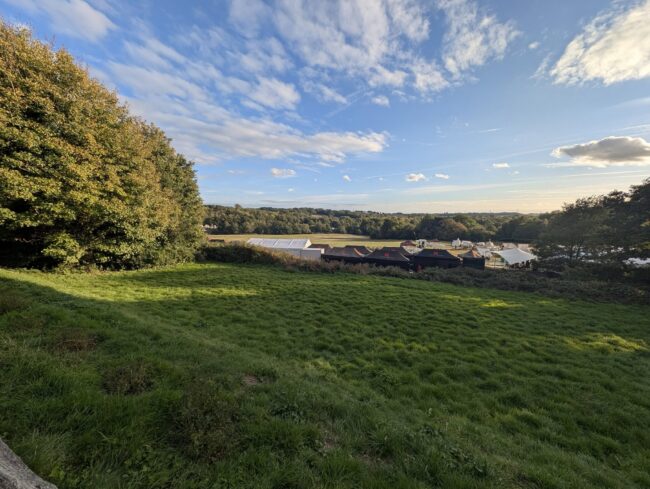
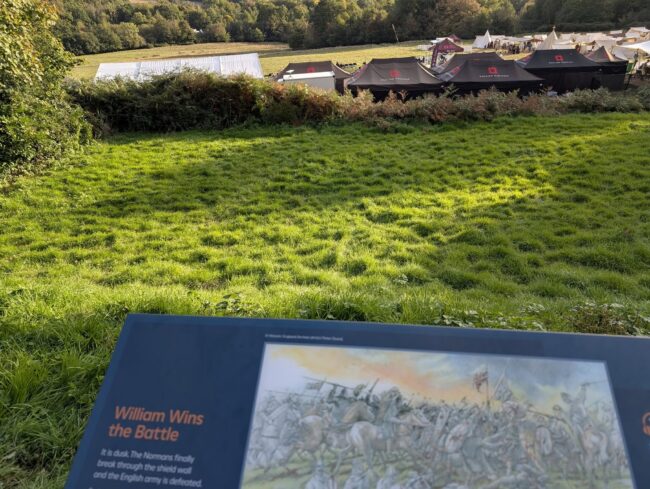
But the more accurate response might be this small hill and field.

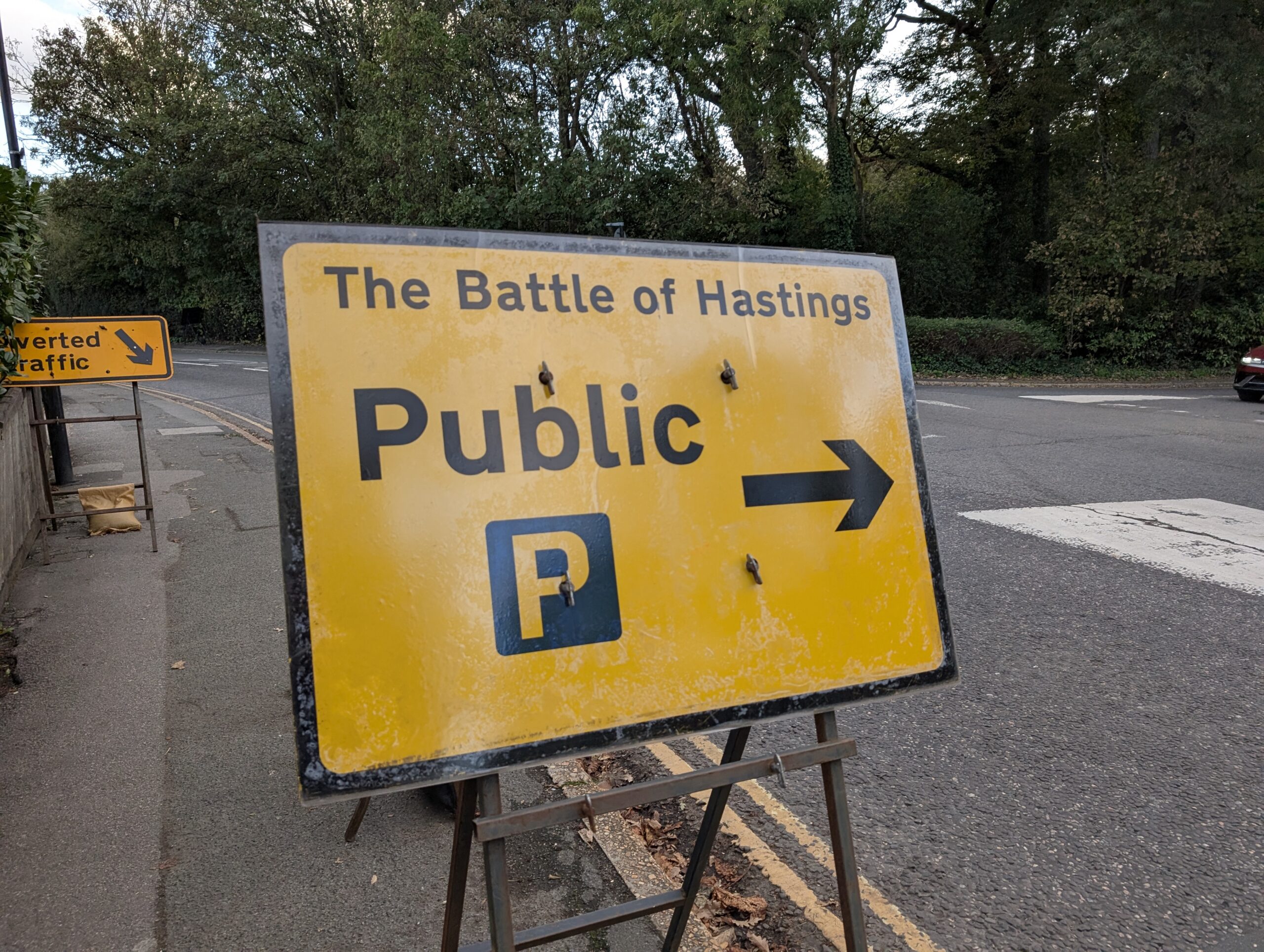
That’s right, the latest edition of property law pilgrimages is to southern England (Sussex) to the appropriately named Battle, UK, site of the 1066 Battle of Hastings, where Guillaume le Batard, Duc du Normandy became William the Conqueror, King of England.

After all, if not for the Norman invasion and conquest of Harold and his English/Anglo Saxons, we law-types might be stuck only with lawyers and petitioners, and not the more fanciful attorney and plaintiffs.

Law French might have stayed continental.

We were in London for the upcoming Brigham-Kanner Property Rights Conference and with the anniversary of the Battle of Hastings coming up (today, October 14) we decided this was as close we were ever going to get both geographically and temporally to the event.

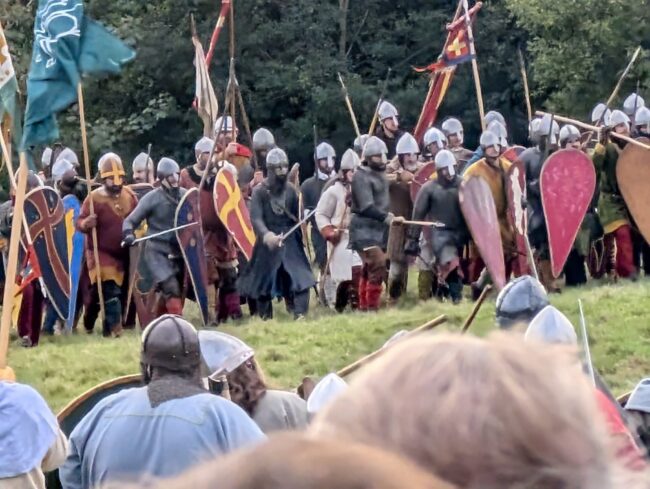
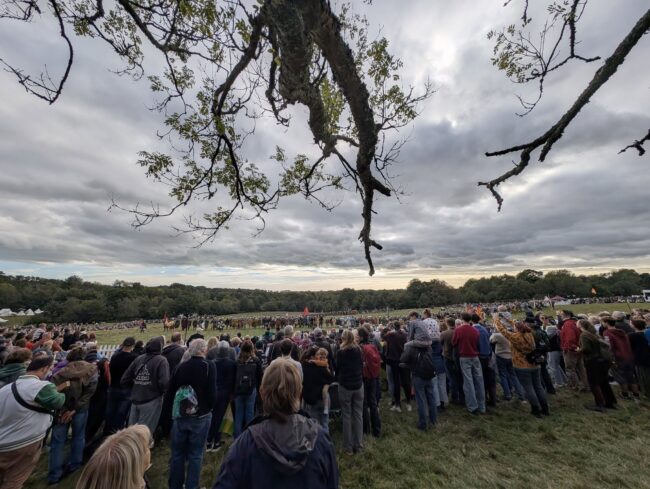
Every year, the English Battlefield Trust stages a recreation of the battle, featuring over 500 authentically-clad and equipped reenactors, complete with period clothing, armor, and weaponry. Most of the “soldiers” were from England and the UK, but a significant number were from the places where Guillaume’s army were from: France, Belgium, the Netherlands, Germany…even a group from as far as Australia.

Couldn’t resist that, so we took a day trip from London to check it out.

We’re covering this as part of our series on property rights pilgrimages where we visit the actual sites of famous or important dirt law events, because even though it is not directly related to property rights and property law, without William winning the day at Hastings, our system of property law might not look like it does.

Plus, this was like a Renaissance Fair with a brawl at the end.

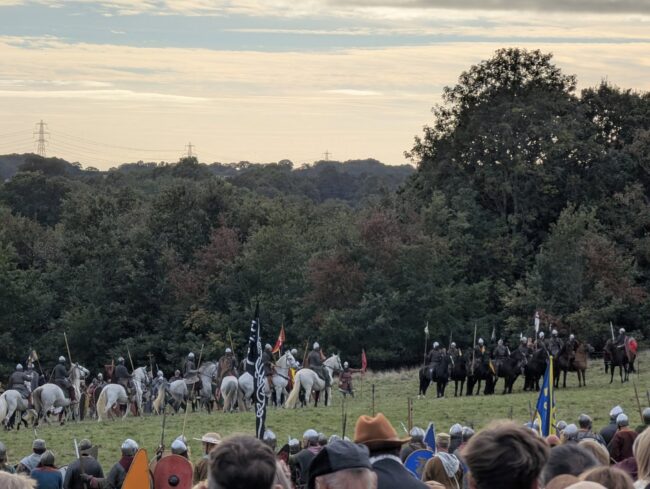
Apparently, in medieval battles there was a lot of trash-talking and parading in front of your own army (in sight of the other), getting them pumped up and excited about the upcoming melee. Here’s William giving it one of those “Braveheart”-type speeches from the back of his horse.

This fight lasted an hour and not all day like the real thing … but this was like the highlight reel of Hastings.

A mix of Monty Python and the Holy Grail (half expected William to say “go away, or I will taunt you a second time!”) and serious history, the re-staging of Hastings 1066 was worth the trip.

There was even a play-by-play announcer calling the fight.

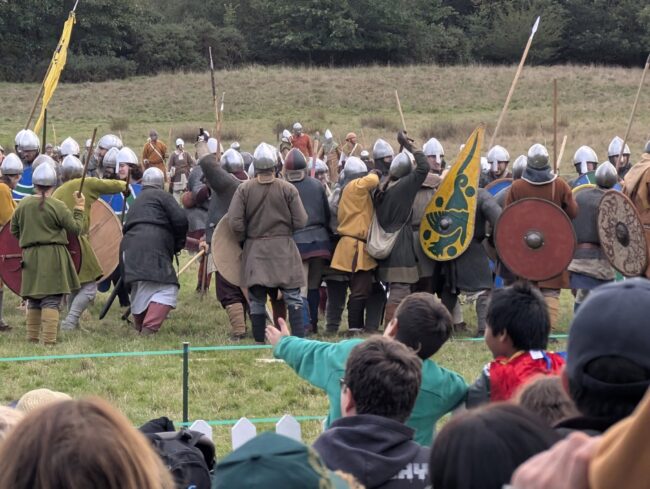
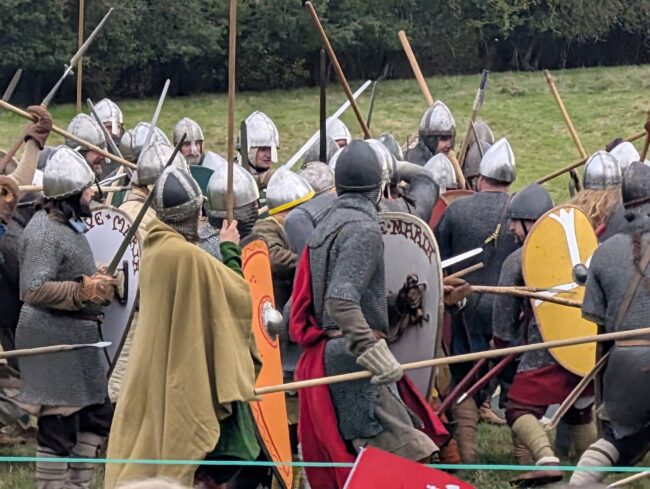
After some serious taunting, William’s forces finally advanced up the hill just like they did back in 1066, crashing into Harold’s shield wall repeatedly. And as in history, the shield wall held until the end, when William’s army suckered some of Harold’s men to break out of the phalanx and chase them down the hill. Uh oh.

There was an actual clanking of swords, the sounds of struggle, as the reenactors really got into the spirit. Some of these dudes are really into it.

The crowd was decidedly pro-Harold, perhaps not surprisingly given the venue.

Announcer: “Here’s William, parading on horseback.”

Crowd: “Boooooooooooo.”

Announcer: “And now Harold, King of England makes an appearance!”

Crowd: “GOD-WIN-SON! GOD-WIN-SON! GOD-WIN-SON!”

More team spirit than a Manchester United footie match.

In the end, the crowd’s exhortations amounted to nothing because — SPOILER ALERT! — the shield wall broke and Harold caught one in the eye, just like 960 years ago.

Game over man, game over.

“Down goes Harold! Down goes Harold!” (With apologies to Howard Cosell and Joe Frazier).

That there are this many people willing to pay to watch a restaging of a Middle Ages battle is somewhat heartening.

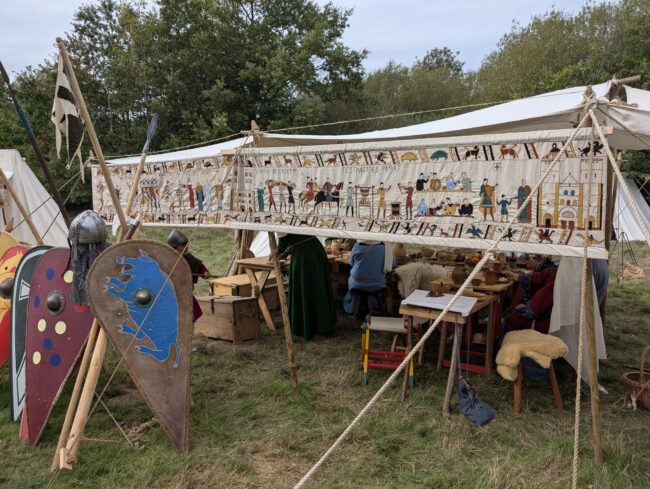
Fuggedaboud the Bayeux Tapestry, we have the Bayeux Throw Rug.

William (now “the Conqueror”) won, Harold II (“No Longer King of England”) lost (he was “deader than Caesar” as they say today and likely said back in 1066), and the rest is history.

A couple of weeks ago, we (along with nationally renown zoning law expert lawprof Michael Wolf), offered our thoughts on “Euclid at 100,” the most most (in?)famous zoning case, now coming up on its 100th anniversary.

The session was recorded and the Federalist Society has now posted it, so if you couldn’t make it live, here’s your chance.

While we and Professor Wolf were not 100% aligned on every issue, you might find it surprising of how much we agreed on. Especially the sense that Nectow v. City of Cambridge, the follow-on case to Euclid, has wrongly been overlooked and that it is time to revive it.

Check it out.

It hardly seems like two decades-plus have passed. After all, it was a mere 10 years ago we were lamenting “Kelo At 10: Still Stinks, And A Decade Has Not Lessened The Odor.” 

But yes, it was 21 years ago today … the U.S. Supreme Court, by the thinnest of margins, held in Kelo v. City of New London, 545 U.S. 469 (June 23, 2005) that there’s nothing inherently suspect about “economic development” takings to justify a higher level of judicial scrutiny than the judges-as-poodles standard of review applied in Public Use challenges to takings for every other reason. 

Where Ms. Kelo’s home used to be.

Susette Kelo’s home was taken on the claim that it was needed as part of the package of incentives to lure a pharmaceutical company to set up shop in New London, which would in turn, raise the overall economic climate in the city. That butterfly-effect theory was good enough for the Court’s majority, which applied rational basis review to her challenge under the Public Use Clause.

What a thin reed on which to hang a taking: someone else may make a more intense use of your property, so you can be disseized. Anyone here whose property is already at its maximal potential use?

Now you see the problem.

Rather than confront this criticism, the Kelo majority adopted a process-based rationale, concluding that the New London Development Corporation reached the decision to take her home via a public process that was part of an overall economic development and revitalization plan, so the outcome was as trustworthy as every other exercise of eminent domain. That’s right: property owners should rely on the political process to protect their rights, not courts. If Ms. Kelo lost in New London’s process, that’s democracy at work and of no constitutional consequence. 

Justice Stevens rested the majority’s conclusion on Berman v. Parker, 348 U.S. 26 (1954), which came to the remarkable conclusion that the legislature’s declaration of public purpose is “well-nigh conclusive.” He also relied on Hawaii Housing Authority v. Midkiff, 467 U.S. 229 (1984), which held that exercises of eminent domain to seize private property are considered under the same rational basis standard of review as police power regulation of private property. 

With those cases setting the stage, observers understood that Ms. Kelo had no chance unless the Court was willing to revisit them and either carve out an exception for economic development takings, or overrule one or both. As we know, that didn’t happen. Students of the decision understand that despite the loss, it wasn’t like it altered all that much, because it simply affirmed the longstanding judicial approach to Public Use.

In addition to reliance on Berman and Midkiff, most revealing was the majority’s stealth-citation to the Supreme Court decision which forms the basis of land use planning and zoning and the high degree of deference which the courts pay to zoning decisions, Village of Euclid v. Ambler Realty Co., 72 U.S. 365 (1926), thus making express what was strongly hinted at in Midkiff. You land users will find the majority’s language very familiar:

Those who govern the City were not confronted with the need to remove blight in the Fort Trumbull area, but their determination that the area was sufficiently distressed to justify a program of economic rejuvenation is entitled to our deference. The City has carefully formulated an economic development plan that it believes will provide appreciable benefits to the community, including–but by no means limited to–new jobs and increased tax revenue. As with other exercises in urban planning and development,12 the City is endeavoring to coordinate a variety of commercial, residential, and recreational uses of land, with the hope that they will form a whole greater than the sum of its parts. To effectuate this plan, the City has invoked a state statute that specifically authorizes the use of eminent domain to promote economic development. Given the comprehensive character of the plan, the thorough deliberation that preceded its adoption, and the limited scope of our review, it is appropriate for us, as it was in Berman, to resolve the challenges of the individual owners, not on a piecemeal basis, but rather in light of the entire plan. Because that plan unquestionably serves a public purpose, the takings challenged here satisfy the public use requirement of the Fifth Amendment.

———————————

12. Cf. Village of Euclid v. Ambler Realty Co., 272 U.S. 365 (1926). 

That “plan” requirement is about as loose in eminent domain as it is in land use law. In the time since Kelo, there have been commentary on the necessity of a plan, as well as cases from other courts which focus on the “plan” which a taking is supposedly part of. Necessary? Some say yes, some say no, as do others. Some courts have held that an imaginary plan is ok.

We visited the site last year, and if there was a plan, there doesn’t seem to be much evidence of that plan.

Should the fact that many of these plans are just pie-in-the-sky have any impact on Justices who believe that the process by which these plans are adopted is more important than the question of whether the plans will actually work? The usual majoritarian processes by which plans are adopted and someone’s property is targeted are not very good at protecting vulnerable owners from a government officials’ starry-eyed thinking and economic pipe dreaming. We think that is where the majority’s assumptions were horribly wrong. Check out what the great teacher and practitioner of eminent domain law, Professor Gideon Kanner, wrote about this in his final law review article, “Eminent Domain Projects that Didn’t Work Out,” 12 Brigham-Kanner Property Rts. J. 171 (2023).

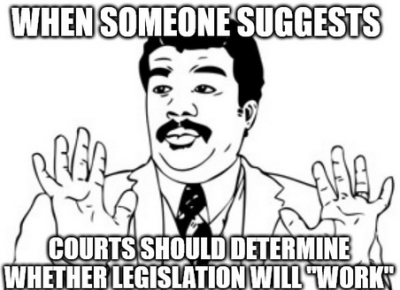
In the land use arena, we haven’t seen any indication that judges care all that much about the chances of success of government plans, whether those plans be zoning, planning, economic legislation, or eminent domain. Indeed, courts studiously eschew any role in what is called the “means-end-fit,” or whether legislation will “work.”
Tyson

But we wish courts would care in eminent domain, even if they don’t care generally. There’s something different about eminent domain and takings someone’s property away than when the government is merely exercising its police or other power to regulate property, isn’t there?  

True, eminent domain comes with just compensation. But as Kelo case starkly illustrated, sometimes the dignity of keeping your property cannot be replaced with money, and courts should recognize and protect that. The Supreme Court’s recent decision in Sheetz was a good sign the Court is starting that recognition. There, the Court was in “radical agreement” that just because it is the legislature which imposes an exaction as the price of exercising your constitutional property rights, does not insulate the legislation from the dual requirements of logical nexus and rough proportionality.

Here’s the amicus brief we filed in Kelo, where we set out our thinking on what the Public Use Clause requires: 

In undertaking the review of public use issues reserved to the judiciary in Midkiff, 467 U.S. at 240, this Court should adopt the same heightened scrutiny for exercises of the eminent domain power justified by promises of a better economy as it has established for suspect regulatory takings: a taking justified only by economic development is invalid if it fails to substantially advance a legitimate state interest. See Tahoe-Sierra Preservation Council v. Tahoe Regional Planning Agency, 535 U.S. 302, 333-34 (2002) (regulation is an illegal taking if it “fails to substantially advance a legitimate state interest”).

Under the Fifth Amendment’s Takings Clause, the affirmative exercise of eminent domain to take private property is valid only if it is for “public use” and just compensation is provided. U.S. Const. amend. V. In regulatory takings jurisprudence, a regulation has the same effect as an exercise of eminent domain when it either fails to substantially advance a legitimate state interest, or deprives an owner of beneficial use of property. Agins v. City of Tiburon, 447 U.S. 255, 260 (1980). A regulation substantially advances a legitimate state interest when there is a nexus between the regulation and a legitimate aim of government, and the regulation is tailored to achieve its end. Nollan v. California Coastal Comm’n, 482 U.S. 825, 834 (1987) (nexus required); Dolan v. City of Tigard, 512 U.S. 374, 385 (1994) (“rough proportionality” between goal and means used to achieve it).
Br. at 4. 

Let’s wrap this retrospective with this: two decades of searching for some stable mooringshould clue us in that Kelo was never really the source of the problem. Despite capturing the public’s imagination, the real problem isn’t that decision standing alone. After all, the majority’s ruling is expressly based on Midkiff and Berman (despite Justice O’Connor’s vain attempt to distinguish those cases, especially her own opinion in Midkiff).

To make any progress, the Court is going to have to be convinced that there’s something different about the way government regulates private property and the way government seizes private property. Midkiff — and perhaps Berman — need to be revisited and overruled.

It just so happens that we have a case where the property owners are asking just that. 

Let’s hope there’s not another two decades of inaction. 

Kelo v. City of New London, 545 U.S. 469 (2005)

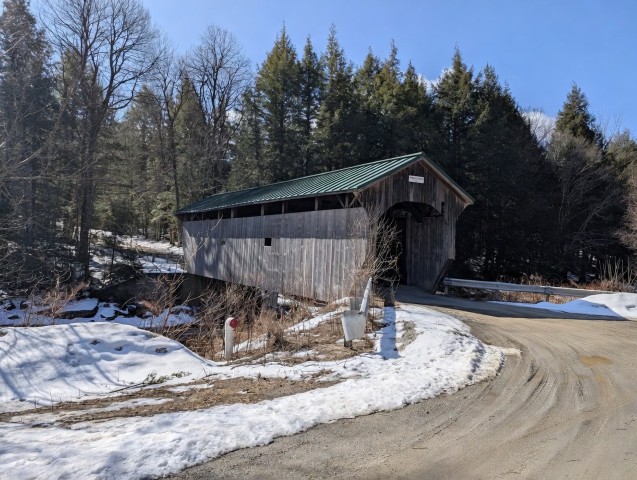
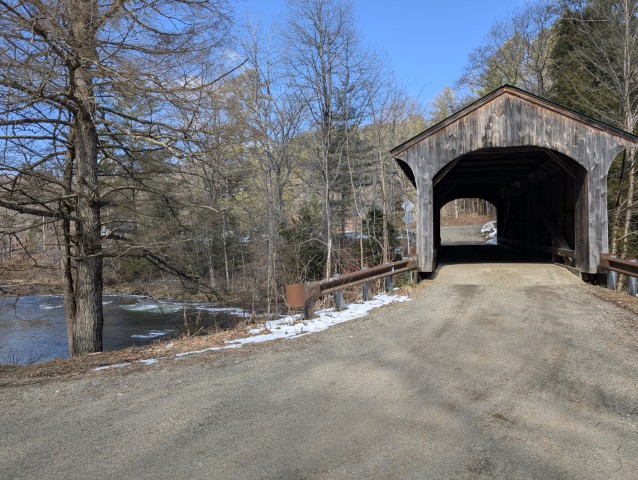
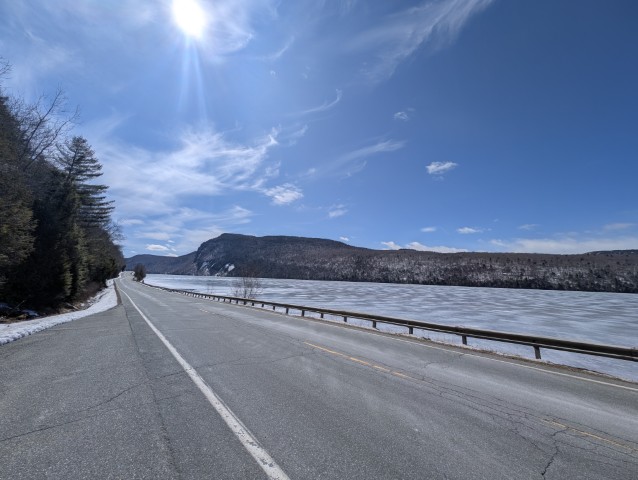
When you think of “Vermont roads,” the first images that might come to mind are mountain byways, covered bridges, and “highways” that elsewhere might qualify as backroads. We came across one such example a couple of days ago.

Although the thought is quaint, in truth the highways of Vermont run the usual gamut from the above (a town-maintained road and one of the state’s numerous covered bridges), to undivided State-maintained highways, such as the below.

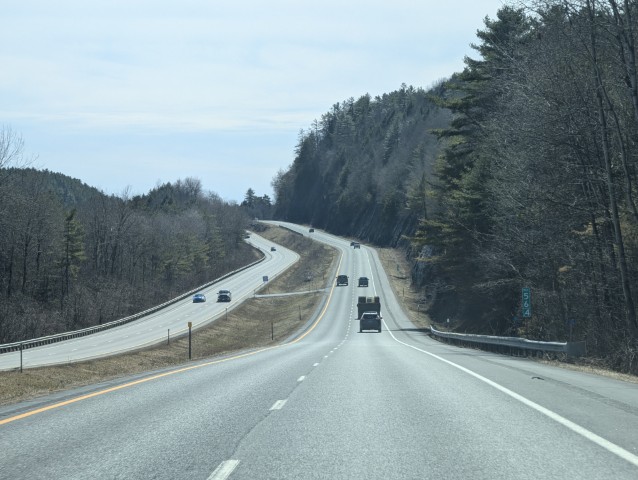
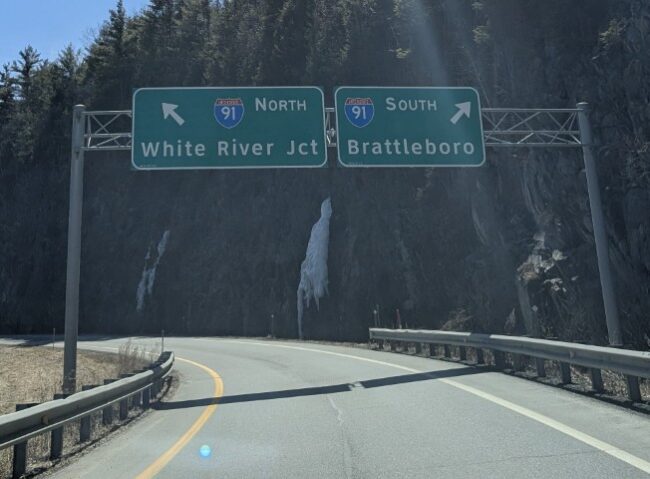
The Vermont road system also includes grade-separated limited access interstates such as the below (the north-south Interstate 91 which runs north-south on the eastern side of Vermont, along the New Hampshire border.

All the above is prelude, because it is here along I-95 south of White River Junction, that today’s story lay.

Unrelated sidebar: for you “experienced” takings mavens, the name “White River Junction” might ring a faint bell. But try and we might, we could locate neither the Howard Johnson’s Restaurant nor the actual Manifesto anywhere in the vicinity during our recent area visit. Thankfully, the Berger-Kanner response (which was to bear fruit less than a year later in First English) is preserved for posterity on the interwebs, while the Manifesto itself has been relegated to the dustbin of history, wrong the day it was written.

But we digress, for today’s post is not about these foundational battles won and lost.

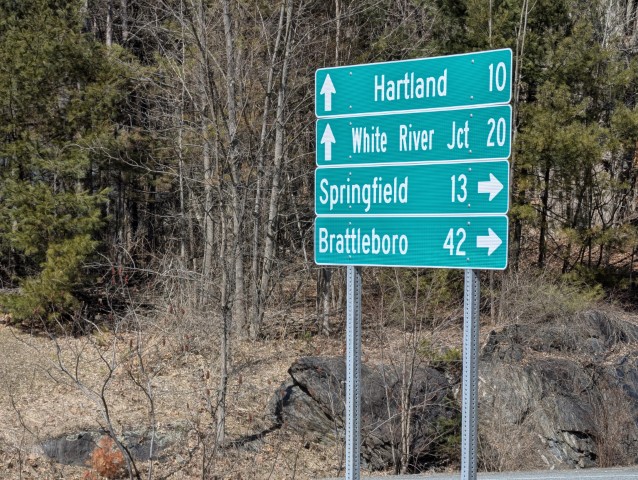
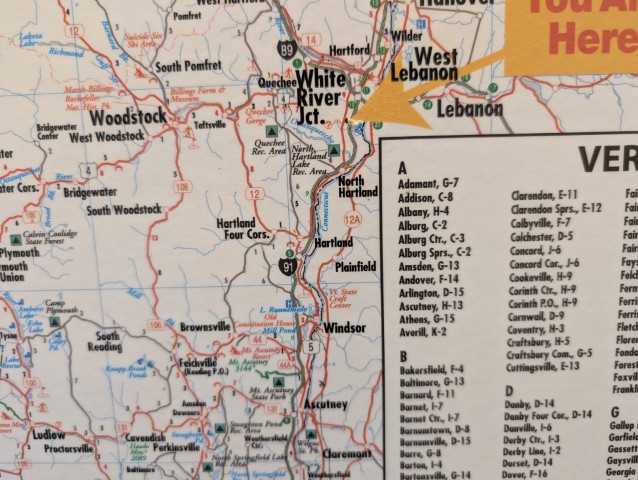
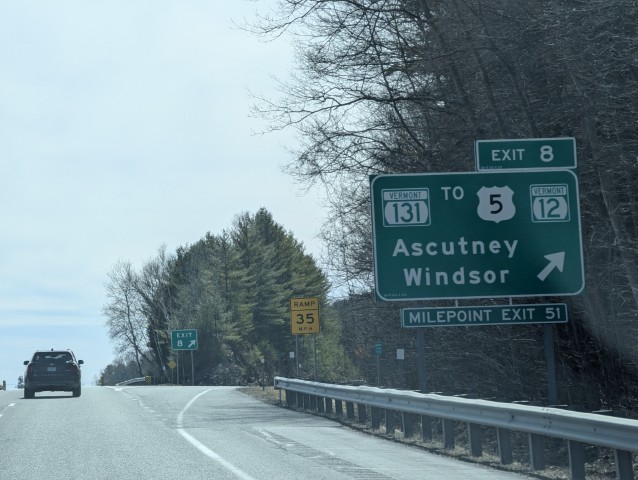
Rather, it takes place a few miles south, in the vicinity of Ascutney. Near Exit 8 from I-91, to be exact.

Here’s an Old School map showing the general vicinity (you remember what a map is, don’t you?).

If Exit 8 sounds familiar, you must be remembering our earlier post involving Exit 8, “A Permanent Memorial To Romaine Tenney, Vermont Eminent Domain Victim” (Nov. 4, 2019). Or maybe this one, “Must Watch: ‘Love of the Land’ – Romain Tenney’s Eminent Domain Protest” (May 27, 2024).

If those don’t jog your memory, perhaps this story from Vermont Digger: “60 years later, a Vermont farmer’s tragic tale lives on. But for how much longer?”

On Sept. 12, 1964, Romaine Tenney locked himself in his Weathersfield house and lit it on fire to protest its imminent bulldozing for Interstate 91. Today, fewer and fewer neighbors are around to share his story.

As we wrote: Romaine Tenney was one of those classic Vermonters. He entered the pages of history more than fifty years ago when, in reaction to the taking of his farm for Interstate 91, he burned his house and farm buildings down, and shot himself. He had nowhere else to go. As author Howard Mansfield puts it:

Tenney was that farmer by the road tourists used to stop and talk to as they sought out a specific kind of Vermont experience.

“Romaine himself, personally, he never went to town meeting, he didn’t write letters to the editor, he didn’t stand up and protest,” he said. “He was just living his life — and history, or the world, came to his doorstep, which is the way it happens all the time.”

We wrote that “[a]n informal memorial to Mr. Tenney — a maple tree (how Vermont) — has stood ever since near Exit 8. We learned more about Romaine Tenney last year when we spoke with Mr. Mansfield about his book “The Habit of Turning the World Upside Down – Our Belief in Property and the Cost of That Belief,” which features a chapter on Mr. Tenney.”

As readers may know, from time to time we like to go on what we call “property rights pilgrimages” to visit the sites of famous property cases or locations of interest even if they did not result in a legal action. Why would we do this, even though many of these spots are unremarkable to the casual eye? Well, as dirt lawyers know, nothing substitutes for a good site visit. Yeah, Google Maps and smartphone photos may give you a general sense of a place, but nothing beats being there, feeling the dirt beneath your shoes, smelling the air, hearing the sounds.

And another reason we like to pay visits to these places is that many are unremarkable. You go to Grand Central Terminal to understand more about the Penn Central takings case, you’re going to get overwhelmed with the majesty of the place. But if you visit the former Tenney property (as we did late last week), there’s nothing at all that is obviously significant about the place or the area. But the unremarkable nature of the place only emphasizes the things that owners often say about their land: it may not seem like much, but to me it is everything. The place I grew up or raised a family. The house my parents owned when they were starting off. And so on. Any property rights lawyer could tell you scores of stories such as these. That’s why we find even places without an obvious attraction are worth visiting.
We think the former Tenney property is one of those.

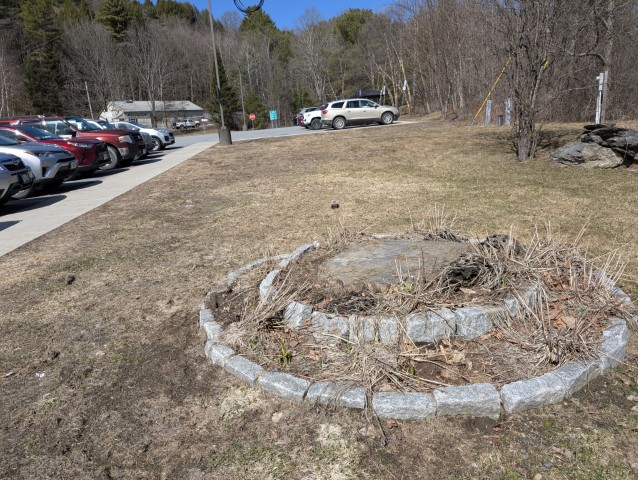
Indeed, once you exit at Exit 8 and pull into the parking lot, it kinda looks like a typical park-and-ride. Until you spot what looks like (and is) a tree stump surrounded by a very modest little henge thing.

When we last left the story in the above-referenced posts, the maple tree that served as the informal memorial to Mr. Tenney was on its last legs.

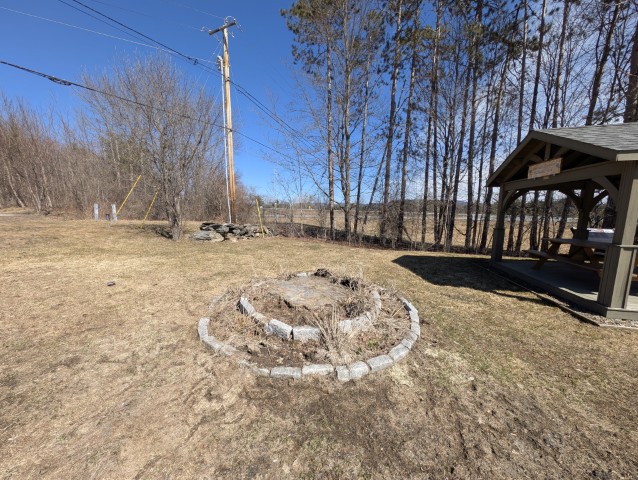
Since that time, the tree had to be removed which prompted a push for a permanent remembrance of the man who refused. Hence Stumphenge, all that remains of the maple tree.

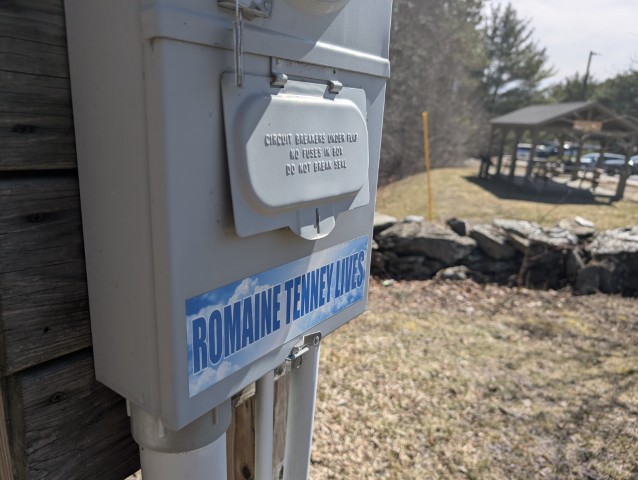
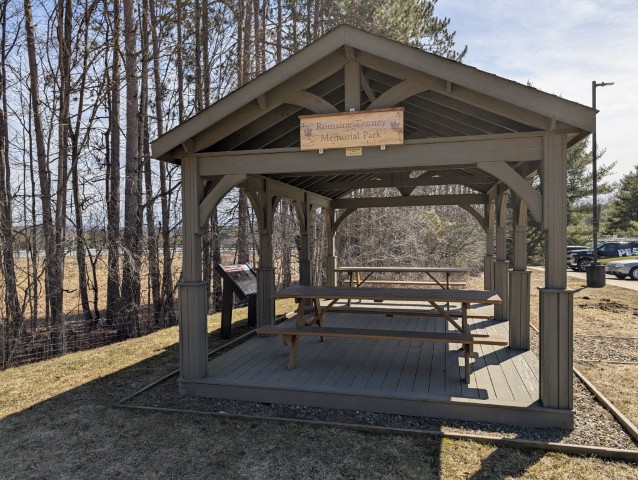
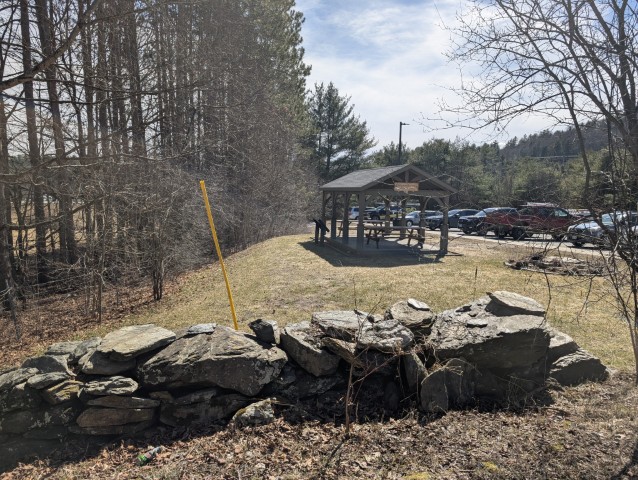
But the tree’s expiration had a grander purpose: it spurred the creation of a permanent memorial to Mr. Tenney. Here’s the maple tree stump, a rock wall, and the memorial itself. That’s I-91 in the background beyond the line of trees, by the way, illustrating how the freeway’s construction cleaved his land in two.

We would have busted out our laptop and written this post on one of the benches, but even though it is March and it is at least officially spring and a cloudless day, it is still pretty cold in this part of the country. So we noped out of that idea and instead took pictures and notes for later.

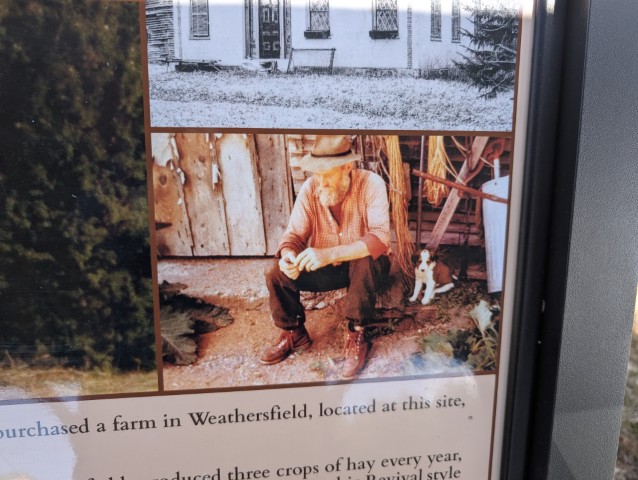
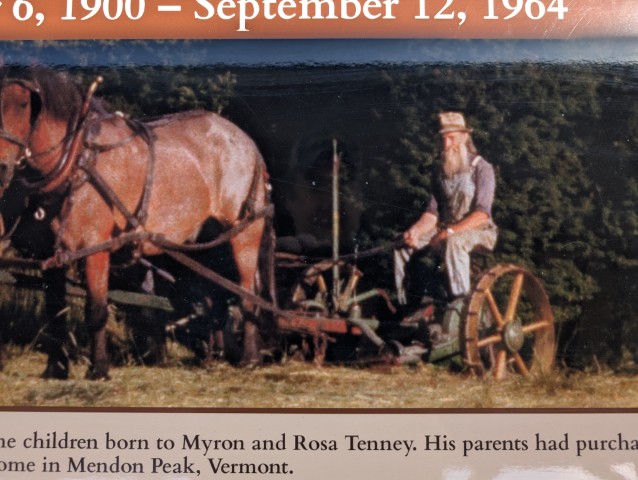
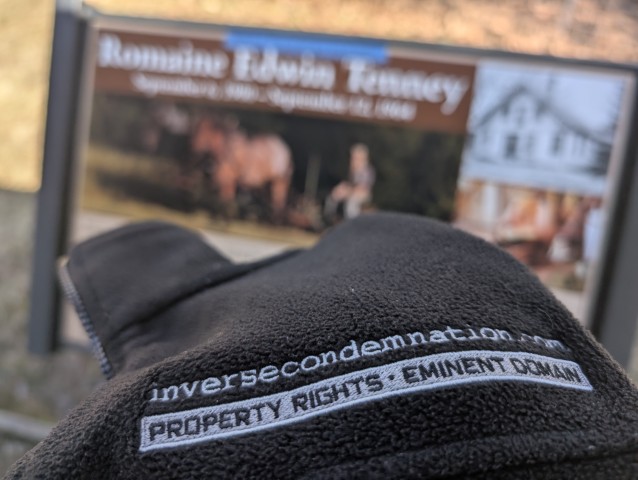
The interpretive sign has photos of Mr. Tenney looking exactly as you imagined he would.

Another photo that you didn’t just imagine.

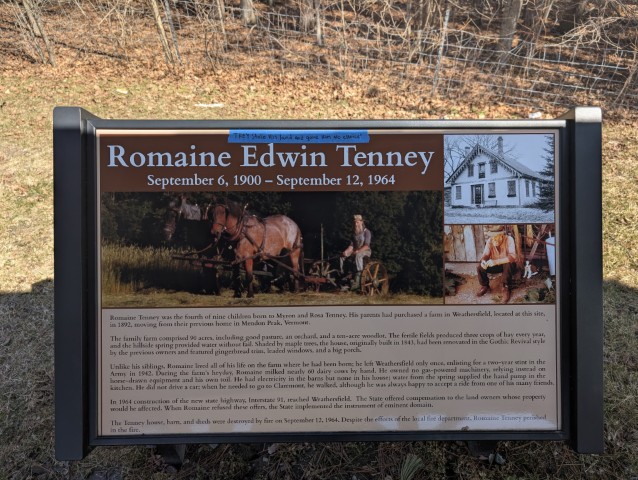
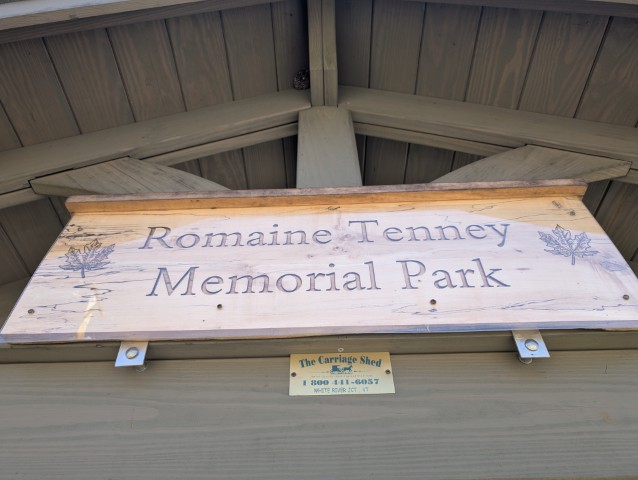
The interpretive sign, telling the casual visitor what and why, and why it is important.

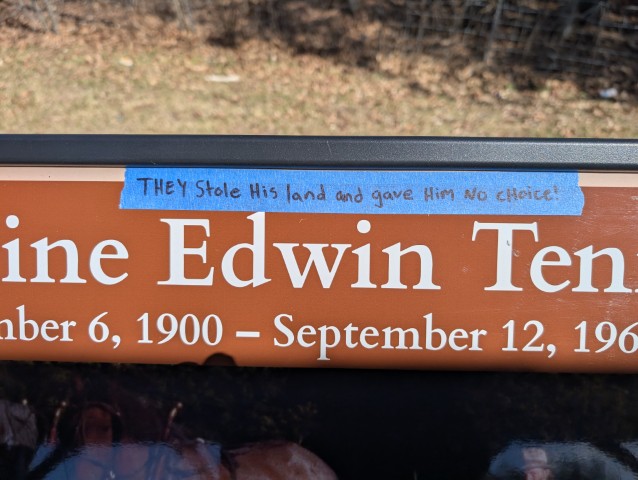
Someone graffiti-ed a pretty good definition of eminent domain on the interpretive sign: “They stole his land and gave him no choice.” And this being Vermont, the graffiti artist was very conscientious and used removable painting tape presumably as to not permanently deface the memorial. Good show!

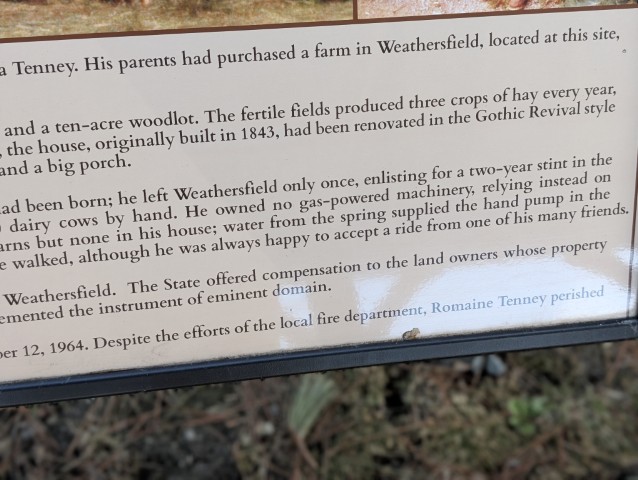
The interpretive sign uses the words “eminent domain” and “compensation.” But we still like the informal definition on the painter’s tape.

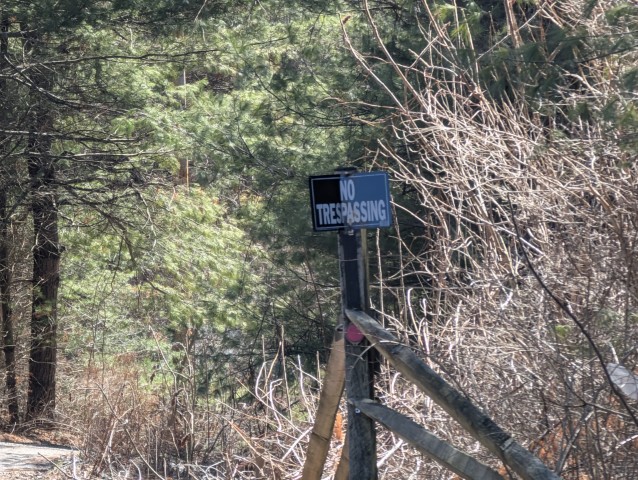
No trespassing … unless you are here to conduct a survey to see if we want to take my land. In that case … trespassing allowed!

Another view. Question we don’t have the answer to: is the rock wall a remnant from the days when Mr. Tenney was here? Or something else? We don’t know.

It shows up as “Romaine Tenney Farmstead” on Google Maps.

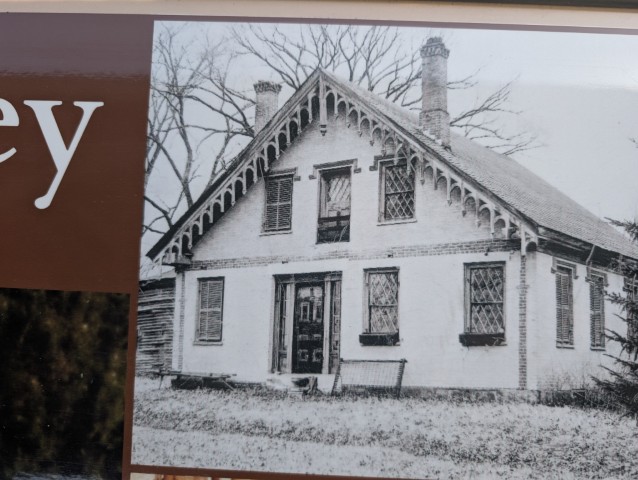
From the interpretive sign. That is a very modest house. No electricity, even. But there’s no doubt Mr. T loved it.

We made a small offering at this shrine to property rights. If Mr. Tenney’s ghost was still in the neighborhood, he made no indication (to us). But we swear we could feel his presence.

So you can get your bearings.

The grammarian in us so wants to proofread this sign.

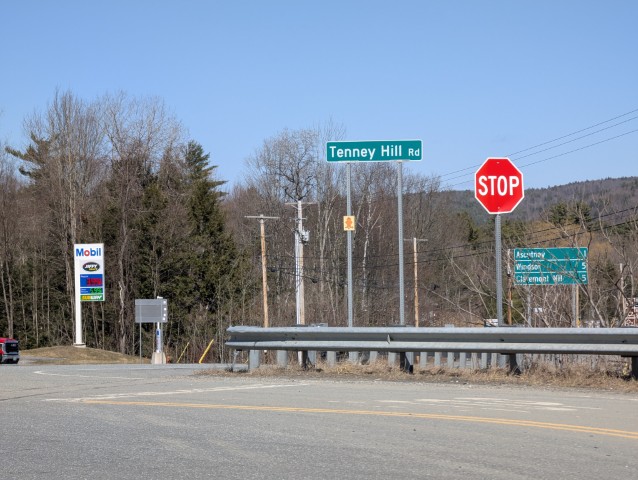
Not far across I-91 in the direction of New Hampshire is Tenney Hill Road.

Tenney Hill Road quickly turns to dirt. That’s I-91 in the middle background.

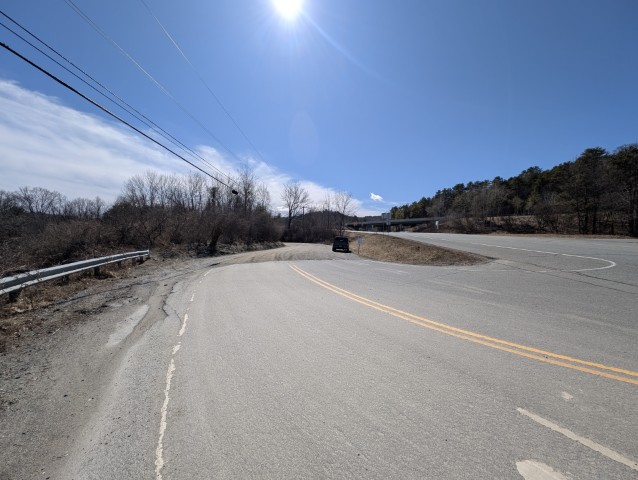
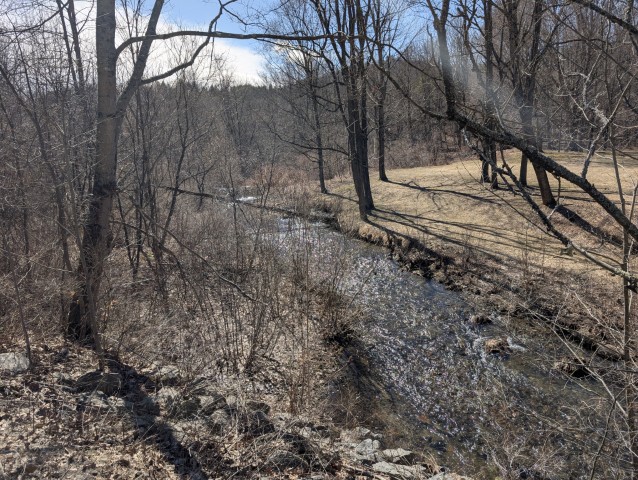
Mill Brook, which once cut through the Tenney property is obviously still there, but cut off from the farm site by the freeway (which is just on the other side of those trees in the mid-foreground in this photo).

What’s nice is that, despite its proximity to the freeway, most of the time you can only hear the meditative sound of the stream flow.

The memorial, a modest remembrance of what appeared to be a modest man, is probably not something you’d want to go way our of you way for, unless like us, you are a property super nerd. In that case, it’s a must visit. And if you are only a mild dirt law nerd, it is definitely worth visiting if you are in the neighborhood, if only to remember a man who felt he had nowhere to go when his land was threatened.

This is going to be a short post, mostly because the U.S. Court of Appeals for the Ninth Circuit’s opinion in KOGAP Ent., Inc. v. City of Medford, No 24-5268 (Nov. 13, 2025) is itself short.

Before we go further, this disclosure: this is one of ours, and our Pacific Legal Foundation colleague Brian Hodges argued the case.

It’s a three-page memorandum opinion so there’s not a lot there to sink our teeth into, and it would be faster for you to just read it yourself, rather than us explaining what it said. Short story is that the city imposed an exaction requiring KOGAP to extend a city street. The court affirmed the exaction has an “essential nexus” to KOGAP’s proposed development project, holding that the street extension was justified because the development would likely result in “more auto-oriented uses.”

But the court held that there’s no evidence that the exaction was “roughly proportional” as required by Dolan:

The City sought to justify the Myers Lane extension based upon traffic concentration in the southeast section of the development resulting from “more auto-oriented uses.” But the City failed to provide evidence at the summary judgment stage that it had measured the alleged traffic distribution impacts of the new proposal. Because it failed to provide evidence to enable a “rough proportionality” analysis, we conclude that the City failed to carry its burden to establish this second prong of the exaction analysis.

Slip op. at 3.

Two notes. First, the burden to prove rough proportionality is correctly on the city, not the owner. Second, the court relied on this being summary judgment, which allocates the burden on the motion in the same way that the burden is allocated at trial. Thus, the city’s failure to submit evidence showing a genuine issue of material fact about the proportionality, means that the court here didn’t merely vacate the district court’s entry of summary judgment in favor of the city, but reversed and remanded with instructions to enter summary judgment in favor of KOGAP:

However, the record does not contain a basis upon which the district court could have held that the City demonstrated rough proportionality between the project’s expected impacts and the exaction imposed.

Slip op. at 3.

KOGAP Enterprises, Inc. v. City of Medford, No. 24-5268 (9th Cir. Nov. 13, 2025) (mem.)

This past week we were busy with the 22d Brigham-Kanner Property Rights Conference at the William and Mary Law School.

Here’s the text of the remarks which I prepared for the session on “Public Safety, Private Property, and Just Compensation.” Note: because of time, I truncated what I planned on saying and kept it shorter.

* * * *

Public Safety, Private Property, and Just Compensation

Before I begin, a prelude. As you learned earlier, yesterday the student Real Estate Law Society produced a reargument of Kelo.

Ms. Kelo won this time. Six-to-zero, adopting the rationale of Justice Thomas’s dissent in the original case, with one concurring opinion. (More about this event in a separate post.)

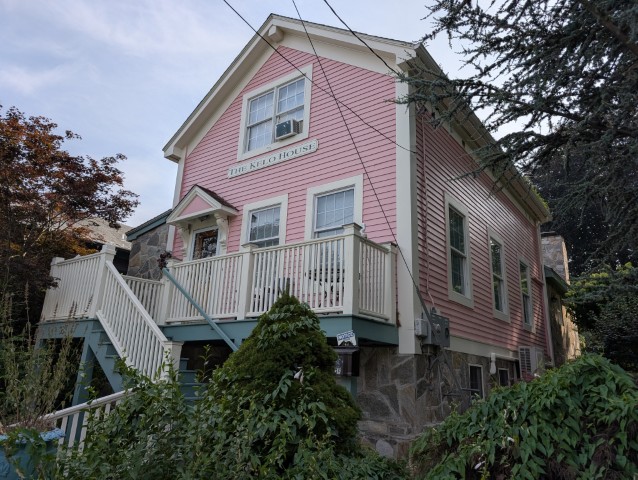
And for those of you in the audience who didn’t know, Ms. Kelo’s famous little pink house was saved, even though her property was not. The house was taken apart board-by-board and relocated to a different neighborhood in New London, where it was reassembled, where it is today. If you are ever nearby, it’s worth a visit.

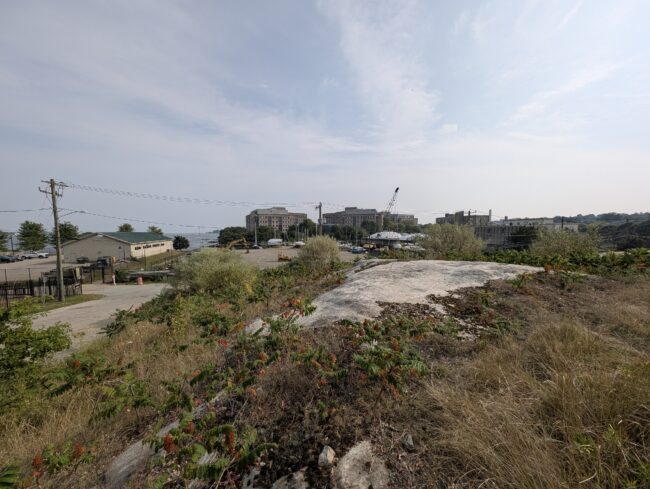
And just a couple of miles away, right across Fort Trumbull, is the former Kelo land, which remains vacant. We paid a visit a couple of months ago, and here’s what it looks like.

OK, let’s get back to the topic of the day: public safety takings.

Dick Miller, a great teacher and mentor of mine once offered up this pearl of wisdom, and of all the things I took with me from my legal education, this one has perhaps stuck the most: “Robert,” he said, “if it ain’t Latin, it ain’t the Law!”

In that vein, the Latin at the heart of our discussion today is familiar to all of us: “salus populi est suprema lex.”

For those of you, like me, who can’t handle Law French much less Latin (for example, I have no idea how to pronounce “voir dire,” except to get the judge to say it first and then parrot her pronunciation), here’s the translation: “The welfare of the people is the supreme law.”

And on that, I would suspect that no matter whether one is a police power hawk or an advocate for property rights, that we would agree that this proposition, at least in its broadest form, should be government’s guiding principle. All government action should be to promote the public health, safety, welfare, or morals. Or put another way, government should not act arbitrarily or capriciously. Or contrary to the law of the land. No less a figure than John Locke—no enemy of property rights—started off his seminal Second Treatise on Government with the phrase (“SALUS POPULI SUPREMA LEX ESTO”). So it has an impeccable pedigree.

And we have seen our Supreme Court take that phrase to heart, particularly when it comes to the sovereign power to regulate and restrict the use of property (the police power), and even the power to expressly deprive an owner of his or her property, in whole or in part through eminent domain. With the takings power being “coterminous” with the police power, there’s little distinction between how government acts, as long as it does so for the public welfare. The difference being that when property is taken—and not merely regulated—the public must provide just compensation.

As the Court has persistently reminded us, the primary principle to be derived from the Fifth Amendment isn’t to stop government from acting in the public interest, but to ensure that the costs and burdens of that action are not concentrated on the owner whose property just happens to be in the way.

And the topic of this panel, SWAT takings—where the government damages or destroys the private property of an innocent homeowner in the course of apprehending a criminal suspect—brings the salus populi principle into sharp focus.

After all, all of the textual elements are there to show that this “goes too far” and a classic police power action should be treated as a de facto taking and trigger the obligation to compensate:

  • an owner has private property (and in the cases brought recently, the property is a home), there’s been a physical invasion resulting in pretty severe damage (some of the photos look like a war zone),
  • the government has unquestionably acted for the public welfare and safety (we all want Five-O to apprehend criminals, I assume),
  • and the owner is being required to bear the costs herself and the public has not offered up compensation (and as an amicus brief I did in one of these cases that is reproduced in your materials noted, homeowner’s insurance generally is not available to permit the owner to pay herself to avoid the risk of such government actions).

Armstrong, cost spreading…we all know the drill:

The Fifth Amendment’s guarantee that private property shall not be taken for a public use without just compensation was designed to bar Government from forcing some people alone to bear public burdens which, in all fairness and justice, should be borne by the public as a whole.

But if there’s a universality in the judicial approach, it is this: no taking … or at least no compensation is required. The variety occurs in how the courts get there.

Some say no absolute right to exclude, with the issue turning on whether the police are acting pursuant to a valid warrant, incorporating by reference Fourth Amendment property law. Some say the owner has no expectations of exclusion of the government as a background principle. Some say the owner can and should anticipatorily mitigate by insurance.

And in what I find to be the least defensible justification, conclude that because the police are exercising the police power—are acting for the public’s health, safety, and welfare—there can be no taking—categorically. Salus populi est suprema lex.

To me, to conclude that because that police action was necessary it is not a taking, is to reject the foundation of the regulatory or de facto takings doctrine: that an otherwise valid exercise of some power other than the eminent domain power will, if it “goes too far” into the property rights of an owner, be deemed to be a taking requiring compensation giving the government a choice: stand down or pay up. The more necessary for public health, safety, and welfare, the more it should be compensated. These are not Kelo-like actions where the government conduct has only predictable, or attenuated, public benefits, but a direct promotion of the public good.

For example, there’s no substantial question the Kohler Act was a valid, and seemingly very necessary, exercise of Pennsylvania’s police power. Even if you discount some of the more breathless portions of the brief of the City of Scranton—complete with photos of collapsed schools and unearthed caskets—the Pennsylvania legislature adopted the Act unanimously, at a time in history when one might expect that one of the stronger lobbies having a lot of influence in that legislature was the coal industry.

One sidebar: inspired by Professor Fischel’s peeks behind the curtain of important cases like the Cedar Rust case, on the day of the 100th anniversary of the Court’s issuance of the Mahon opinions in December 2023, John Ross and I were on site at the former Mahon home and property on that day, where we learned of the inherent oddity at the heart of the case: the Kohler Act was adopted unanimously with the mainstream coal industry aboard. It was designed to curb the mining of wildcat or cowboy mining companies, which would buy up the rights to continue mining coal in mines which more responsible coal companies like Pennsylvania Coal had ceased, precisely to avoid surface collapse. Thus, the Act made it illegal to mine out the support pillars, something the mainstream companies were not doing.

But Mahon (and it is pronounced “man”) sure looks like it was a test case by the Pennsylvania Coal Company. Not too many degrees of separation. Mahon was a lawyer and until Scranton intervened, represented himself. He was the son-in-law of the prior owner, the Chief Engineer of the Pennsylvania Coal Company, the owner who obtained the property subject to the deed covenant that the Pennsylvania Coal Company could mine out 100% of the coal under the home, even if it caused the home to fall into the resulting hole. It wasn’t likely that the Company was actually going to mine out beneath the home of the daughter of its former Chief Engineer.

But in the event that precipitated the litigation, it sent notice to the Mahons that indeed it was going to exercise its rights, and heads up: your house may fall into a hole soon.

The great mystery is why Pennsylvania Coal would challenge a statute it didn’t object to being passed. Perhaps having served its purpose of shutting down the cowboy miners, the mainstream industry wanted to be sure that it wasn’t hoist on its own petard, it was time to get it invalidated. And a historical note: despite winning in the Supreme Court, the Company never did mine out under Mahon’s home, and the present owner confirmed to John and I that of all the homes in his neighborhood, his home is the only one which has never suffered any subsidence.

And one final note on this sidebar: after that visit and with the consent of the owner, John and I thought it might be a good idea to commemorate the Mahon decision. After all, less that 3 miles away as the crow flies, Pittston, PA is the location of another famous Supreme Court decision, Erie RR v Tompkins.

If that deserved a roadside marker, then doesn’t Mahon?

I’m happy to report that, with the support of some of you in this room, that the Pennsylvania Historical Marker Commission recently approved our application for a Mahon property marker, to note the importance of the Supreme Court’s decision. Stay tuned for more – John and I will let you all know when the dedication ceremony for the marker is scheduled and ask you to join us in Northeastern Pennsylvania.

Now back to our story.

That all said, we tend to focus on the Holmes 8-Justice majority in Mahon and its “goes too far” language, contrasting it with the “government could hardly go on” phrasing later in the opinion. But we should pay more attention to the solo dissent of Justice Brandeis, who argued that because the Kohler Act was so necessary, it cannot be a taking, and cannot result in compensation. Salus populi est suprema lex.

This was a dissenting view, and why I think it is too bad that it is overlooked, is that the necessity principle seems to adopt and incorporate it, and it is troubling to me that Brandeis’ rationale is deployed to deny compensation, when a solid exercise of police power is not terribly relevant to the compensation question. But it is a minority view, and it should be seen as such.

But that’s just saying what won’t work. Thus far, the question of SWAT takings has not been taken up by the Supreme Court under any theory, despite at least a couple of very solid vehicles presenting the case. So what approach might interest the Court? Especially in a way that does not risk the Court’s majority, or even a minority in dissent, scaling back on what I view as the fundamental principles of Mahon?

As discussed earlier, I suspect what might catch the Court’s attention would be arguments centered on — you guessed it — text, history, and tradition. The Supreme Court has deployed the text, history, and tradition approach across a wide range of cases, not just property, and it looks like it is here to stay at least for a while.

The text on SWAT takings seems pretty straightforward. The public is “using” the property of innocent homeowners, or at least appropriating – temporarily – the owner’s right to exclude.

What about history and tradition? There, I have observed that courts focus on wartime or emergency cases which hold no compensation. But that history doesn’t seem to line up exactly with SWAT takings, because the cops chasing a suspect isn’t a “war” and it happens with such regularity that it hardly seems like an “emergency” where the usual non-emergency rules must be applied in a time of extreme distress.

What does tradition and our common law roots have to say about this?

After the Great Fire of London in 1666, the Fire Court was established was created to resolve “[d]ifferences touching Houses burned or demolished by reason of the late Fire which happened in London” between landlords and tenants. The court began its seating on January 1, 1668. The legislation charged the court with resolving disputes about the required rebuilding, property boundaries, the “Rents as if the same had not been burned,” and the like. The legislation noted the goal of spreading the public loss among the entire public, too:

And for that it is just that every one concerned should bear a proportional share of the loss, according to their several Interests, wherein in respect of the multitude of cases varying in their circumstances no certain general rule can be prescribed.

The Armstrong principle, applied.

As noted above, the jurisdiction of the court included not only structures actually burned by the fire, but those “pulled down or otherwise demolished, defaced, or otherwise ruined by reason of the said Fire.” The vibe of the statute seems to have been to get these disputes resolved in a single forum, and quickly (appeals had to be made in seven days for example).

This seems to presume that some kind of compensation was owed when someone’s property was purposely destroyed or damaged in order to protect the public’s welfare and safety.

This is in line with Lord Coke’s admonition in the Saltpetre Case that even though the King’s “saltpetre men” could exercise the King’s prerogative to enter private property with warrants against the will of the owner in order to mine saltpetre for use in gunpower to defend the realm against France and Spain (especially the Spaniards!), that the Crown has an obligation to leave the owner in as good a position he would have been in without the entry:

Yet it was resolved, that he may dig for Salt-peter, for this that the Ministers of the King who dig for Salt-peter, are bound to leave the Inheritance of the Subject in so good Plight as they found it[.]

12 Coke at C1. Sounds a lot like “the full and perfect equivalent” and “the owner shall be put in as good position pecuniarily as he would have been if his property had not been taken.” Seaboard Air Line Ry. v. United States, 261 U.S. 299 (1923).

And – thanks to a former student of mine who is now practicing eminent domain law with Clint Schumacher – David Wilde, I now understand that the compensation principle even when – or perhaps especially when – destruction or damaging of private property is necessary to promote the public good.

In the trial court arguments in the Ship Money Case, David discovered that the issue came up, and the advocate argued that in such cases there’s no proclaimed that there’s no “prejudice” because the Crown or the Parliament was obligated to indemnify for any loss. Fascinating stuff.

But OK, that’s English law. What about American law?

And again I have David to thank for this. His research is showing that in colonial and early American law, legislatures recognized that in the case of fires, local officials were authorized to “tear down or blow up” homes to stop the conflagration from spreading. But importantly, that the owners of those destroyed houses “shall receive reasonable satisfaction, and be paid by the same, and be paid by the rest of the inhabitants whose houses shall not be burnt.” History and tradition indeed.

But this is statutory or local ordinance, not constitutional law? As to that, we need look no further than Tyler v. Hennepin County for the Supreme Court looking at how state law addressed similar issues for an example. I suggest that were the Court presented with a case of a SWAT taking, it could take up the issue and resolve it without diving into the morass of Penn Central which, in my view, wrongly focuses the takings question on the “taken” part of the Fifth Amendment and not the “public use” requirement.

Thank you for granting me this time. A shout out to my students who are here today, thank you for being here. And a hearty congratulations to our Prizewinner, Professor Fischel.

Here’s the speaker list for the upcoming (22nd Annual) Brigham-Kanner Property Rights Conference, taking place October 23–24, 2025, at William & Mary Law School in Williamsburg, Virginia. Here’s the agenda.

  • Vicki Been, Judge Edward Weinfeld Professor of Law and Co-Director, Furman Center for Real Estate & Urban Policy, NYU School of Law
  • James Burling, Vice President of Legal Affairs, Pacific Legal Foundation
  • David L. Callies, Benjamin A. Kudo Professor of Law, Emeritus, Richardson School of Law, University of Hawaii
  • James W. Ely, Jr., Milton R. Underwood Professor of Law, Emeritus, Professor of History, Emeritus, Vanderbilt University
  • Lee Anne Fennell, Max Pam Professor of Law, University of Chicago Law School
  • M. Nolan Gray, Senior Director of Legislation & Research, California YIMBY
  • Roderick M. Hills Jr., William T. Comfort III Professor of Law, NYU School of Law
  • Donald J. Kochan, Professor of Law and Exec. Director, Law & Economics Center, Scalia Law School, George Mason University
  • Julia D. Mahoney, John S. Battle Professor of Law, University of Virginia School of Law
  • Thomas W. Merrill, Charles Evans Hughes Professor of Law, Columbia Law School
  • Jeffrey Redfern, Senior Attorney, Institute for Justice
  • Patrick E. Reidy, Associate Professor of Law, Notre Dame Law School
  • Shelley Ross Saxer, Laure Sudreau Endowed Professor of Law, Caruso School of Law, Pepperdine University
  • Gregory H. Shill, Professor of Law and Dean’s Fellow, Sandra Day O’Connor College of Law, Arizona State University
  • Clint Schumacher, Partner, Dawson & Sodd
  • Brett S. Tensfeldt, Partner, Brigham Property Rights Law Firm
  • Robert H. Thomas, Joseph T. Waldo Visiting Chair in Property Rights Law, William & Mary Law School, Director, Property Rights Litigation, Pacific Legal Foundation
  • Michael Allan Wolf, Richard E. Nelson Eminent Scholar Chair in Local Government, Levin College of Law, Florida State University

Kelo Re-Mooted
In addition to the Friday speaking panels, on Thursday, October 23, the William and Mary Law School Real Estate Law Society (a student organization) is presenting a “re-argument” of the Supreme Court arguments in Kelo v. New London, in recognition of that case’s twentieth anniversary. Arguing for Susette Kelo will be her lawyer in the real case, the Institute for Justice. The Justices will be property law professors and eminent domain practitioners.

Will the Moot Supreme Court reach a different outcome with the benefit of two decades of experience and hindsight? This event is open to the public, so please join us and find out!