Here’s the latest in an issue we’ve been on for a long time: whether government actions taken under the police power are categorically exempt from providing just compensation when those activities take or damage private property.

In Blue 42 Organics, LLC v. Georgia Dep’t of Public Safety, No. S25G1493 (Sep. 9, 2026), the Georgia Supreme Court held no, and that the State was not categorically immune from an inverse condemnation claim just because the government damaged the property in the course of an apparently valid exercise of the police power.

Whether it is what we call “SWAT takings,” or a government claiming it is immune because it was exercising the police power, or deploying the police power as the dispositive factor in the Penn Central “character” factor, the argument is the same: no liability for just compensation when the government is acting within the broad power to regulate and restrict to promote the public health, safety, welfare, and morals. Here’s a sampling of some of our posts strenuously objecting to that argument:

Wait, I Thought The Police Power and the Public Use Clause Were “Coterminous”

CA3: Claim That Govt Is Keeping Property Seized (But Not Used) As Evidence “checks all the Fifth Amendment boxes.”

Cert Denied In Police Power Takings Case (Lech v. Greenwood Village)

Fed Cir Tries To Avoid “Police Power” Takings Exception In Bump Stock Case By (Unsuccessfully) Finessing The Property Interest

The Blue 42 case came about after Georgia state police aircraft flew low enough to damage crops on Blue 42’s hemp farm, and Blue 42 sued in state court for inverse condemnation under Georgia’s constitution. The trial court dismissed the case and the court of appeals affirmed, concluding that the damage occurred in the course of a valid exercise of the State’s police power, which meant no inverse claim.

The Georgia Supreme Court disagreed. That court held that police power justifications may be exceptions to the usual rule to pay compensation, but situations involving extreme or “urgent public necessity” are “very narrow” and

that from our earliest days, this Court recognized that just compensation was generally required when the government destroyed property for public use and that there was a narrow exception to this general rule when government destroyed private property in extreme or urgent situations.

Slip op. at 8 (footnote omitted).

We recommend you read all of the “history and tradition” stuff the court lays out in this part of the opinion. Not only is it instructive, it is very interesting. There’s also some good stuff about the Georgia Constitution’s Just Compensation Clause that is worth repeating here:

From our earliest days, this Court recognized that the doctrine of just compensation was a part of Georgia foundational law because it was a part of the English common law that we adopted nearly 250 years ago. See, e.g., Parham, 9 Ga. at 349 (“It is not, therefore, necessary to go to the Federal Constitution for [the principle]. It came to us with the Common Law — it is part and parcel of our social polity — it is inherent in ours, as well as every other free government.

Slip op. at 5-6 (footnote omitted).

There’s also a section of the opinion devoted to describing the “police power.” Yes, it is a broad power, and “[h]istorically, legislative bodies have exercised police power in a wide range of contexts, including zoning restrictions, building standards, health regulations, nuisance abatement, and alcohol regulations.” Slip op. at 12. This “power is among the broadest of government powers.” Id.

But this broad power “is not limitless.” Slip op. at 13. It must be exercised within the bounds of the Georgia Constitution, and the police power does not permit the government to “invade the personal rights and liberty of the individual citizen by legislation which has no reasonable relation to a legitimate State purpose.” Slip op. at 14.

The Georgia Supreme Court has now joined others which hold the same. See, e.g., this case, this one, and this one.

While we like this decision, we also find it weird that we have to constantly relitigate a foundational 104 year old SCOTUS decision (remember that in Mahon, Justice Brandeis dissented on the basis there could be no takings liability because Pennsylvania’s Kohler Act was unquestionably an exercise of its police power).

Blue 42 Organics, LLC v. Georgia Dep’t of Public Safety, No. S25G1493 (Ga. Sep. 9, 2026)
Here’s a cert petition that asks whether a local government (here, the granola-swanky Marin County, California) as a condition of approving a building permit may require a property owner to restrict uses of the land to commercial agriculture, and bind all future owners of the property as well.

Because this is one of ours, we won’t be going into great detail but will instead leave it to you, starting with the Questions Presented:

Owners of agriculturally zoned land in Marin County, California, may lawfully build a single-family residence on their property. But the County refuses to issue a residential building permit unless the landowner records a restrictive covenant limiting ownership to commercial farmers who actively and directly farm the land. The covenant runs with the land in perpetuity, binding all future owners. The California Court of Appeal upheld the requirements, finding that forcing property owners to be commercial farmers furthers the County’s goal of “maintain[ing] agriculture as a viable industry.” The questions presented are:

1. Whether Marin County may, under its power to promote the public health, safety, morals, or general welfare, compel private landowners to enter and permanently remain in a government-chosen occupation as a condition of a residential development permit?

    2. Whether the Due Process Clause of the Fourteenth Amendment—which protects the fundamental right to “engage in any of the common occupations of life,” Meyer v. Nebraska, 262 U.S. 390, 399 (1923)—also encompasses the fundamental right not to be forced into an occupation of the government’s choosing?

    Follow along here, or on the Court’s docket.

    Stay tuned, as always.

    Petition for a Writ of Certiorari, Benedetti v. County of Marin, No. 25-1241 (U.S. May 1, 2026)

    Here’s the latest in a case we’ve been following.

    After a loss at the Eighth Circuit, the property owners have filed this cert petition.

    This is the case where court concluded that the city’s issuance of a closure order to reVamped after the business ended up on the city’s “blighted list” was not a regulatory taking. The city had issued citations for various code violations and sent compliance orders.

    The Eighth Circuit rejected the owner’s takings claim, holding that the resultant closing of the owner’s business was a valid exercise of the police power, and that “temporary closure of the Inn did not amount to a regulatory taking proscribed by the Fifth Amendment. A lawful exercise of a state’s police power to regulate in the interest of public health and safety is generally not a taking.”

    Here are the Questions Presented:

    1. When a government’s appeal process is illusory or non-existent to allow a party to challenge a government’s total closure of a business resulting in the loss or taking of property, and the government further impedes the process, implicating a Takings Clause claim, whether the illusory appeal process is a per se violation of procedural due process under 42 U.S.C. § 1983 requiring no need to exhaust state remedies before the claim becomes ripe for federal adjudication under this Court’s legal principle as explained in Knick v. Twp. of Scott, 588 U.S. 180, 185 (2019) and Patsy v. Board of Regents of State of Fla., 457 U.S. 496 (1982).

    2. There is a Circuit split regarding the existence of categorical “police power” exceptions in the context of the Takings Clause of the Fifth Amendment. The Seventh, Eighth, Ninth and Tenth Circuits hold that there are categorical police-power exceptions to the Takings Clause. The Fourth, Sixth and Federal Circuit have held that Supreme Court’s jurisprudence recognizes that Government actions taken pursuant to the police power are not per se exempt from the Takings Clause. The question presented is:

    Whether the Takings Clause of the Fifth Amendment contains a categorical “police power” exception immunizing the government from providing just compensation.

    As we’ve said before, the fact that a government is exercising the police power isn’t the be-all-end-all analysis in takings (where the court must accept the notion that the government is lawfully exercising its power). The takings inquiry isn’t focused on what the government did, or especially why, but on the effects of the otherwise-valid action has on the owner’s property rights. We wish courts would stop taking the shortcut and do the takings work.

    We shall follow along with the petition’s progress here, or you can follow on the Court’s docket. Stay tuned.

    Petition for Writ of Ceritorari, reVamped LLC v. City of Pipestone, No. 25-1177 (U.S. Apr. 14, 2026)

    Here’s one you don’t want to miss. Lawprof Shelley Ross Saxer has published “Forfeiture Takings, Police Power, and Necessity Destruction,” 80 U. Miami L. Rev. 147 (2025).

    Here’s the Abstract:

    Civil forfeiture laws allow law enforcement to seize property when there is probable cause it has been used or possessed in violation of legal rules, often before an owner has a chance to contest the government’s seizure in court. In the criminal context, forfeiture is typically an in personam action that requires a criminal conviction and is part of a defendant’s sentence. In the civil context, however, forfeiture is an in rem proceeding brought against the property derived from or used to commit an offense––not against the person who committed the offense. As such, a civil forfeiture may not require a criminal conviction or predeprivation hearing, and, under the “guilty property” theory, developed in England before eventually being incorporated into the United States judicial system, may even apply to property whose owner may be wholly innocent of any wrongdoing. In many cases, the value of the property seized does not justify hiring a lawyer even if the owner could afford one. Law enforcement then uses these assets to supplement their operations budgets, which, in turn, may alter prosecutorial priorities and approaches.

    The focus of this Article is how the Takings Clause should apply to civil forfeiture given the recent Supreme Court decision in Tyler v. Hennepin County addressing tax forfeitures. In many of the civil forfeiture cases, the takings claims have been rejected based on the “police power” exception. Similarly, courts have dismissed takings claims to recover for the police damage or destruction of the property of innocent owners during law enforcement activity based on the “police power” or the “necessity” exception to takings law. The Article analyzes and denounces the courts’ continuing use of the nonsensical “police power” and “necessity” exceptions to the Takings Clause to dismiss takings claims against the government for civil forfeiture and police destruction of private property. In addition to examining the historical background of criminal and civil forfeitures, the Article discusses due process challenges to the seizure and forfeiture of property based on the divide between civil and criminal proceedings and examines the role that excessive fines challenges play in civil forfeitures.

    The Article proposes a framework suggesting we discard the legal fiction of “guilty property” theory in favor of a rebuttable presumption presented at a predeprivation due process hearing that any forfeiture, whether civil or criminal, be treated as punitive and therefore subject to appropriate due process requirements and excessive fines challenges. If the government fails to return property to an innocent owner, retains more property than required to compensate the government, fails to return property held to be used as evidence, or fails to promptly return seized property in the same condition to criminal defendants whom the government fails to prosecute or whom the jury acquits, the government should be responsible for paying just compensation for a taking under the Fifth Amendment. Any fines or civil penalties associated with a compensatory forfeiture such as the tax forfeiture in Tyler v. Hennepin County will be subject to an excessive fines challenge if they are beyond the taking of the surplus proceeds over the debt.

    Posted here on the U. Miami Law Review site. Don’t miss it.

    If your first reaction to the Texas Court of Appeals (First District)’s decision in City of Houston v. The Commons of Lake Houston, Ltd., No. 01-21-00369-DV (Jan. 12, 2023) is scratching your head, then please come join us in bewilderment.

    After all, the court held that a takings claim failed because the city is immune from inverse condemnation. Say what? We thought that the self-executing nature of the just compensation requirement of the U.S. Constitution (and the Texas Constitution) means that claims of sovereign immunity don’t hold water in inverse cases.

    The Commons wants to develop “The Crossing,” one of those big master-planned communities. The usual development activities entailed: master plan, subdivision plats, city approvals for infrastructure, and even some actual site work. “By April 2018, The Commons had invested millions of dollars in planning and infrastructure for The Crossing.” Slip op. at 2.

    But in reaction to Hurricane Harvey, the city adopted an ordinance amending the city’s approach to development in floodplains. And “[s]ignificant portions of The Crossing are located within the City’s 100-year or 500-year floodplains.” Id. The ordinance was based on FEMA maps, which are required to be used as a condition of obtaining flood insurance. The regs changed the way the city was going to regulate development in the predicted 100 and 50 year floodplains. Instead of requiring that residences in the 100-year floodplain build one foot above flood elevation (and having no requirements for the 500-year floodplain), the new ordinance “required that new residential structures
    within the 500-year floodplain be built at least two feet above the flood elevation.” Slip op. at 6. 

    The Commons asserted that applying the new ordinance to its already-underway project “would substantially damage the market value of the property and that the current development plan would be unfeasible.” Slip op. at 7. State court inverse condemnation claim (under the Texas Constitution only) followed.

    The city responded to the lawsuit by asserting the claims were not ripe because it had not reached a final decision denying the project (the new ordinance contains a variance mechanism), and when the trial court disagreed and held the case ripe, the city appealed and the court of appeals reversed: not ripe.

    The Commons then went through the motions it needed to go through to confirm that yes, indeed, the city wasn’t going to let The Crossing continue as originally ok’d. There was some of the usual “your application isn’t complete” dance, after which The Commons submitted a new plan with a 72% reduction in developable land. “The City granted The Commons’ amended plan.” Slip op. at 10.

    Next up, Round 2 of the lawsuit. Or more accurately, the Second Lawsuit. “The Commons alleged that the City’s amended floodplain ordinance ‘intentionally and unreasonably restricted The Commons’ [] use and enjoyment of its property,'” and took it without compensation (asserting a Lucas-like and a Penn Central-like theory under Texas law). Id. 

    The city tried the ripeness gambit again, but its main attack was that the takings claim was “barred by governmental immunity because the 2018 Floodplain Ordinance does not give rise to a takings claim as a matter of law.” Slip op. at 11. Jump ahead to page 18 of the slip opinion for the reasons why the Court of Appeals agreed.

    The city argued that The Commons could not assert a takings claim because the amended ordinance merely complied with FEMA requirements, and “requiring compliance with local laws consistent with FEMA/NFIP requirements does not constitute a taking.” Slip op. at 18. Moreover, the ordinance can’t be a taking because it is a police power regulation, “adopted to accomplish legitimate goals, [which] are substantially related to the public’s health, safety, or general welfare, and are reasonable.” Id.

    Hey, we were just “track[ing] the criteria of the NFIP,” claimed the city. Id. The court agreed that the U.S. Court of Appeals had already determined that if the government is just following FEMA and NFIP requirements, then, well, it just can’t be a taking. See Adolph v. Federal Emergency Management Agency, 854 F.2d 732 (5th
    Cir. 1988). But when did compliance with other law constitute some kind of safe harbor from the Just Compensation requirement? The parties argued about the applicability of Adolph and the details (see slip op. at 20-22), but to us, the bigger issue is what does compliance have to do with it at all: either the city’s regulations go “too far” and affect The Commons’ use of its property, or they don’t. Does it matter why the city adopted the new floodplain ordinance?

    To us, if the city is required to conform to FEMA requirements that means only that the regulation is likely to pass due process and public use muster, and really has no bearing at all on the impact of the regulation on a property owner’s rights.

    As if the court concluding that Adolph controlled wasn’t enough, starting on page 25 the opinion alternatively held that there could not be a taking because — get this — the new floodplain ordinance is a valid exercise of the city’s police power.

    Yes, healthsafetywelfaremorals. But as we noted above (and have noted here many many times), the validity vel non of a regulation has little to do with whether it works a regulatory taking. You’d think that a valid regulatory purpose was the prerequisite to a takings claim not the stop sign. Some courts get it right.

    We ask you: go read pages 25-28 of the Texas court’s opinion. Sounds a lot like a due process analysis, doesn’t it? All about the purpose of the ordinance. How it is reasonably designed to protect the public. How it survives the rational basis test.

    Our response (since this is a case from the South, we feel entitled): bless your heart.

    In case we’re not being clear: the entire regulatory takings doctrine would make no sense if all the government need do to avoid liability is show that the regulations claimed to effect a taking are valid exercises of the police power. Indeed, the takings doctrine pretty much presumes that the taking is the consequence of an otherwise valid exercise of power. To conclude, as the court did, that the regulation can’t be a taking because it is a valid exercise of the power to protect the healthsafetywelfaremorals of the public simply gets you into a self-proving rule.

    Come on, Texas! We thought you got this stuff better than that.

    City of Houston v. The Commons of Lake Houston, Ltd., No. 01-21-00369-DV (Tex. Ct. App. Jan. 12, 2023)

    Continue Reading An Ordinance Isn’t A Taking Because It’s A Valid Exercise Of Police Power?: What The Heck Is Going On In The Texas Court Of Appeals (First District)?

    A short one (unpublished) from the U.S. Court of Appeals for the Sixth Circuit, considering an issue we’ve been following: what is the effect of the government’s claim that it is regulating property for what looks like a valid “police power” purpose?

    As noted, that’s a road we’ve been down before. Here’s a sampling:

    In Bojicic v. Dewine, No. 21-4123 (Aug. 22, 2022), the Sixth Circuit was considering a takings and due process challenge to the governor’s Co-19 shutdown orders. The court rejected the district court’s rationale that the claim could be rejected simply because “the state acts pursuant to its police powers to protect public health.” Slip op. at 15.  

    In support, the court cited United States v. Droganes, in which we held that seizure and retention of property under the police power is not a public use. 728 F.3d 580, 591 (6th Cir. 2013). But that case involved the government’s failure to return property the plaintiff had agreed to forfeit after being charged criminally. Id. at 585. It did not concern the kind of regulatory taking at issue here.

    Defendants cite several other cases purportedly holding that exercises of the police power are not compensable takings. Principally, the Defendants rely on Keystone Bituminous Coal Association v. DeBenedictis, 480 U.S. 470 (1987), decided after Penn Central. That case discussed whether the government must compensate property owners when it prevented them using their property for certain purposes. The Court explained that “‘all property in this country is held under the implied obligation that the owner’s use of it shall not be injurious to the community,’ and the Takings Clause did not transform that principle to one that requires compensation whenever the State asserts its power to enforce it.” 480 U.S. at 491–92 (cleaned up) (quoting Mugler v. Kansas, 123 U.S. 623, 665 (1887)). And it added that “the public interest in preventing activities similar to public nuisances is a substantial one, which in many instances has not required compensation.” Id. at 492.

    Slip op. at 15-16.

    The appeals court acknowledged that yes, the state has a strong interest in preventing harm, but “no appellate court seems to have applied the police-power language so broadly as to categorically declare that no state response to a public-health emergency could be a taking. True, this police-power exception has been applied in the context of criminal forfeitures and abating nuisances. But to hold that a regulation intended to benefit public health can never be a compensable taking would be an unwarranted extension of existing precedent.” Slip op. at 16.

    That’s something we argued in this article (“Evaluating Emergency Takings: Flattening the Economic Curve,” 29 Wm & Mary Bill of Rights J. 1145 (2021)). We view a valid police power reason as the predicate to a takings claim, and not a bar. After all, if the government lacks a valid health, safety, welfare, or morals reason supporting the restriction, that’s a due process problem (mostly). It’s only after a court makes that call that it can consider whether compensation might be owed.

    So score one for the property owner!

    But that was not the end of the story. Having rejected the district court’s rationale for dismissing, the Sixth Circuit didn’t stop there: “[w]e therefore analyze this issue under the Penn Central framework” since no Lucas economic wipeout was alleged by the plaintiff. Id.

    And don’t miss the way the court analyzes the multi-factor test. First, it concluded that “[t]he first two factors—the economic impact of the regulation on the plaintiff and the extent to which the regulation had interfered with the plaintiff’s distinct investment-backed expectation—weigh in favor of the Plaintiffs.” Id. Oh boy, things are really looking up, no?

    Not so fast. The court concluded that the final factor–the character of the government action–“weighs even more heavily in the Defendants’ favor.” Slip op. at 17. Indeed, the character is “dispositive.” Id. Why, you ask? It looks like the court went back and cut the police power argument, and paste it here. The character of the government action was that the state imposed the restrictions “to protect public health by reacting quickly in the face of a fast-spreading and novel virus.” Id. As we suggested in the article referenced above, the “character” inquiry is not just another way of asking whether the government has a good police power reason for the regulations. Character asks about the nature of the imposition on the plaintiff’s rights by asking does it require some surrender of a fundamental aspect of property, or is it more a rearrangement of the benefits and burdens of life? It’s not some kind of alternative police power test as the Sixth Circuit concluded. 

    Next, the court held that the character of the state’s Co-19 restrictions here were temporary (“in effect for only a little over two months”). The court recognized that Tahoe-Sierra “analyzed a per se regulatory taking,” but also asserted “the language applies equally here.” Slip op. at 17. But again, what does that have to do with character? Aren’t temporary takings also compensable (we sure think so)?

    The court, of course, expressed it’s “sympathy” for the plaintiffs because “they were forced to shut down their businesses, give up income, and endure the uncertain difficulties of the pandemic.” Slip op. at 18. But because the government was “facing the unexpected arrival of a virus of unknown destructive capacity,” it was “forced to act and to act quickly.” Slip op. at 18. Thus, no taking.

    Bojicic v. Dewine, No 21-4123 (6th Cir Aug. 22, 2022) (unpub.)

    Continue Reading CA6: No “Police Power” Exception To Takings (But It’s Nonetheless Dispositive As Penn Central’s Character)

    As we’ve said before, you don’t need to know much about takings doctrine to understand that a challenge wherein the property alleged to have been taken are “bump stocks” — devices that allow rapid activation of a semi-automatic rifle such that it roughly imitates a fully-automatic weapon — to understand that courts may be inherently reluctant to limit the government’s authority to regulate their use and ownership even to the point of outlawing it. There’s a long judicial history of courts not getting in the way when it comes to the other branches’ response to the problem du jour. The judicial reluctance many not be rational, it may not be doctrinally consistent. But, in our view, it just is, and that’s something that owners of such property and those of us who seek doctrinal clarity have to take into account.  

    Here’s the latest in a case we’ve been following, that in our opinion could be Exhibit “A” proving the notion that courts are unwilling to limit the power of government in these type of situations (where something has become toxic) — either directly, by curbing its regulatory power or indirectly through the just compensation requirement — that they put themselves through a lot of analytic twists and turns to avoid doing so. 

    In McCutchen v United States, No. 20-1188 (Oct. 1, 2021), the Federal Circuit did what you might expect: it affirmed the Court of Federal Claims’ dismissal of the plaintiffs’ complaint which seeks just compensation for the taking of their (now-outlawed) bump stocks. We criticized the CFC’s rationale that the reason the bump stock ban was not a taking was because it was a valid “police power” safety measure (putting aside for the moment that the feds don’t have what you’d call a “police power” of course): the CFC “simply repeated the trope that the ban was a valid exercise of the government’s regulatory power (which, we think was not really a question), and thus no taking.” As we’ve noted before, this analysis is very unsatisfying. A takings claim like this doesn’t challenge the validity of the ban (Lingle, anyone?), but instead says “if you are going to ban these things, the pubic needs to provide compensation.”

    The Federal Circuit avoided the CFC’s erroneous analysis, claiming to go a different way: “[w]e affirm, but we do so on a threshold ground different from, though related to, the Claims Court’s grounds.” Slip op. at 4. That’s a good thing, because unlike many courts, some are beginning to get the idea that just because a regulation is imposed for an arguably valid police power reason (or other proper regulatory justification in the case of federal restrictions), does not insulate it from takings review. Indeed it is the first step in the takings analysis not the last. See this Fourth Circuit decision, for example, where the court concluded “[t]hat Government actions taken pursuant to the police power are not per se exempt from the Takings Clause is axiomatic in the Supreme Court’s jurisprudence.” Good for the Federal and Fourth Circuits.

    So how did the Federal Circuit get to the no-takings result, without going down the same (wrong) path the CFC traveled? It looked at the property interest alleged, and concluded that the owners of bump stocks were already subject to existing federal regulations that prohibit machineguns, and that the new prohibition on bump stocks is simply a new agency interpretation of the long-standing rule.

    Congress has banned “machineguns” since 1934, in a statute that also defined what a machinegun is. That definition remained the same until 1986, when Congress amended it to include “any part … for use in converting a weapon” into a device that shoots more than a single round with a single pull of the trigger. The AG has the authority to promulgate rules and regulations enforcing this provision. And that’s what happened here, the Federal Circuit concluded.

    The regulations being challenged define a bump stocks as a device or part that allows someone to shoot multiple rounds with a single trigger pull. The court also noted that the AG’s interpretation changed over time, and in the past — between 2008 and 2017 — had excluded bump stocks from the machinegun definition. See slip op. at 9. But after the Las Vegas massacre in which the shooter used a bump stock, the AG “clarified” that bump stocks are, in the government’s view, machineguns. The Federal Circuit focused on this as the key. Thus, this wasn’t some new rule outlawing bump stocks, but a “pre-existing law circumstance” (slip op. at 15) — merely an enforcement of the longstanding prohibition of machineguns.

    The court first pointed out it was avoiding the hard question:

    We do not reach the grounds on which the Claims Court relied. In particular, we do not decide under what circumstances a measure that newly bars possession of personal property (as opposed to restricting a use of property) and that serves a “police power” purpose (and is constitutionally authorized for the federal government) is not a “taking,” and thus requires no compensation. Nor do we decide whether mandating permanent dispossession by ordering destruction of personal property cannot be a “physical taking,” even if the government-specified alternative to destruction is surrender to the government and the mandate is backed by government remedies of seizure and forfeiture for a willful violation as well as criminal remedies for a knowing violation.

    Slip op. at 13-14 (footnote omitted).

    To do so, the court engaged in what we see as a clever sleight-of-hand, something that occurs frequently in takings cases by determining the property interest involved never included the right to make the now-barred use: courts frequently avoid addressing the Armstrong principle by narrowing the scope of the property interest claimed to be taken. Here, the Federal Circuit concluded that although the bump stock owners unquestionably possessed property as defined by state law, the longstanding federal regulation of that property was a background principle that inhered in the title to these things. See slip op. at 17 (“And valid preexisting federal-law limitations on what otherwise would be state-law property rights are among the limitations that may inhere in title so as to limit compensable property rights.”).

    In short, the owners of the bump stocks never had the right to keep and transfer them:

    In this case, the federal-law prohibition on possession and transfer, together with a congressional grant of implementation authority, predated the existence, let alone plaintiffs’ possession, of the bump-stock-type devices that plaintiffs were compelled to destroy or surrender. That prohibition is a very specific one, defined in terms of the physical operation of particular devices, not in terms simply of a broadly stated goal. The latter situation raises issues not presented here.

    Slip op. at 18 (footnote omitted).

    But wait…weren’t these things ok before the AG reimagined the regulations to include them in the definition of machinegun? That’s where the court got creative. The sleight-of-hand we referred to above starts on pages 18 and 19, where the court rejected what at first glance might have been the property owners’ most compelling argument — that the AG’s latest interpretation was a “new” prohibition because in the past it had a differing view of whether bump stocks qualifed as machineguns.

    The Federal Circuit was able to avoid that argument by concluding the owners conceded the point when they acknowledged the AG’s new interpretation is a “legally valid interpretation of the statutory prohibition[.]” Slip op. at 18. But we’re guessing that isn’t quite what the owners conceded, as it seems more likely that they merely acknowledged that they were not challenging the validity of the current prohibition, something that Federal Circuit doctrine requires them do in order to bring a takings claim in the CFC. A challenge to the validity of the prohibition is either an APA or a due process challenge, and those belong in a district court not the CFC (where jurisdiction is limited by the Tucker Act to money claims). In short, because of the split jurisdiction between the CFC and the district courts, you cannot raise both a challenge to the validity of the action and a takings claim.

    But the court took that concession as also acknowledging the limitation of the challenged regulation on the owner’s property rights, which to us seems like bootstrap logic. If the Federal Circuit’s approach to the owner’s “concession” is universally applied, it would result in a property owner acknowledging the validity of the regulation challenged as a taking as a ticket to the takings claim, but at the same time conceding that the challenged regulation is a background principle, wiping out the claimed property right.

    We think the heart of the Federal Circuit’s rationale that starts of page 20 of the slip opinion for why the AG was not truly switching gears and implementing a “new” prohibition, but rather was merely returning interpretation of the machinegun prohibition to where it had always been is a real exercise in the metaphysics of Chevron deference. The AG’s most recent take on the definition of machinegun might or might not be the “best interpretation” of the statute’s meaning, but the statute itself has always been clear, according to the court. See slip op. at 20 (“In either event, the preexisting statute itself, properly understood, barred the possession or transfer at issue. In these circumstances, the bar always limited plaintiffs’ title, and plaintiffs never had a property right against government assertion of the duty to destroy the devices at issue or surrender them.”).

    Or, the court alternatively concluded, even if the statute was not clear, the owners’ property rights were always subject to the government changing its mind on including bump stocks in the definition of machinegun:

    For plaintiffs here, the preexisting limitation on their title included subjection to future valid agency interpretations of the possession-and-transfer prohibition (as assumed here) adopted in the exercise of that authority. In these circumstances, plaintiffs had no property interest protected by the compensation requirement of the Takings Clause against such a valid interpretation when adopted.

    Slip op. at 21. In short, where a statutory term might be ambiguous (and what statute isn’t, we ask?), the owner’s property rights must account for the ambiguity by applying Chevron deference. Slip op. at 21 (“By 1986, the Supreme Court’s 1984 decision in Chevron already made clear that the law, for a statute like 18 U.S.C. § 922(o), included the possibility of reasonable resolutions of ambiguities”).

    Property rights are shaped by Chevron? Holy cow, that’s a new one; or perhaps just way of backing into the old claim that property rights are limited by “highly regulated” markets.

    Having concluded that the bump stock owners’ property interests did not include the right to be free of regulation that might outlaw the property, the court easily concluded that there was no taking. No “property,” no need to even evaluate the physical deprivation or even a Penn Central claim.

    To us, despite the court’s claim to have avoided the CFC’s rationale that a valid-police-power-regulation-is-not-a-taking, it pretty much undertakes the same analytical approach. But the Federal Circuit dresses it up better. After all, if the prohibition being challenged is part of the property’s “background principles,” what is left of the property itself other than the very Hobbesian notion that the state defines an owner’s expectations at will? Here, the Federal Circuit endorses that idea when it concluded that despite the AG expressly excluding bump stocks from the definition of machinegun between 2008 and 2017, the AG had also put the owners on notice in the ATF Handbook where it reserved the right to change its mind. See slip op. at 23 (“Nevertheless, classifications are subject to change if later determined to be erroneous or impacted by subsequent changes in the law or regulations”). Here, the law or regulations didn’t change, but the circumstances did.

    In short, the official word of the the government is good…until it isn’t. Proceed at your own risk.

    Are we surprised by the result in the Federal Circuit? No. Are we just a little bit disappointed that the court went about it this way? Yeah, just a little.

    McCutchen v. United States, No. 20-1188 (Fed. Cir. Oct. 1, 2021)

    Continue Reading Fed Cir Tries To Avoid “Police Power” Takings Exception In Bump Stock Case By (Unsuccessfully) Finessing The Property Interest

    There are two main rationales supporting the Pennsylvania Commonwealth Court’s opinion in Pileggi v. Newton Township, No. 1279 CD 2019 (Jan. 5, 2021), holding that the Township’s denial of a permit was not a taking. The first, in our view, is simply wrong. The second is perhaps more supportable, but still troubling.

    This is a case about a gong. No, not the brass instrument gong, but the other type. Pennsylvania law requires the Township to have a waste plan. Under the plan, a landowner can make proposals for how she can develop in accordance with the plan, or if she can show that the plan doesn’t meet the property’s needs she may submit a private request to the state’s Department of Environmental Protection, or in some circumstances an owner may request a permit to build a sewage disposal facility on site.

    Starting back in 2003, the property owners tried pretty hard to get the Township to approve. Start on page 5 of the slip opinion to understand the efforts they made. In short, they submitted applications, tried the various ways under the law to get approvals, and tried and tried again. They even tried the admin objection route. To no avail. “The Township rejected both the module and request for a revision.” Slip op. at 7. Apparently tired of trying, “[r]ather than file an appeal to this Court, Appellants commenced the present inverse condemnation action on August 29, 2019.” Slip op. at 7. Yes, you read that right: they tried for 16 years.

    The trial court dismissed and the appellate court affirmed. The court’s first rationale is the one that particularly bothered us. It held there was no inverse condemnation because when it regulated gongs, the Township was exercising its police powers and not its eminent domain powers. To that we say “no s**t!”- if the Township were exercising its eminent domain power, then the owner would not have to sue for a de facto taking, would it? Isn’t the entire inverse/takings doctrine premised on the idea that an exercise of government power other than the eminent domain power results in a taking?

    The focus in inverse and takings cases is supposed to be on the impact of an otherwise valid exercise of governmental power on the uses of the property, not on the power the government was exercising, right? If “hey, this is a police power exercise and thus not a taking” vibe is the test, then when would a court ever find a taking?  

    We suppose we can’t really fault an intermediate appellate court for going down this road, because the roadmap was established by the Pennsylvania Supreme Court, and the court here seemed to just be applying existing (bad) precedent that results in courts examining the wrong thing. Instead of looking at the remaining uses of the property, the analysis instead focuses on the kind of behavior the government may regulate. The court was able to distinguish an earlier case, for example, by concluding that the regulation in that case was about “aesthetics,” and not therefore a true exercise of the police power. See slip op. at 14-15. Gong regulation is not about aesthetics. (But last time we checked, regulation of aesthetics generally may be part of the police power.)

    This first rationale holds no water at all with us; but there it is. Okay, rant over. 

    On to the alternative rationale: the court concluded that the Township’s permission for a landowner to get rid of sewage isn’t a property right worthy of constitutional protection, but is a governmental benefit — an “inchoate interest” in the conferral of an entitlement. Slip op. at 17. Since the Township might have granted the owners’ request, it was not a taking to deny it. Even repeatedly. Because the deprivation of use of the land was not a Lucas 100% wipeout. That, to us, seems to point to a Penn Central analysis, but the opinion didn’t even mention that one. Who knows, maybe the owners didn’t raise it, but its absence does stick out.

    Pileggi v. Newton Township, No. 1279 CD 2019 (Pa. Commw.. Jan. 5, 2021)

    Continue Reading The PA Gong Show: No Taking When Gov’t Exercising Police Power (Say What?)

    Please plan on joining us on Wednesday, July 22, 2020, at 1pm ET (10am PT) for a long-form program on “Emergency and Police Power: Property Claims in Times of Crisis.”

    Our speakers are Professors Craig Konnoth (Colorado) and John Nolon (Pace), and one of the lawyers on the forefront of the nationwide legal challenges, Harmeet Dhillon (San Francisco). I’ll be moderating, along with Professor Sarah Adams-Schoen (Oregon).

    Here’s the program description:

    On the eve of the centennial of Pennsylvania Coal Co. v. Mahon (US 1922), this panel will revisit the question: How far can the police power be stretched to protect the public against dangers? The panel will evaluate the scope of state and local authority to respond to emergencies and the implications for private property rights—asking, how far is too far? What is the scope of implied limitations on private property rights in times of crisis? When does the diminution of existing property rights require compensation? Can local governments respond to a crisis without delegated authority or in defiance of state mandates? What rights do property owners/landlords/tenants have to privately respond in times of crisis.

    The panel will delve into the timely and enduring question of how far the police power stretches to protect the public against dangers—asking, how far is too far? Can local governments respond to a crisis without delegated authority or in defiance of state mandates? What rights do people have to privately respond in times of crisis?

    Register here. We hope you can join us.

    Continue Reading July 22, 2020: “Emergency and Police Power: Property Claims in Times of Crisis” (ABA Webinar)

    Lech

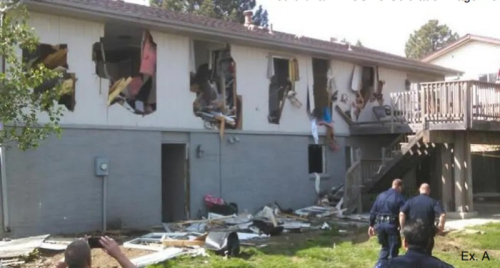
    The Supreme Court today declined to review a Tenth Circuit decision that held a municipality could not be liable for a taking when its police officers pretty much destroyed a house in the course of dislodging a suspect who had holed up there. 

    Along with our colleague Bill DeVinney, we filed an amicus brief in support of the homeowner, arguing that an invocation of “police power” isn’t the only question in these kind of cases, and the government’s assertion that it destroyed property for a police power purpose is but one of the factors a court considers when an owner asserts the destruction resulted in a taking. Police power may be a compelling factor militating against compensation. But it should never be the sole factor, as the Tenth Circuit concluded.

    We had hoped that the Court would take notice of this case because after after the petition was filed, the coronavirus pandemic exploded and the legal questions about the power of the government to act for police power and other emergency reasons while avoiding takings liability has moved to the forefront of a lot of people’s thinking. We set out our thinking about this issue (including Lech) in Evaluating Emergency Takings: Flattening The Economic Curve. 

    The “police power categorically isn’t a taking” issue isn’t going away. We’ll stand by for the next case.

    Continue Reading Cert Denied In Police Power Takings Case (Lech v. Greenwood Village)