
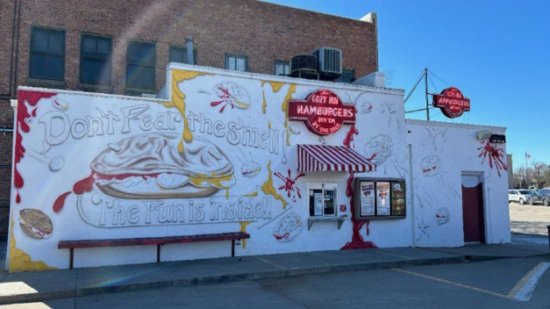
Is this a mural, or a sign? (It matters because Salina, Kansas regulates signs but not murals.) And does a hamburger painted on the wall transform an unregulated mural into a regulated sign merely because the building is occupied by a burger joint?
That was the question resolved in Cozy Inn, Inc. v. City of Salina, No. 25-3225 (10th Cir. Oct. 30, 2026), where the U.S. Court of Appeals for the Tenth Circuit affirmed entry of summary judgment against Salina, concluding that the city’s sign code failed even intermediate scrutiny.
Disclosure: our shop filed an amicus brief supporting the property owner.
The dispute arose after Cozy Inn, a century-old hamburger joint, commissioned a UFO-themed exterior display featuring burger-like flying saucers attacking the restaurant with ketchup and mustard. The city allows “murals” without size limits or permits, but concluded Cozy Inn’s art was a regulated “sign” because the depicted burgers were pretty much what the business sold. The city ordered the work stopped.
The parties disagreed whether that distinction was content-based, which would have triggered strict judicial scrutiny (and you know what that means in terms of the outcome). But the Tenth Circuit didn’t need to answer that question because it held the ordinance couldn’t survive even intermediate scrutiny.
The city invoked the usual suspects: traffic and pedestrian safety, aesthetics, and property values. Seems like pretty legitimate governmental interests, but merely identifying legitimate interests wasn’t enough because the city failed to produce evidence showing a sufficiently close fit between those interests, and treating painted “signs” differently from painted “murals.” Slip op. at 13-14.
The city’s evidence didn’t establish that a painted wall display referencing the products sold inside created any greater safety, aesthetic, or property-value concerns than similar mural that didn’t depict the products sold. The court rejected the city’s invitation to rely on “common sense” and the fact that other municipalities employed similar regulations. As the court put it, narrow tailoring requires actual evidence, not “speculation or conjecture.” Slip op. at 11. Dig this, where the court quoted this choice part of the deposition of the city’s expert:
Q. Are you aware of any evidence that would establish that a burger-esque UFO mural is more dangerous that a pizza-esque UFO mural?
A. Again, I can’t think of anything that specific.
Slip op. at 21.
There was also a prior-restraint problem. The code required the city to issue or refuse a permit within ten days unless the applicant agreed to more time. Instead, it put Cozy Inn’s application on indefinite hold while it reconsidered its regulations. The record didn’t establish that the owner consented to an indefinite delay. The Tenth Circuit therefore also affirmed the ruling that the City imposed an unconstitutional prior restraint.
File this one away for the next time the government defends a restriction on property-related speech by arguing the distinction is just common sense. It isn’t, and intermediate scrutiny may be intermediate, but it still requires the government to show its work.
Cozy Inn, Inc. v. City of Salina, No. 25-3225 (10th Cir. Oct. 30, 2026)