
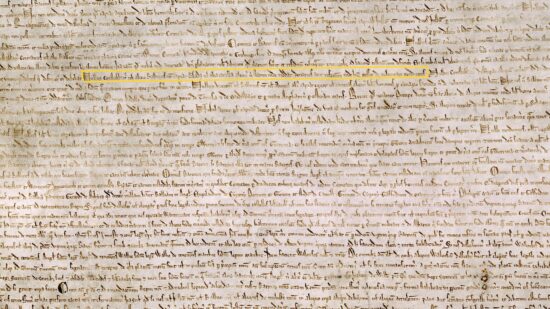
If you’ve ever wondered where the odd, backwards syntax of the Takings/Just Compensation Clause of the Fifth Amendment comes from, look no further than this highlighted provision in the original 1215 Magna Carta.
Written in medieval Latin (natch), the sentence structure is not the same as English (modern or Old). The Fifth Amendment is a curious way of stating the two main limitations on the sovereign power of eminent domain, and if we were drafting such a provision today, we might do it as some state constitutions do: “Private property may be taken, but only if for a public use and only upon payment of just compensation.” Otherwise, we might get accused by Mrs. Stevens (our second grade English teacher) of “writing in the passive voice.”
But our recent visit to London for the 2016 Brigham-Kanner Property Rights Conference included a stop at Runnymede to see the site where Magna Carta was sealed, and also included a stop at the British Museum, which is in possession of one of the four remaining copies of the 1215 King John Magna Carta.
And we just had to lay eyes on it.
We did, and here’s proof.
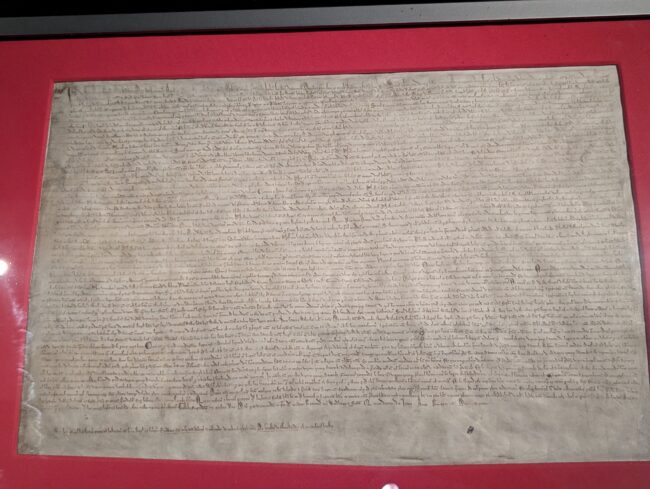
You can walk right up to it and stick your nose about 6″ away from the document. Get up close and kind of personal with the thing.
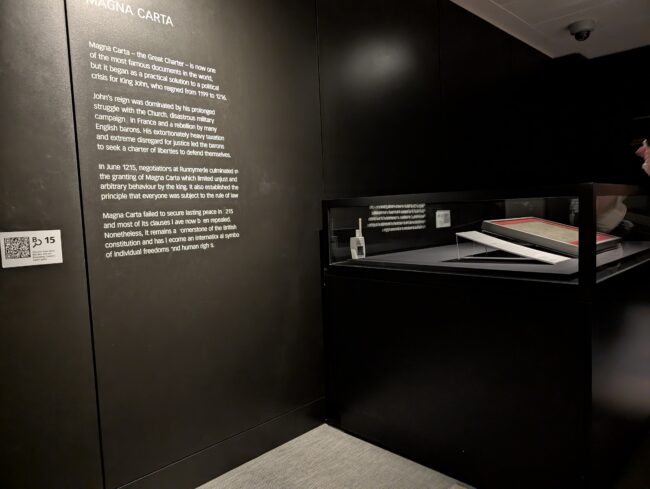
The entire thing, in a frame, under glass.
The things that most surprised us? First, it is small, about the size of two table place settings. Second, because it is small, the writing is teeny-tiny and literally everything there is “fine print” (maybe that’s why John Softsword repudiated it so quickly). And finally, it is very well-preserved and the writing is quite easy to read.
If you are ever in town, a visit is a must. Free, unless you (like us) took a tour with a guide to tell us some of the insights about this document and others in the Library’s collection.
So there we were, pretty much alone with the O.G. Magna Carta. Our eyes skimmed the parchment, until we found the provision we were looking for, about one-third the way down, and a bit left of center:
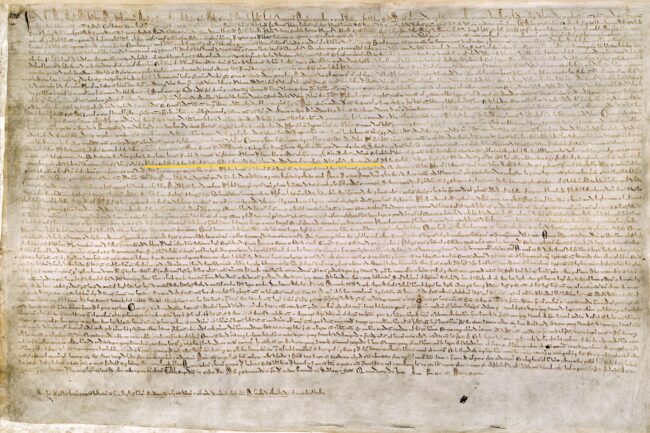
“Nullus constabularius, vel alius ballivus noster, capiat blada vel alia catalla alicujus, nisi statim inde reddat denarios, aut respectum inde habere possit de voluntate venditoris.”
Highlighted for your convenience.
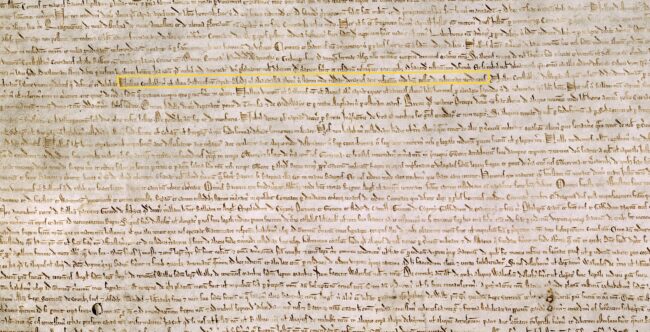
If you are not up on your medieval Latin, here’s the translation:
“No constable or other bailiff of ours is to take anyone’s corn [grain] or other chattels, unless he pays cash for them immediately, or obtains respite of payment with the consent of the seller.”
Syntax look familiar? We think so. Even though there is no direct evidence that Messrs. Madison or Morris used article XXVIII as the basis for the Fifth Amendment, the language seems to us to provide nearly a direct link. Seems pretty obvious to us. You?